Why “Direction” is the cheapest milestone to get right and the most expensive one to discover you missed
There is a moment early in most ventures when the founder is ready to build and has not yet decided what they are building.
It rarely feels like that from the inside. From the inside it feels like clarity. The founder can describe the problem, the vision, the kind of people who will love it. They can pitch it in a minute. What they cannot yet do is answer five plain questions and because nothing about the idea feels unfinished, they skip straight past them into design files and developer quotes.
This is the first stage of the milestone map we use for a venture’s first 500 days. We call it Direction, and it is the one founders most often skip, because nothing ships during it. No app, no logo, no launch post. It feels like doing nothing.
It is also the stage that decides how long everything after it takes.
What a skipped Direction stage costs

Natmanch, a Mumbai marketplace for booking performing artists, is the clearest example we have of the cost.
Before the founder came to First500days, the platform had already been attempted once, through freelancers. That attempt consumed months and produced nothing that shipped. The founder had a clear, specific idea. What she did not have and what nobody in the freelance arrangement had been responsible for was a defined business and a product scope to build against.
The second attempt was split evenly: three months on strategy and scope, then three months of building. Six months after the engagement began, Natmanch was live as a three-panel platform serving organisers, artists and administration, with artists listed across fourteen categories.
Same idea. Same founder. The difference was that the second build had something to be measured against.
That is the pattern worth recognising. A build without Direction does not fail loudly. It drifts. Every week produces some work, and no week produces a decision about whether the work is right because nobody wrote down what “right” was.
Direction is a set of decisions, not a document
The most common misunderstanding about this stage is that it produces a plan. It does not. It produces decisions specific enough that the market can prove them wrong.
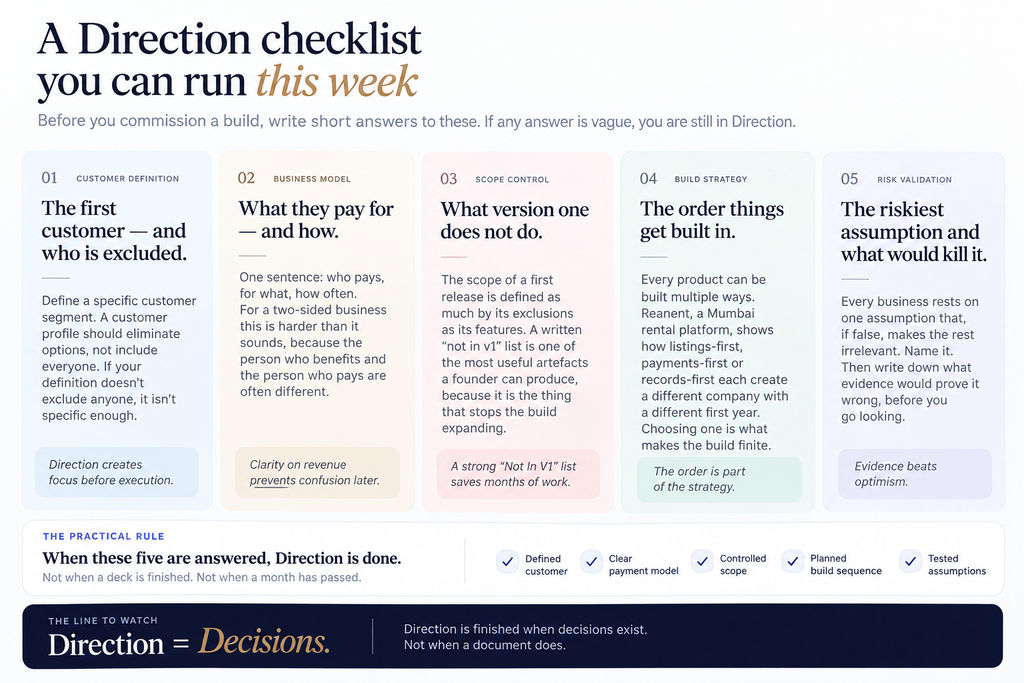
We think of it as five decisions:
1. The first customer — and who is excluded. “Small businesses” is not a customer. “Independent coaching institutes in tier-two cities with fewer than 200 students” is. The test is simple: if your definition does not rule anybody out, it has not been decided.
2. What they pay for, and how. One sentence: who pays, for what, how often. For a two-sided business this is harder than it sounds, because the person who benefits and the person who pays are often different.
3. What version one does not do. The scope of a first release is defined as much by its exclusions as its features. A written “not in v1” list is one of the most useful artefacts a founder can produce, because it is the thing that stops the build expanding.
4. The order things get built in. Reanent, a Mumbai rental platform that turns a tenant’s history into a portable trust record, is a good illustration. A two-sided rental product can be built listings-first, payments-first or records-first and each of those is a different company with a different first year. Choosing one is what makes the build finite.
5. The riskiest assumption and what would kill it. Every business rests on one assumption that, if false, makes the rest irrelevant. Name it. Then write down what evidence would prove it wrong, before you go looking.
When those five are answered, Direction is done. Not when a deck is finished or a month has passed.
Why capable teams skip it most
You might expect inexperienced founders to be most at risk here. In our experience it is often the opposite.
A team that can build will build. Shipping features is satisfying and visible; choosing a first customer feels abstract and slightly uncomfortable, because it means saying no to everyone else. So strong teams stay busy and can stay busy for a year without ever deciding who they are for.
Talarto, a Pune venture building a trusted marketplace for performing artists, arrived with three open questions and the same answer against each: no clarity on the business, no clarity on the product, no clarity on go-to-market. Written out, that looks like three problems. It behaves like one. Nobody can specify a product for a business that has not been defined, or market a product that has not been specified.
Three months of work settled the business model first, then planned and launched the MVP, then brought the first users on. Closing the first question made the other two easier rather than harder.
“Just ship and learn” when it works and when it doesn’t
The strongest objection to all this is the lean-startup instinct: stop planning, ship something small, and let the market tell you.
For many businesses, that is right. If a first version is cheap to build and the model has one side, shipping quickly is often the fastest way to produce Direction-stage evidence.
But “ship and learn” quietly depends on Direction existing. Learning requires knowing what you expected. A release built without a defined customer, model and scope cannot fail in an informative way when nobody uses it, you cannot tell whether the customer was wrong, the price was wrong, the feature set was wrong or the channel was wrong. You have spent the build and learned only that something did not work.
And some businesses cannot be tested small at all. Reanent’s trust record only exists if a real tenancy runs through the platform; no landing page or waitlist would have proved anything. For businesses like that, Direction carries more weight, not less, because the first real test is an expensive one.
A Direction checklist you can run this week
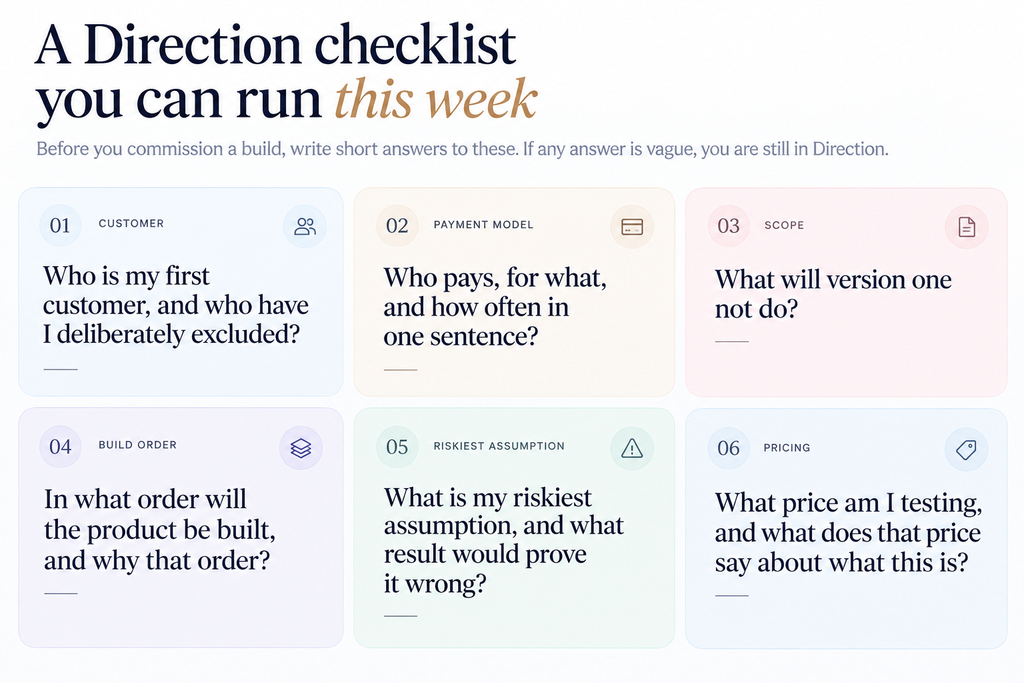
Before you commission a build, write short answers to these. If any answer is vague, you are still in Direction:
- Who is my first customer, and who have I deliberately excluded?
- Who pays, for what, and how often in one sentence?
- What will version one not do?
- In what order will the product be built, and why that order?
- What is my riskiest assumption, and what result would prove it wrong?
- What price am I testing, and what does that price say about what this is?
If you can answer all six specifically enough to be wrong, you are ready to build. If you cannot, the most productive thing you can do this month is not writing code. It is making these decisions.
Closing
Direction is the stage where the least visible work produces the most leverage. It is also the only stage where mistakes cost a conversation instead of a rebuild.
If you are about to spend the next six months building something, the useful exercise is not another round of features or a better deck. It is pressure-testing the five decisions underneath the build. If you want a second opinion on yours, First500days runs free 30-minute strategy calls for founders at exactly this point.