The letter arrives and the process everyone prepared for ends. What begins is the part nobody prepares for: two scheduled reviews, seven settlement criteria you need two of, and a business that now has to work in a country where nobody knows you.
General information, not immigration advice
The contact point and settlement requirements below are from GOV.UK and the Immigration Rules for the UK Innovator Founder route and were checked at the time of writing. Endorsing bodies set their own processes on top of them, and their requirements govern. Other routes work differently. Take advice from a qualified immigration adviser on anything that affects your permission.
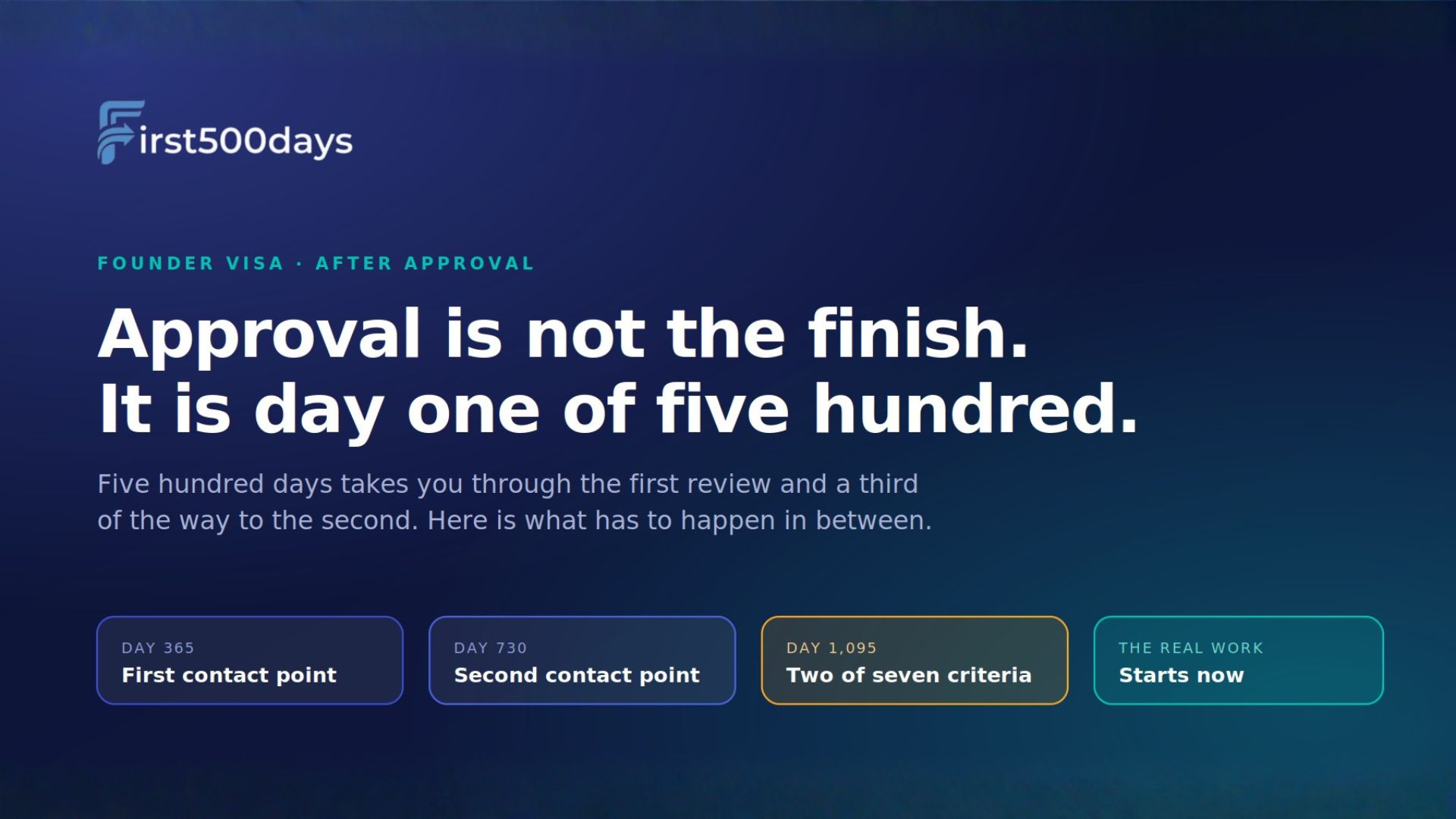
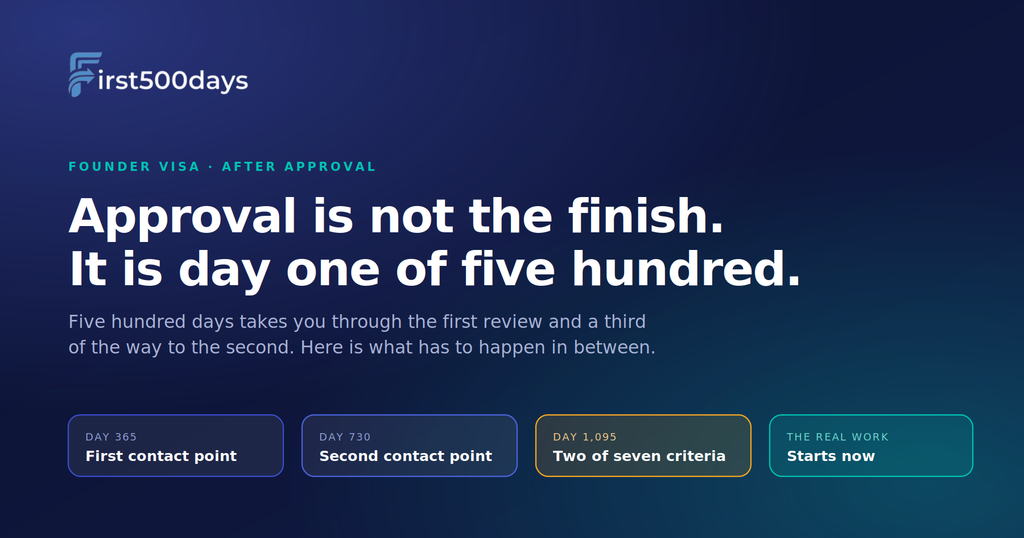
Five hundred days is about sixteen months. It takes you through the first contact point with your endorsing body at month twelve and a third of the way to the second at month twenty-four, with the settlement decision at month thirty-six visible from the start. What determines how that ends is not the visa. It is whether you sold something to somebody in this country, and whether you started working towards two of the seven settlement criteria in year one rather than year three.
The five hundred days
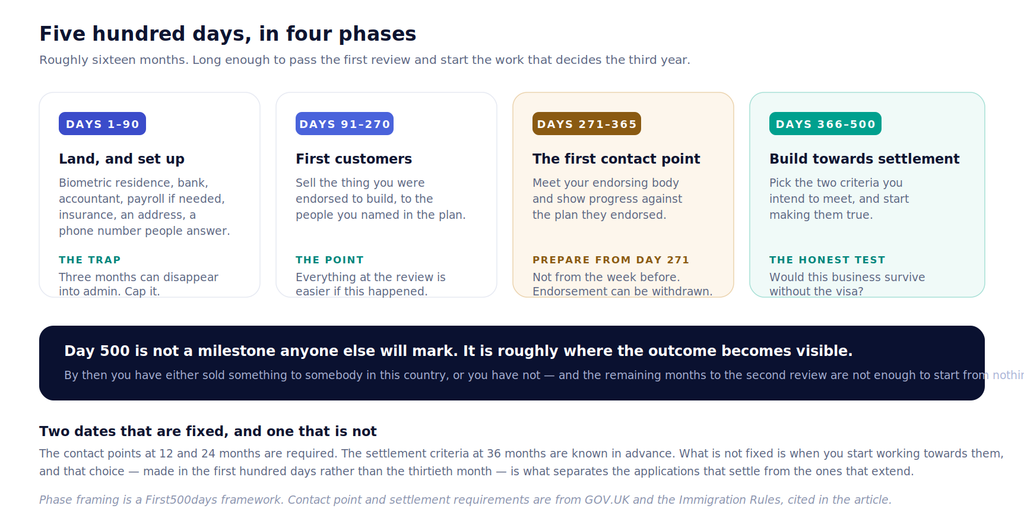
Days 1 to 90 are administration, and they are a trap. Residence permit, bank account, accountant, payroll registration if you are employing anyone, insurance, an address, a phone number people will answer. All necessary, all shapeless, and all capable of absorbing three months while producing nothing a reviewer will care about. Put a date on when setup ends, and keep it.
Days 91 to 270 are the ones that matter. Sell the thing you were endorsed to build, to the people you named in the plan. Everything at the first review is easier if this happened, and nothing else compensates if it did not.
Days 271 to 365 are the first contact point. You must meet your endorsing body after 12 months to show you are making progress with the business.[1] Prepare from day 271, not from the week before.
Days 366 to 500 are where the third year gets decided. By now you should know which two settlement criteria you are building towards, and be visibly making them true.
Day 500 is not a milestone anyone else will mark. It is roughly the point at which the outcome becomes visible — because the months remaining before the second review are not enough to start from nothing.
The contact points are reviews, not formalities
You meet your endorsing body after 12 months and again after 24 months to show progress.[1] The Immigration Rules require at least two contact point meetings at regular intervals during the permission period.[2]
Treat them as what they are: a review by people who read your plan and are checking whether the thing they endorsed is happening. Endorsement can be withdrawn, and that has consequences for your permission.
What makes them go well is unglamorous. Bring the numbers: revenue, customers, users, spend, headcount. Bring the changes and the reasons for them. Bring what you got wrong and what you did about it — a founder who has learned something in a year is more credible than one who reports that everything went to plan, because nothing goes to plan.
And bring the plan itself. Refer to it. Show where you are ahead, where you are behind and why. The comparison is going to be made whether you make it or not, and making it yourself is a considerably better position.
When the business changes — and it will
This is the question we are asked most often after approval, usually anxiously: the business is not going the way the plan said, is that a problem?
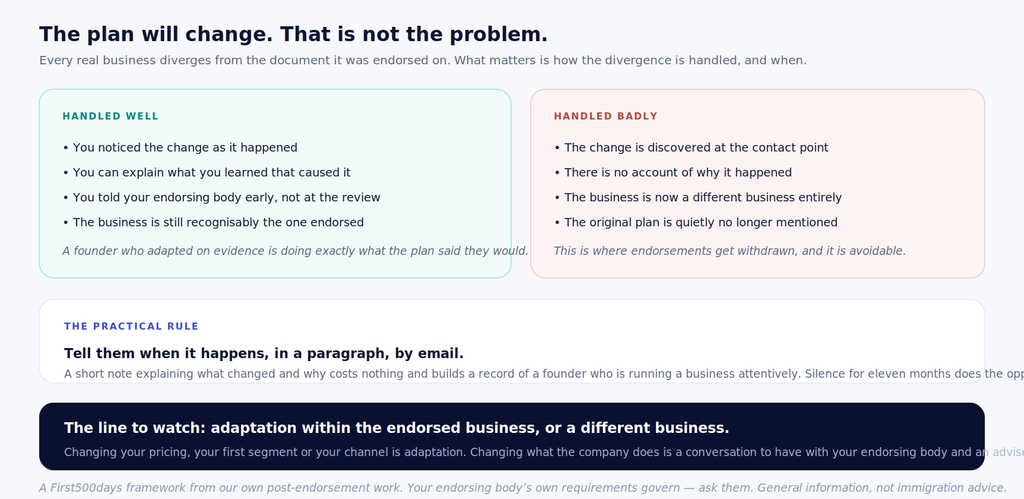
Usually not, if it is handled properly. A founder who has adapted on the basis of evidence is doing precisely what a good plan predicts they will do. The endorsing body assessed a business and a person; a person who responds to what customers actually say is the person they thought they were backing.
What causes problems is not the change. It is the discovery of the change, eleven months later, by someone who was not told.
The practical rule is simple and almost nobody follows it: tell them when it happens, in a paragraph, by email. What changed, what you learned that caused it, what it means for the plan. It costs nothing, it builds a record of someone running a business attentively, and it converts a potential problem at the review into a piece of context they already have.
There is a line to watch. Changing your pricing, your first segment, your channel or your timeline is adaptation. Changing what the company fundamentally does is a different question, and one to raise with your endorsing body and an adviser early rather than to discover the significance of later.
Working backwards from month thirty-six
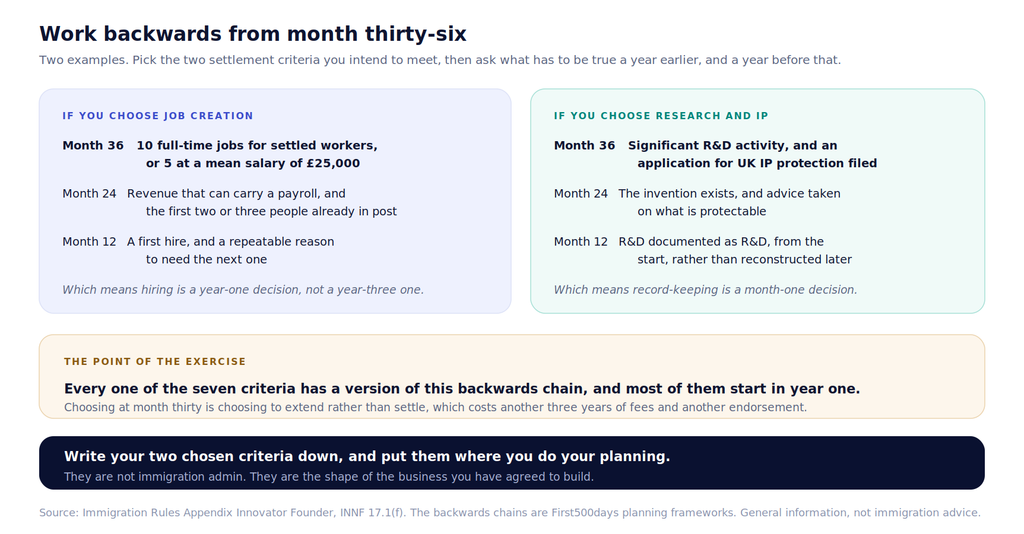
Settlement requires at least two of seven criteria: £50,000 invested and actively spent; customers at least doubled over three years and above the mean for comparable UK businesses; significant R&D activity plus an application for UK intellectual property protection; £1 million annual gross revenue; £500,000 with at least £100,000 from exports; ten full-time jobs for settled workers; or five such jobs at a mean salary of at least £25,000.[2]
Read those as business targets rather than immigration admin, because that is what they are. Then work backwards.
If you intend to meet the job creation criteria, ten full-time roles at month thirty-six implies revenue carrying a payroll at month twenty-four, which implies a first hire and a repeatable reason for the next one at month twelve. Hiring becomes a year-one decision.
If you intend to meet the research and intellectual property criterion, a filed application at month thirty-six implies knowing what is protectable at month twenty-four, which implies documenting your R&D as R&D from the beginning rather than reconstructing it afterwards. Record-keeping becomes a month-one decision.
Every one of the seven has a version of that chain. Choosing your two at month thirty is choosing to extend rather than settle — another three years of fees, another endorsement, another two contact points.
The part nobody writes about
Everything above is process. The harder part of the first five hundred days is not procedural at all.
You have arrived somewhere with no network. Nobody has heard of your company and nobody has heard of you. The people who would have taken your call at home do not exist here, and the first thirty conversations are cold in a way they never were before. Founders who were well-connected in their previous market feel this hardest, because they are experiencing beginner difficulty with expert self-expectations.
A few things genuinely help, and they are worth doing deliberately rather than hoping they happen.
- Build one relationship a week. Not networking events — one real conversation with one person who knows something you do not. Fifty of those in a year changes your position completely.
- Find the other founders in your situation. People eighteen months ahead of you on the same route are the most useful contacts available, and they are usually generous, because somebody did it for them.
- Get the family settled early. Schools, healthcare registration, somewhere that feels like home. An unhappy household is the most common reason people leave, and it has nothing to do with the business.
- Expect a difficult month somewhere around four to six. The arrival energy has gone, the admin is done, and the market has not responded yet. It is normal, it passes, and knowing it is coming makes it shorter.
- Keep one connection to the old market. A customer, a partner, a friend. Cutting everything at once is unnecessary and it removes a source of confidence you will want.
The honest test at day 500
Would this business survive if the visa disappeared tomorrow? If yes, the settlement criteria will look after themselves, because they are just descriptions of a company that works. If no, the problem is not immigration and it will not be solved by immigration. That question is worth writing on something you look at, and answering honestly every few months.
A short list for the first hundred days
- Set a date when setup ends. Administration expands to fill whatever it is given.
- Choose your two settlement criteria and write them down. Put them where you do your planning.
- Book the first contact point in your calendar now, along with a preparation date ninety days earlier.
- Start the record-keeping you will need — customers, revenue, R&D, spend, headcount — in whatever form you will actually maintain.
- Get to a first customer before you get to a perfect product. Everything downstream is easier from there.
- Tell your endorsing body when something changes. A paragraph, by email, at the time.
None of that is difficult. All of it is easier to do in month one than in month thirty, which is the argument of this entire article and, more or less, of everything else we publish.