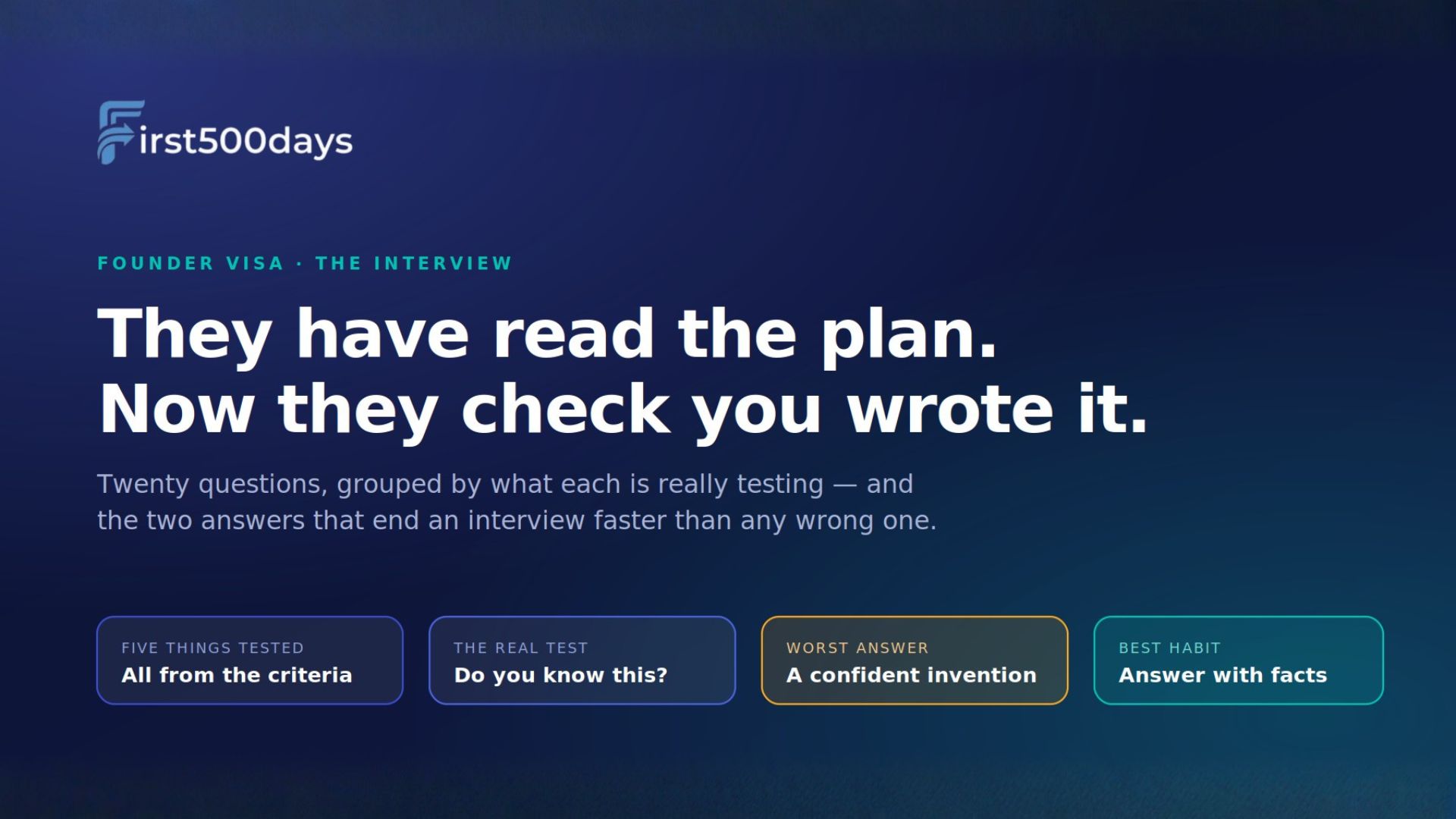
They have already read the plan. The interview exists because a document can be written by anyone and a conversation cannot. Twenty questions, grouped by what each is really testing, and the two answers that end an interview faster than any wrong one.
General information, not immigration advice
Endorsing bodies run their own processes: some interview, some do not, and formats differ. The criteria the questions map to are quoted from GOV.UK and the Immigration Rules and were checked at the time of writing. The question groupings and preparation guidance are our own, drawn from preparing founders for these conversations. Take advice from a qualified immigration adviser.
Every question in a founder visa interview maps to one of five criteria: originality, evidence of demand, the fit between you and the business, viability against the resources you actually have, and whether it scales beyond you. Underneath all five sits one question — does this person actually know their own business. Answer with facts rather than phrasing, say “I don’t know yet” when it is true, and never contradict your own written plan.
What is being tested
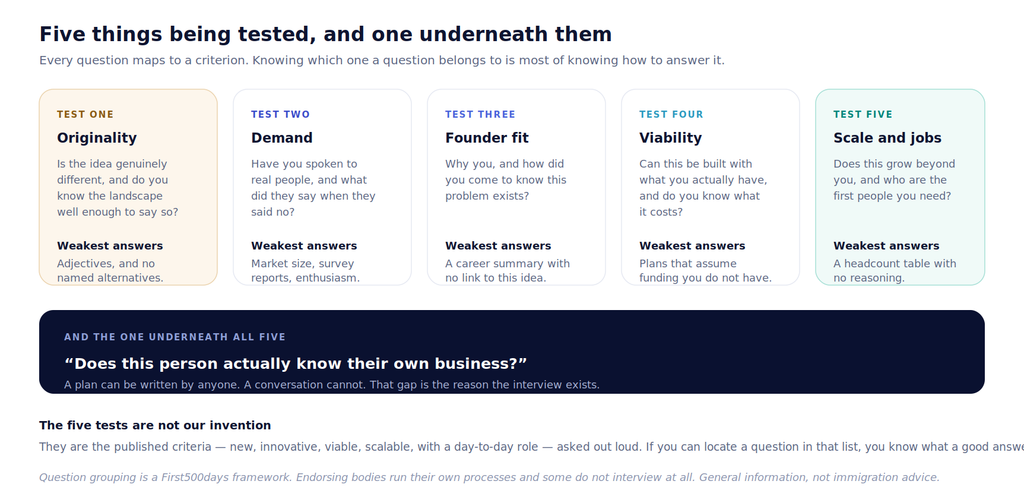
The five tests are not our invention. They are the published criteria — the business must be new, innovative, viable and scalable, and you must have a day-to-day role carrying out the plan — asked out loud.[1][2]
That is genuinely useful in the room. If you can place a question in one of the five groups, you know what a good answer contains. A question about competitors is an originality question, so the answer needs named alternatives and a specific difference. A question about your background is a founder-fit question, so the answer needs to connect your history to this problem rather than list your career.
A plan can be written by anyone. A conversation cannot. That gap is the entire reason the interview exists.
Twenty questions
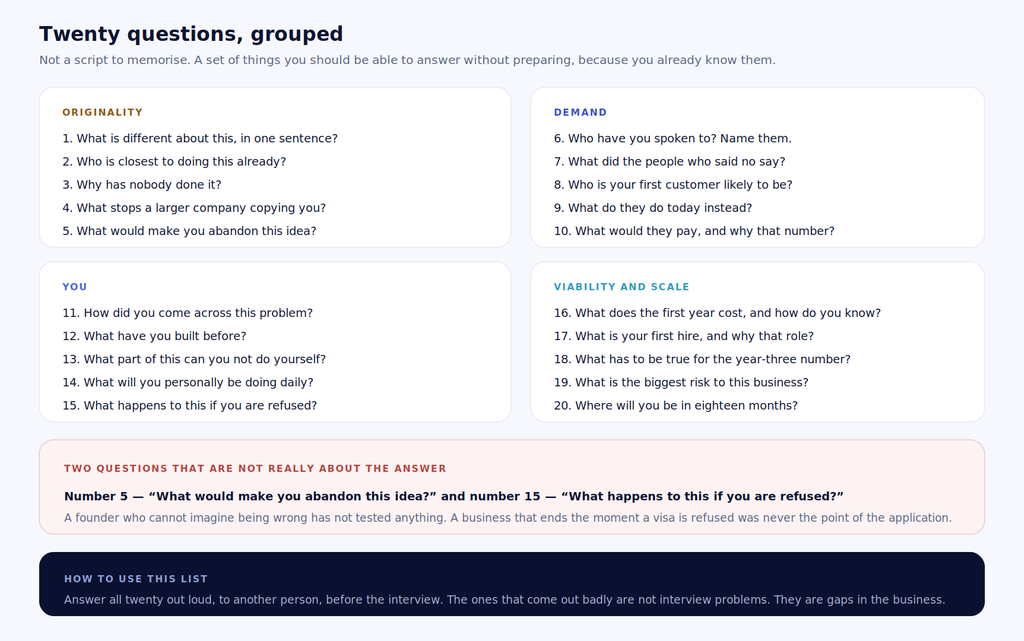
Four of these deserve comment, because they are the ones that most often go badly.
“What did the people who said no say?” Most founders describe only the encouraging conversations, which tells an assessor that either the research was thin or the reporting is selective. Being able to describe an objection accurately — and what you did about it — is one of the strongest signals available to you, and almost nobody uses it.
“What part of this can you not do yourself?” An honest answer is a strength. A founder who claims to be able to do everything has either not thought about the work or is telling the assessor something untrue in the first five minutes.
“What would make you abandon this idea?” A founder who cannot imagine being wrong has not tested anything. The good answer names a specific, checkable condition: if these three pilots do not convert, the model does not work and we change it.
“What happens to this if you are refused?” This is the question underneath the whole route. A business that ends the moment a visa is refused was never really the point of the application, and assessors know it. If the honest answer is that you would build it somewhere else, more slowly, that is a good answer.
How to answer
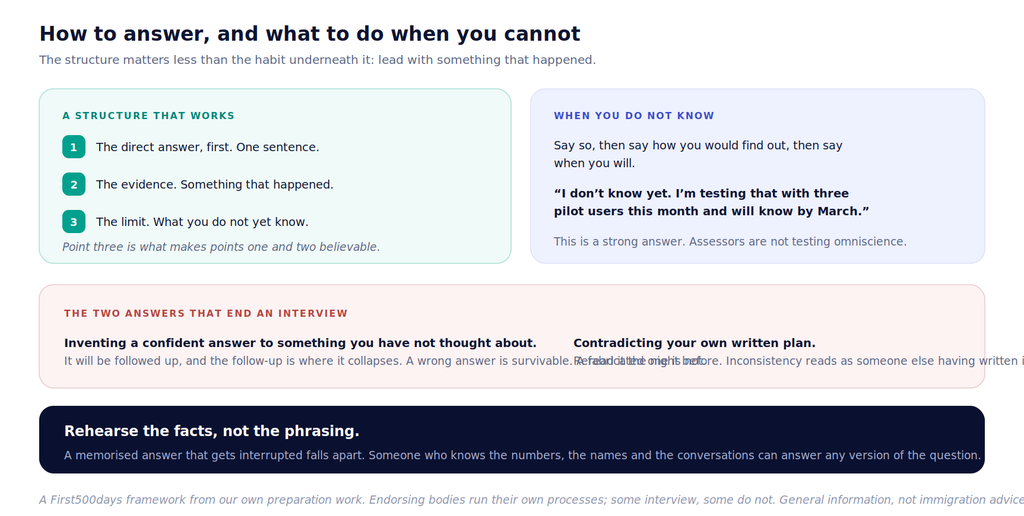
Three parts, in order. The direct answer in one sentence. Then the evidence — something that actually happened. Then the limit: what you do not yet know.
The third part is what makes the first two believable. An answer with no acknowledged limits reads as either inexperience or sales, and both are unhelpful in a conversation whose subject is credibility.
When you do not know something, say so and then say how you will find out and by when. “I don’t know yet. I’m testing that with three pilot users this month and will know by March” is a strong answer, not a weak one. Assessors are not testing omniscience; they are testing whether you are the kind of person who finds things out.
The two answers that end an interview
Inventing a confident answer to something you have not thought about. It gets followed up, and the follow-up is where it collapses. A wrong answer is survivable; a fabricated one is not, because it changes what the assessor believes about everything else you have said.
Contradicting your own written plan. Reread it the night before. Inconsistency between the document and the person reads as someone else having written the document, which is the specific thing the interview exists to detect.
Preparing properly
- Answer all twenty out loud, to another person. Not in your head. The ones that come out badly are not interview problems — they are gaps in the business, found cheaply.
- Rehearse the facts, not the phrasing. A memorised answer that gets interrupted falls apart. Someone who knows the numbers, the names and the conversations can answer any version of a question.
- Know your own numbers without notes. Price, cost, conversion, the year-one total, the first hire. Reaching for a document to answer a question about your own business is a bad moment.
- Have three names ready. Three people in the market you have spoken to, what each said, and what you did as a result. It answers half a dozen questions at once.
- Reread the plan. The night before, properly, including the financial assumptions.
- Prepare one question of your own. A real one, about the market or the route or what they see fail. It is a conversation, and treating it as one helps.
If you are nervous about your English
This is a common and reasonable worry, and it is worth separating two things. The language requirement is a separate, documented test — B2 on the CEFR scale for the UK route, proved by a qualification or a secure English language test. The interview is not another language exam. Nobody is scoring your fluency; they are checking whether you know your business. Speaking slowly, asking for a question to be repeated, and taking a moment before answering all read as considered rather than as weak.