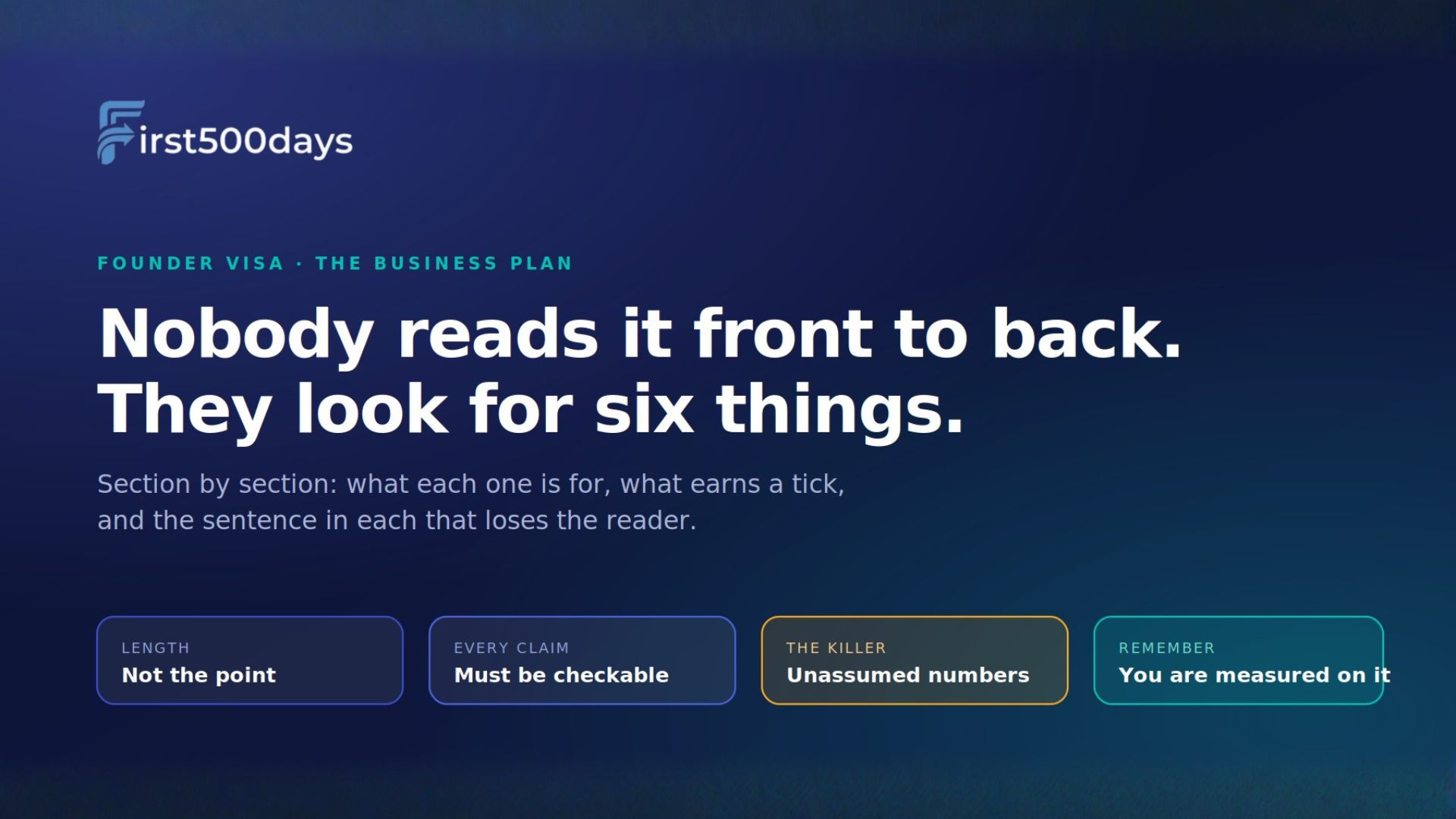
Nobody reads an endorsement business plan front to back. Assessors look for six things, in a predictable order, and stop reading early when they cannot find them. Here is what each section is for, and the sentence in each that loses the reader.
General information, not immigration advice
The requirements quoted below are from the Immigration Rules for the UK Innovator Founder route and were checked at the time of writing. Endorsing bodies set their own additional criteria and their own document requirements, and other countries’ routes differ. Everything else here is our own view from preparing and reviewing these documents. Take advice from a qualified immigration adviser.
A plan gets endorsed when an assessor can find, quickly: what is different in one checkable sentence, who specifically has the problem, evidence they want it, why this founder, how it makes money, and how it employs ten people rather than one. It gets ignored when the innovation is asserted, the competition section says “none”, the traction section describes enthusiasm rather than events, and the financials arrive without assumptions. Length is not the variable. Checkability is.
The six questions
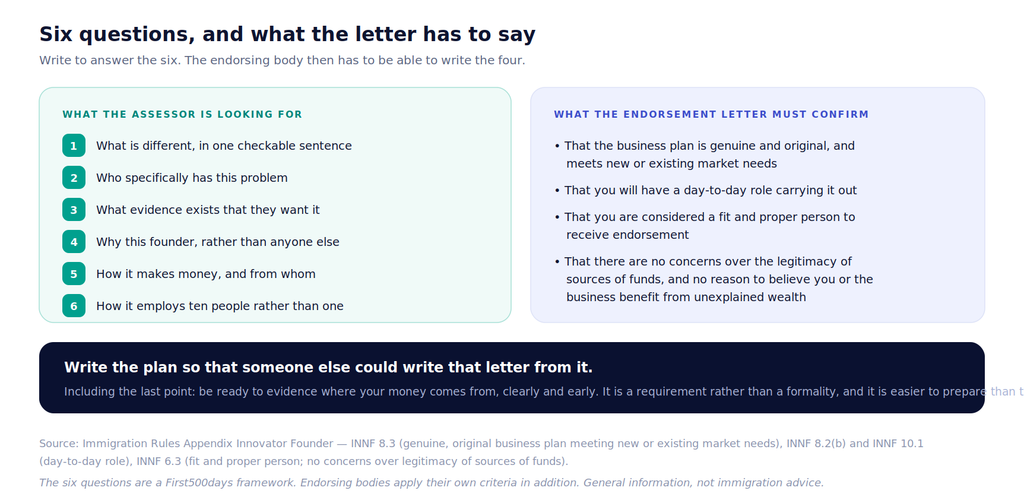
Everything in the document is in service of six questions. If a section does not help answer one of them, it is decoration — and decoration in a document being assessed for credibility is worse than nothing, because it uses the reader’s attention.
The right-hand panel is worth sitting with, because it is what your reader has to produce. The endorsement letter must confirm that you have a genuine, original business plan meeting new or existing market needs; that you will have a day-to-day role carrying it out; that you are considered a fit and proper person; and that there are no concerns over the legitimacy of your sources of funds.[1]
Write the plan so that someone else could write that letter from it. That is the whole brief.
That last requirement deserves practical attention. Be ready to evidence where your money comes from, clearly and early — bank statements, sale documents, employment history, whatever applies. It is a requirement rather than a formality, and preparing it in advance is considerably easier than being asked about it late.
Section by section
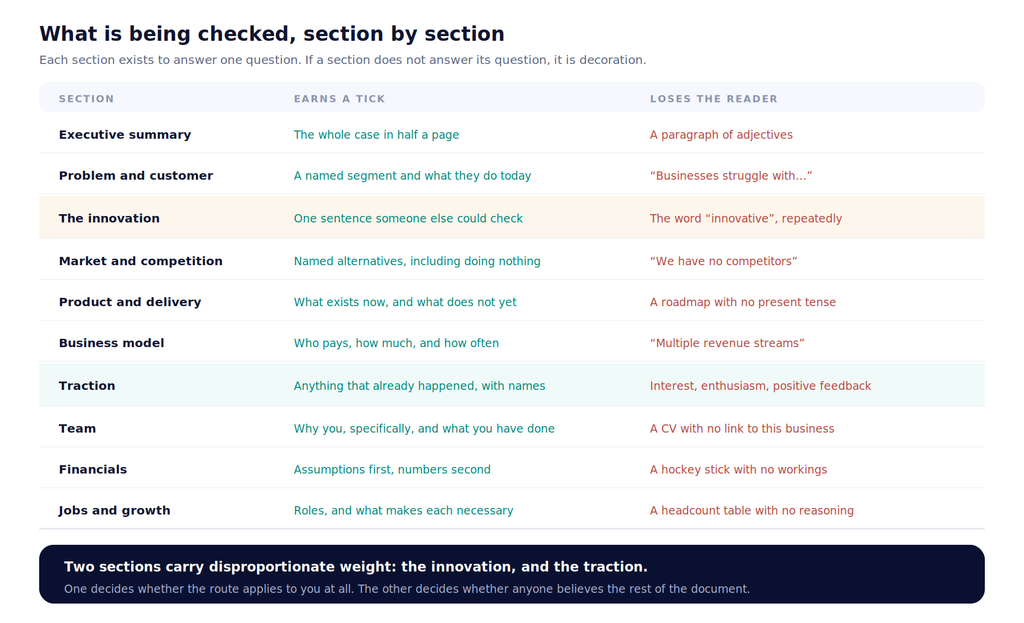
Some of these are worth expanding.
The executive summary is not a warm-up. For many assessors it is the whole first impression and sometimes the only page read carefully. Put the entire case in half a page: what it is, who it is for, what is different, what has already happened, what you are asking for. If the summary works, the rest of the document is confirmation. If it does not, the rest is unread.
The competition section is where the innovation is proved. This is counter-intuitive and it is the most useful structural insight in the article. Naming your closest alternatives — including the spreadsheet, the phone call and doing nothing — and saying exactly what each does and where it stops, is what makes a difference legible. “We have no competitors” reads as insufficient research, without exception.
The traction section should contain events, not sentiments. “Strong interest from the sector” is a sentiment. “Two named organisations have signed letters of intent; eleven users have completed onboarding; £3,400 invoiced” is a set of events. Events can be checked, which is why they persuade.
The team section must connect the person to this business. A CV is not enough. The reader is looking for a reason why you, rather than anyone else, are the person to build this — domain experience, technical depth, a relationship with the customer, a personal encounter with the problem.
Jobs and growth should be reasoned, not tabulated. A headcount table tells the reader you have thought about a spreadsheet. Naming three roles and explaining what makes each necessary at that point tells them you have thought about the business.
Financials that survive being read closely
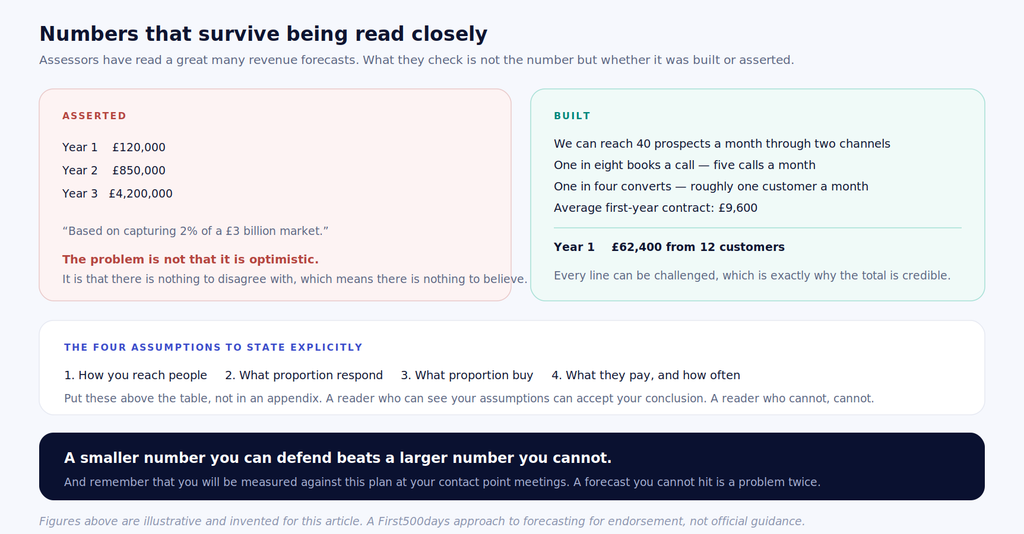
Financial projections are where credibility is most often lost, and rarely for the reason founders fear. The problem with a hockey stick is not that it is optimistic; it is that it is unfalsifiable. “Two per cent of a £3 billion market” contains nothing anyone can disagree with, which means it contains nothing anyone can believe.
Build the number instead. State four assumptions explicitly, above the table rather than in an appendix: how you reach people, what proportion respond, what proportion buy, and what they pay and how often. Then let the total fall out of them.
A reader who can see your assumptions can accept your conclusion, and can also disagree with one line while accepting the rest — which is a far better outcome than rejecting the whole forecast. A smaller number you can defend beats a larger number you cannot.
And there is a second reason to be conservative that has nothing to do with the assessment. You will be measured against this plan at your contact point meetings after 12 and 24 months. A forecast you cannot hit is a problem twice.
Ten sentences to delete
Every one of these appears constantly, and every one costs you credibility with a reader who has seen it before.
- “We have no direct competitors.”
- “The market is worth £X billion and growing at Y% a year.”
- “Our proprietary technology…” — unless you then say what it is.
- “We will disrupt the industry.”
- “There has been strong interest from potential customers.”
- “Our innovative, AI-powered platform…”
- “We plan to capture 2% of the market.”
- “Multiple revenue streams.”
- “A world-class team.”
- “This is a huge opportunity.”
Notice what they share: each asks the reader to accept a conclusion rather than showing them the evidence that produces it. Replace each with the specific fact underneath it, and the document gets shorter and more persuasive at the same time.
On buying a business plan
A written plan is a communication problem, and a good writer helps with communication problems. What a writer cannot do is make a business original, produce evidence of demand, or connect you to a market you have not spoken to. If the underlying case is weak, a professionally written document makes it a professionally written weak case — and assessors read a great many of those. Spend the money on the evidence first; the writing is comparatively cheap once there is something to write about.
Practical notes on the document itself
- Check your endorsing body’s own requirements first. They set format, length and supporting documents, and they differ. Their requirements override any general advice, including this article.
- Front-load. Put the strongest evidence in the first three pages. Assume the reader’s attention decays.
- Make claims traceable. Where a number comes from somewhere, say where. Where it is your estimate, say that too.
- Keep one version of the truth. The plan, the deck and the interview answers must agree. Inconsistency is read as carelessness at best.
- Write it yourself, then get help editing. You will be asked about every part of it, verbally, by someone who has read it.