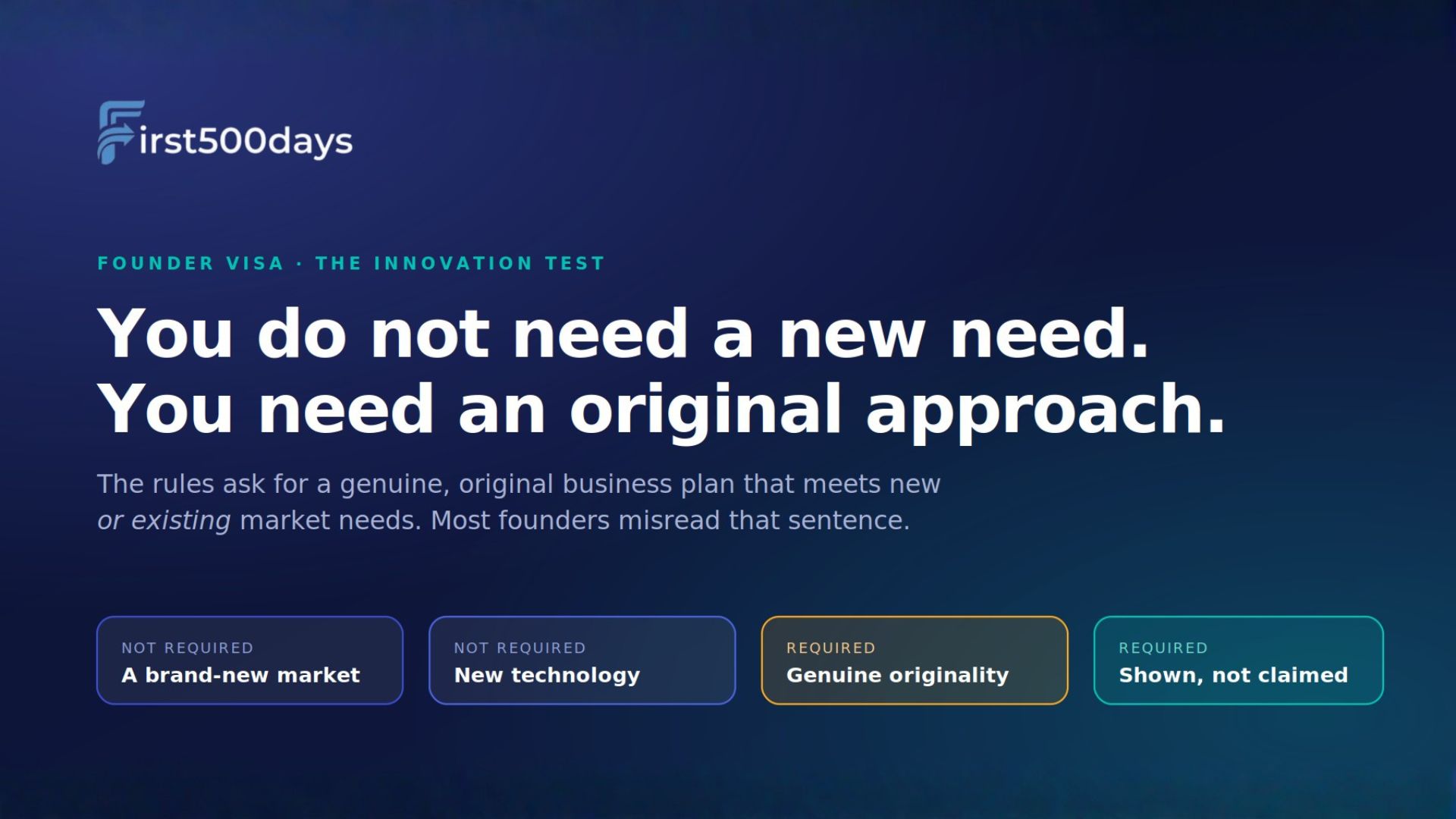
The rules ask for a genuine, original business plan that meets new or existing market needs. Most founders read that sentence as demanding a new market and a new technology. It does not, and the misreading costs people applications they could have made.
About the examples in this article, and the title
Every example here is an illustrative composite written for this article. Endorsing bodies do not publish case files. Anyone showing you real passed and failed applications is either breaching a confidence or inventing them, and either is worth knowing about an adviser. The rules quoted below are from the Immigration Rules and GOV.UK and were checked at the time of writing. This is general information, not immigration advice.
Innovation on this route does not mean a new invention, a patent or an unserved market. The Immigration Rules require a genuine, original business plan that meets new or existing market needs — so the need can be entirely familiar as long as the approach is genuinely original. Originality can live in the product, in how it is delivered, in who it is for, or in how it is paid for. What fails is not a lack of novelty so much as a failure to say plainly what is different.
The sentence that does the work
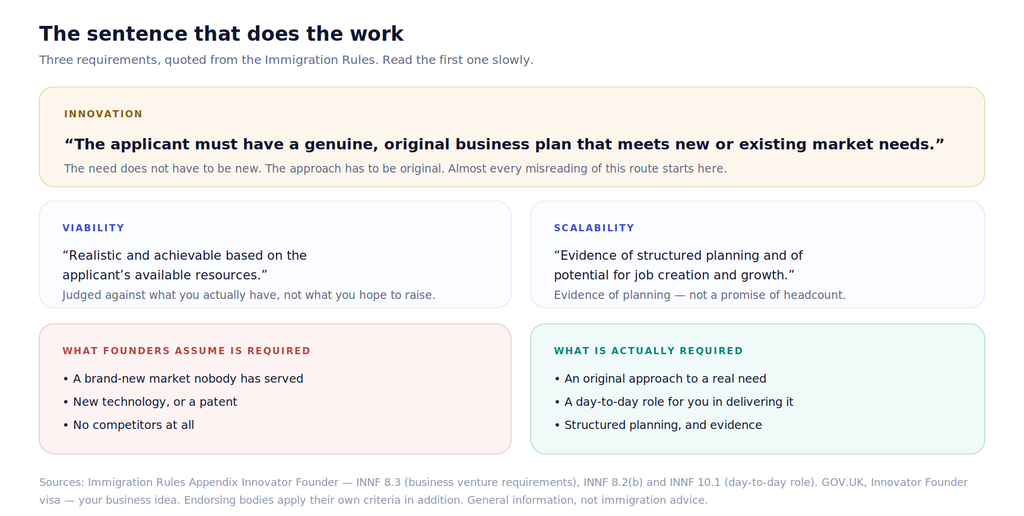
The business venture requirement in Appendix Innovator Founder is that “the applicant must have a genuine, original business plan that meets new or existing market needs”.[1] Two words in that sentence do most of the work, and they point in opposite directions from where founders usually look.
“Original” is a high bar and it attaches to the plan, not to the market. GOV.UK puts it more bluntly still: you must have an original business idea which is different from anything else on the market.[2]
“Or existing” is the permission most people miss. The need does not have to be new. Payroll, logistics, dentistry, insurance claims, school admissions — all ancient needs, all extremely well served, and all still capable of hosting an original approach.
You do not need a new need. You need an original approach to a need, and you need to be able to say what it is in a sentence someone else can check.
Alongside it sit the other two tests. Viability is judged on whether the plan is realistic and achievable based on your available resources — what you actually have, not what you hope to raise.[1] Scalability asks for evidence of structured planning and of potential for job creation and growth.[1] And separately, you must have a day-to-day role in carrying out the business plan, which is why this route does not work as a passive investment.[1]
Four places originality can live
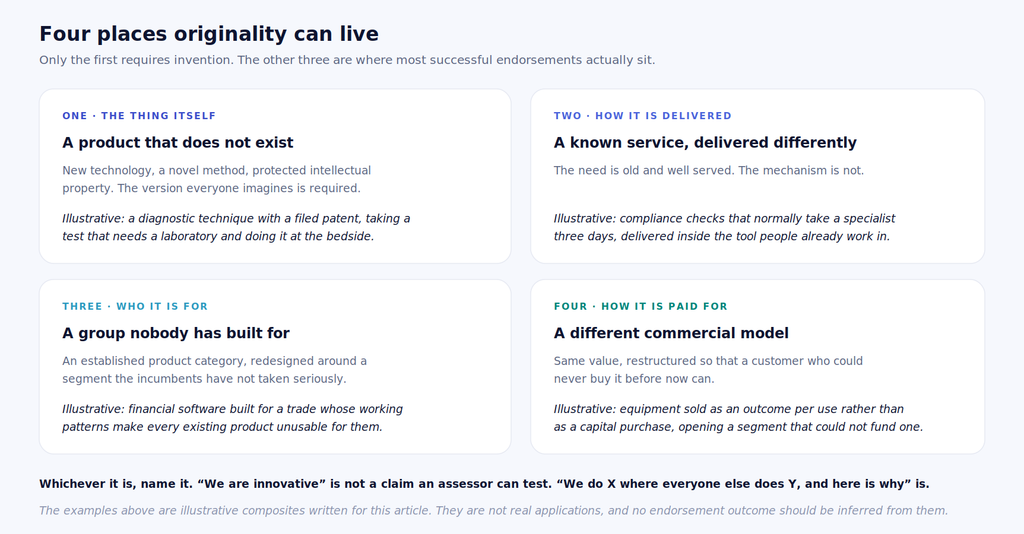
In the thing itself. New technology, a novel method, protected intellectual property. This is the version everyone imagines is required, and it is the least common route to a successful application because most founders are not inventors.
In how it is delivered. The need is old and well served; the mechanism is not. A specialist process compressed into software, an in-person service delivered remotely, something that took three days done inside a tool people already use. The customer has always had this problem. Nobody has solved it this way.
In who it is for. An established product category redesigned around a segment the incumbents have never taken seriously — because it was too small, too awkward, too regulated or too unfashionable. The product category is old; the fit is new.
In how it is paid for. The same value, restructured so that a customer who could never buy it now can. Outcome-based rather than capital, subscription rather than licence, per-use rather than per-seat. If the model opens a segment that was previously priced out, that is a real and defensible originality claim.
Whichever it is, name it. “We are innovative” is not a claim anybody can test, and untestable claims do not pass assessments.
The same business, described two ways
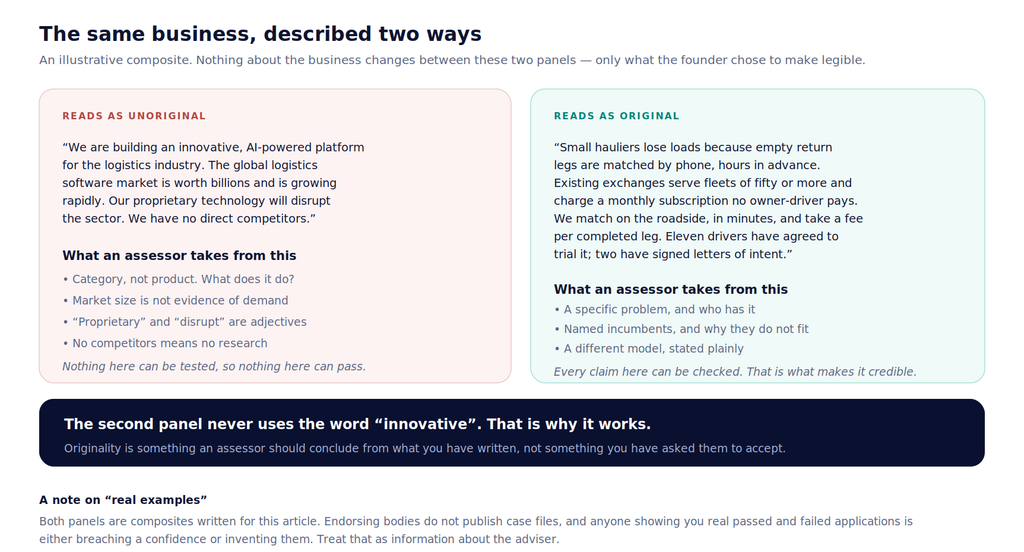
Look at what the second panel does that the first does not. It names a specific problem and who has it. It names the incumbents and explains precisely why they do not serve this customer. It states the commercial model plainly. And it offers evidence — eleven drivers, two letters of intent — that an assessor could in principle check.
It also never uses the word “innovative”. That is not a coincidence. Originality is a conclusion an assessor should reach from what you have written, not a request you have made of them.
The first panel fails for a reason worth stating carefully: not because the business is bad, but because nothing in the description can be tested. “Proprietary” and “disrupt” are adjectives. A market size is evidence that a category exists, not that anyone wants your product. And “no direct competitors” reads as insufficient research, every single time.
What tends to fail the innovation test
Some patterns come up repeatedly, and they are worth recognising in your own plan.
- “Uber for X.” If the whole idea is a well-known model applied to a new vertical, the originality lives in the vertical, not the model — so the plan has to explain what is genuinely different about that vertical and why the model has to change to fit it.
- “Same product, better service.” A real competitive advantage and not an originality claim. If service is the differentiator, look for what makes the service structurally different rather than merely better.
- “It does not exist in the UK yet.” A business that exists elsewhere and is being imported is a legitimate business and a difficult innovation claim. If this is your situation, the original element usually has to be something you have changed for this market, and you must be able to say what.
- “We use AI.” Using widely available technology is not, by itself, originality. What matters is what it lets you do that could not be done before, for whom, and why that is not straightforwardly copied.
- A general-purpose consultancy or agency. Hard on both innovation and scalability, and covered in more detail elsewhere in this cluster.
The competitor section is where innovation is proved
Counter-intuitively, the strongest place to demonstrate originality is the competitive analysis. Name the closest alternatives — including doing nothing, and including the spreadsheet or the phone call your customers use today. Then say, for each, exactly what it does and where it stops. If your difference survives that exercise honestly, you have your innovation claim, written in a form an assessor can verify. If it does not survive, you have found out something important before paying an endorsement fee.
How to write the claim
One structure works better than any other, and it fits in a paragraph.
- Who has the problem — specifically, not a category.
- What they do today — named, including the workaround.
- Where that stops working — the specific point of failure.
- What you do instead — the mechanism, plainly.
- Why nobody has done it — a constraint that has changed, a market too small until now, expertise that is rare.
- What evidence you have — conversations, letters, a pilot, a prototype, a paying customer.
Write those six things and the word “innovative” becomes unnecessary. Skip them and no amount of the word will help.