
First, the fact most articles on this subject have not caught up with: the programme is paused. Second, the thing that explains everything about how it works when it is open — each designated organisation can support only ten complete applications a year.
Status check, and a disclaimer
As published by IRCC at the time of writing, the Start-up Visa Program is paused: applying required a valid 2025 commitment certificate and an application by 30 June 2026, and the programme is closed to all other applications. Programme status changes — check IRCC directly before acting on anything here. This article is general information and not immigration advice.
The Canada Start-up Visa splits the decision in two. IRCC checks that you are eligible — ownership structure, language at CLB 5, settlement funds, admissibility. A designated organisation decides whether to back you, and that is an investment or incubation decision made by people who can support only ten complete applications a year. Preparing for it as an immigration application rather than as a fundraise is the most common and most expensive mistake on this route.
Where the programme stands
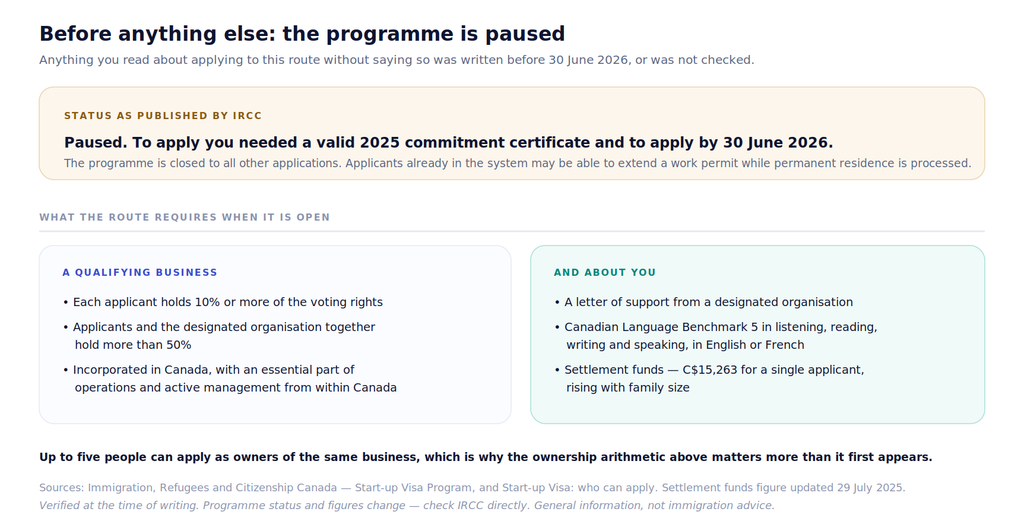
IRCC’s own page carries a “Paused” status: to apply you needed a valid 2025 commitment certificate and to apply by 30 June 2026, and the programme is closed to all other applications.[1] Applicants already in the system may be able to extend a work permit while permanent residence is processed.[1]
We are stating this first, and prominently, because a very large amount of content about this route is being published as though it were open. If you are being sold a Start-up Visa service today, the first question to ask is what exactly is being sold, and on what timeline.
The rest of this article is about how the route works when it operates — which is worth understanding both because programmes reopen and because the evaluation logic is instructive for founder visas generally.
The two decisions
The eligibility side is a checklist. A qualifying business means each applicant holds 10% or more of the voting rights, and applicants together with the designated organisation hold more than 50%; the business must be incorporated in Canada, with an essential part of operations and active management from within Canada.[2] You need Canadian Language Benchmark 5 in listening, reading, writing and speaking, in English or French, and settlement funds — C$15,263 for a single applicant, rising with family size.[2]
Up to five people can apply as owners of the same business, which is why the ownership arithmetic matters more than it first appears: five founders each need at least 10%, and the designated organisation’s stake counts towards the combined majority.[2]
The support side is not a checklist at all. It is a decision made by a fund, an angel group or an incubator, using their own criteria and their own process.
Why designated organisations are so selective
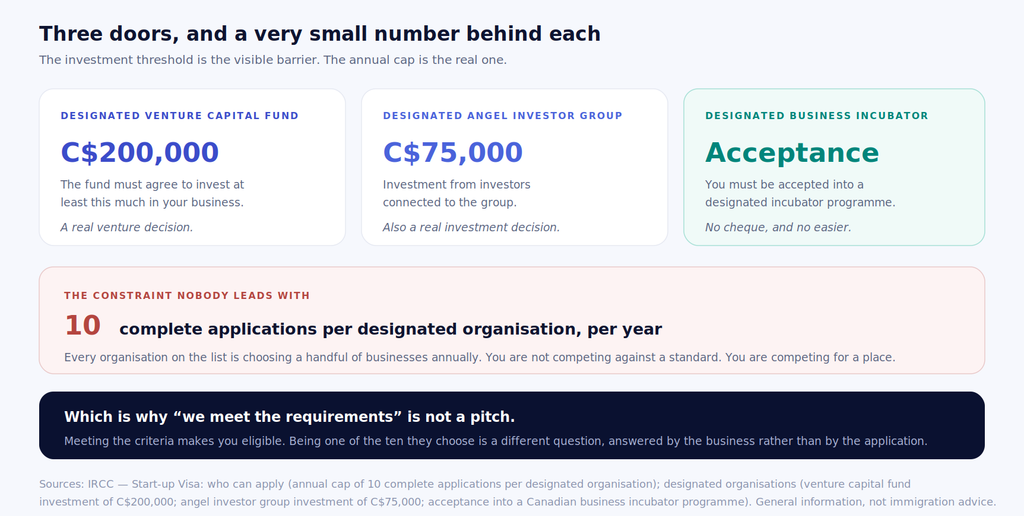
There are three routes to a letter of support. A designated venture capital fund agreeing to invest at least C$200,000. A designated angel investor group investing at least C$75,000. Or acceptance into a designated Canadian business incubator programme.[3]
Those thresholds are what everyone reads. The number that actually shapes the process is different: a designated organisation can support only ten complete applications a year.[2]
Think about what that means from their side. Every organisation on the list is choosing a handful of businesses annually, from a queue that is considerably longer than ten. They are not applying a standard and admitting everyone who clears it. They are ranking, and taking the top few.
Meeting the requirements makes you eligible. Being one of the ten they choose is an entirely different question, and it is answered by the business rather than by the application.
It also explains something founders often experience as rudeness: the speed with which organisations disengage. When the annual allocation is ten, the cost of spending three weeks on a marginal application is one of those ten slots. Assessors triage hard and early, and a pitch that does not distinguish itself in the first meeting rarely gets a second.
What they are actually assessing
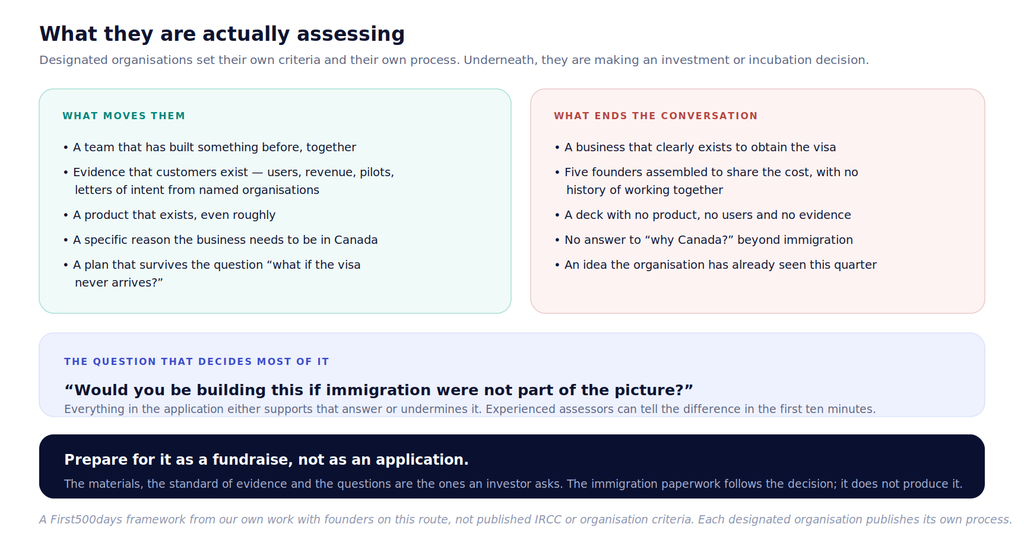
Designated organisations publish their own criteria and run their own processes, and they differ. What they have in common is that they are being asked to put their name, and often their money, behind a business.
Team is usually first. Have these people built something before? Have they built it together? A team assembled for the application is visible, and a group of five founders with no shared history who happen to need visas is the pattern most likely to end a conversation early.
Evidence beats plans. Users, revenue, pilots, letters of intent from named organisations. Anything that shifts the discussion from what you intend to what has already happened. This is the same principle that governs endorsement in the UK, and it is worth noticing that it holds across every founder route in this cluster.
“Why Canada?” needs a real answer. A customer base, a research cluster, a supply chain, a co-founder, a regulatory environment that suits what you are building. “Because we want to move to Canada” is a legitimate personal answer and a poor commercial one, and the person opposite is making a commercial decision.
And the question underneath all of them: would you be building this if immigration were not part of the picture? Every element of the application either supports that answer or undermines it, and experienced assessors form a view quickly.
How to prepare, if and when it reopens
- Prepare as a fundraise. The materials, the standard of evidence and the questions are an investor’s. The immigration paperwork follows the decision; it does not produce it.
- Build the evidence first. Users, revenue, a pilot, a working product. Months of work, and the single highest-return thing you can do.
- Choose organisations deliberately. They differ by sector, stage and thesis. Ten slots a year means fit matters more than volume — a targeted approach to three well-matched organisations beats twenty generic ones.
- Be honest about the team. If there are five of you, be able to explain what each person does and why they are necessary. If you cannot, there are not five of you.
- Have the Canada answer ready. Specific, commercial, and true.
- Watch the programme status. Check IRCC directly rather than relying on any adviser’s summary, including this one.
If the route is closed, what then?
The honest answer is that a paused programme is not a plan. If Canada is genuinely the right market, there are other routes into it that are not dependent on this one, and they are worth taking advice on. If the goal is to build the business somewhere it can succeed, the comparison across the UK, Singapore, the UAE and elsewhere is a better use of the next month than waiting for an announcement. We have written that comparison separately.