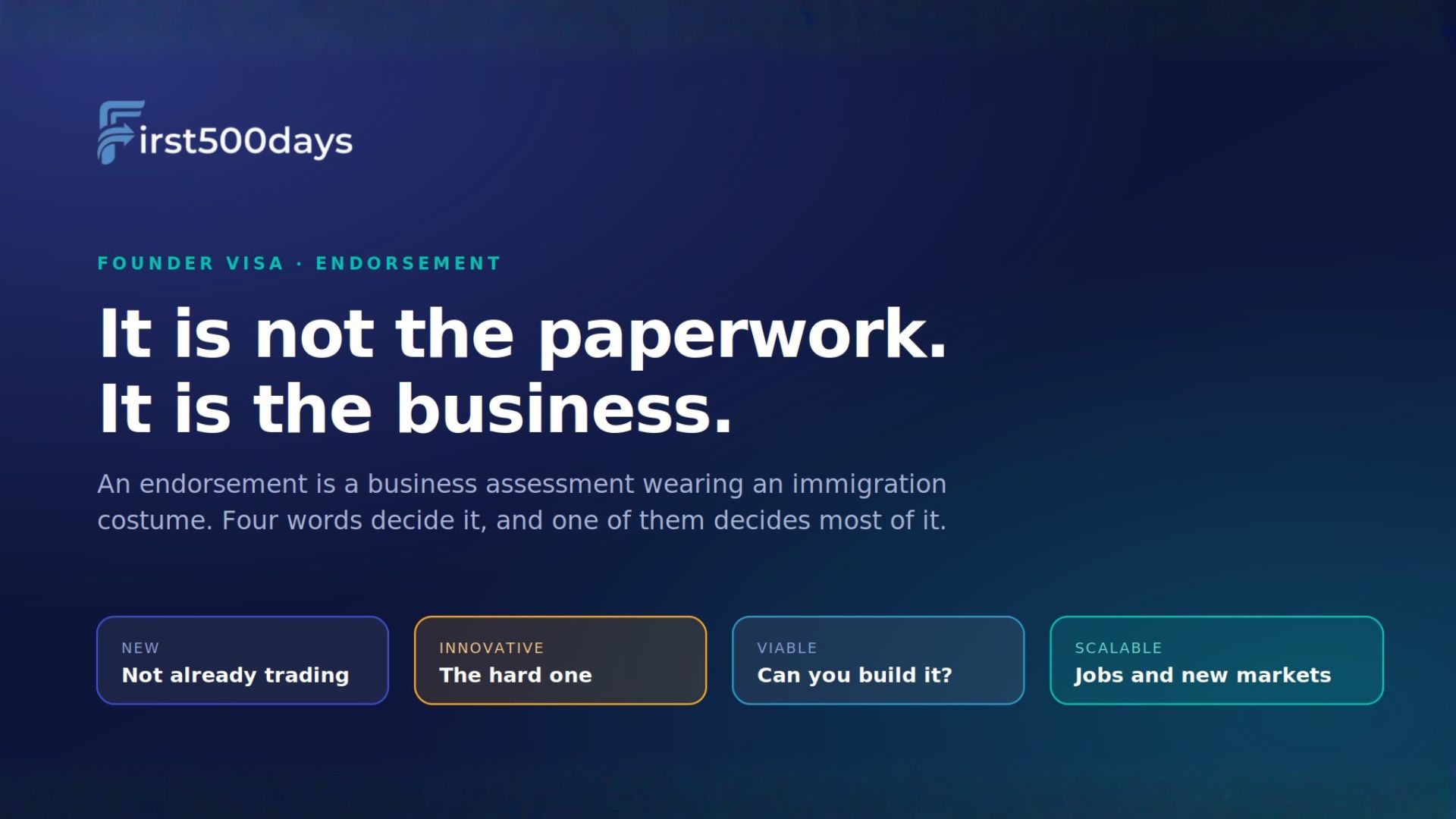
Founders prepare for an immigration process and are assessed on a business one. The endorsing body is not deciding whether you deserve to come. It is deciding whether this business belongs on this route, and four words settle it.
General information, not immigration advice
The criteria quoted below are from GOV.UK for the UK Innovator Founder route and were checked at the time of writing. Endorsing bodies apply their own published criteria on top of them, and those differ between bodies and change. Other countries’ founder routes work differently. Take advice on your own circumstances from a qualified immigration adviser.
Endorsement applications fail because the business does not meet the test, not because a document was missing. The endorsing body must be satisfied that the business is new, innovative, viable and scalable — and “innovative” is where most applications come apart, because founders assert it rather than demonstrate it. A refusal is usually a judgement about the idea, and no amount of rewriting fixes an idea that does not meet the criterion.
You are being assessed on the business
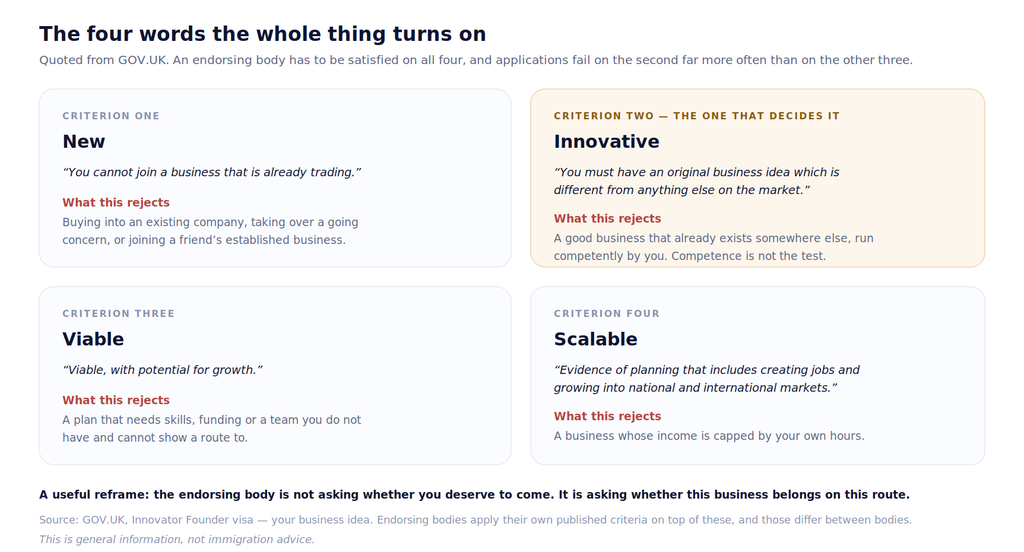
GOV.UK is unusually direct about what the endorsing body is looking for. The business must be new — “you cannot join a business that is already trading”. It must be innovative — “you must have an original business idea which is different from anything else on the market”. It must be viable, with potential for growth. And it must be scalable — “you must give evidence of planning that includes creating jobs and growing into national and international markets”.[1]
Read that second one again, because it is the sentence the whole route turns on. It does not say “a well-run business”. It does not say “a business that will succeed”. It says an original idea, different from anything else on the market.
Endorsement is not a quality award. A genuinely excellent business can be refused because it is not original, and that is the system working as designed rather than a mistake.
This is the reframe that changes how people prepare. Founders arrive with a pitch designed to prove they are capable, credible and hard-working. All of that is necessary and none of it is the test.
The seven reasons, in order
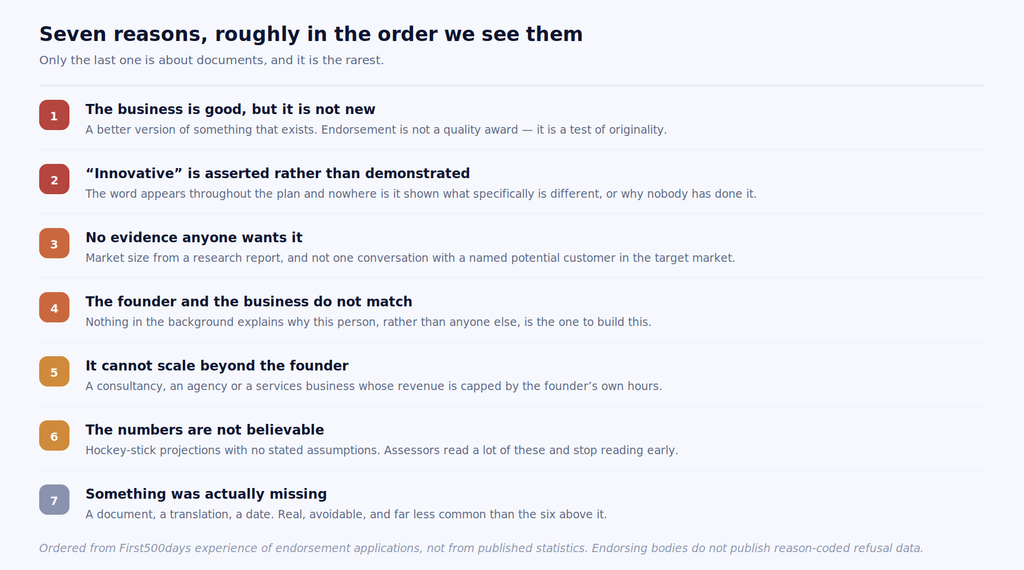
Some of these deserve unpacking.
“Innovative” asserted rather than demonstrated is the single most common failure we see. The word appears fifteen times in a plan and nowhere does the plan say, in one sentence, what specifically is different and why nobody has done it. If your differentiation cannot survive being stated plainly in a sentence, it will not survive an assessor.
No evidence anyone wants it is the second. A market-size figure from a research report is not evidence of demand for your product; it is evidence that a category exists. Ten conversations with named potential customers in the target market is worth more than any number of citations, and it is available to anyone willing to do it.
The founder and the business do not match is the one applicants are least aware of. Assessors are reading for a reason why this person, rather than anyone else, is the one to build this. Domain experience, a technical background, a relationship with the customer, a personal encounter with the problem — something. A plan that any competent person could have written raises the obvious question of why it is this person applying.
It cannot scale beyond the founder catches a whole category of otherwise sensible businesses. Consultancies, agencies and services businesses where revenue is a function of the founder’s own hours struggle against a criterion that asks explicitly for evidence of creating jobs and growing into national and international markets.
What a refusal actually tells you
A refusal is expensive in a way that is easy to underestimate. There is the fee, which is the smallest part. There are the months of preparation. There are the decisions made in anticipation of an outcome that did not arrive — a resignation, a lease, a school place. And there is the fact that a second application starts from a weaker position, because something now has to have changed.
Which is why the useful question after a refusal is not “how do we present this better?” It is “which criterion did we fail, and is that fixable?”
- If the idea is not original, no rewrite fixes it. Either find the genuinely novel part of what you are doing and build the business around that, or accept that this route is not the right one.
- If the evidence is thin, that is entirely fixable, and it takes months rather than weeks. Go and get customers, letters of intent, pilots, a working product.
- If the fit between you and the business is weak, that is fixable too — by building something closer to what you actually know.
- If it does not scale, that is a business model question, and changing the answer means changing the business rather than the document.
The self-assessment
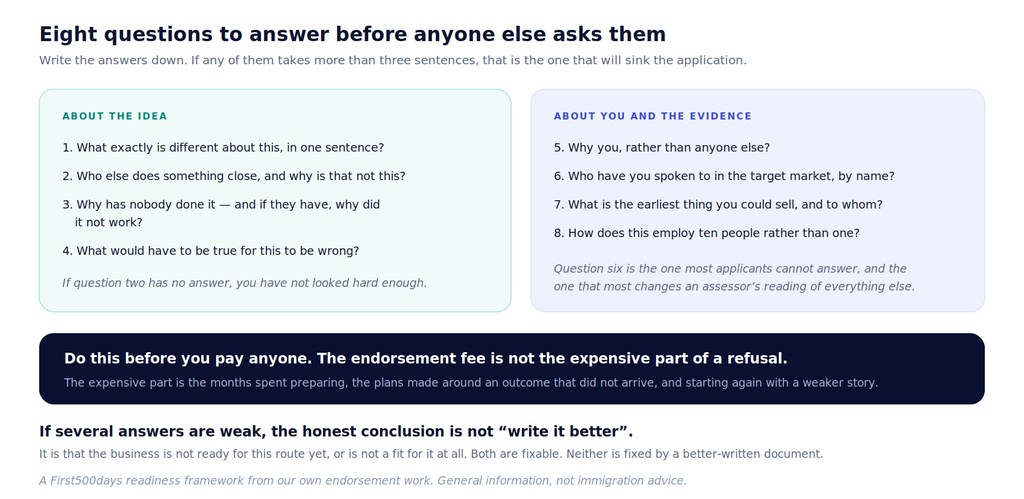
Question six — who have you spoken to in the target market, by name — is the one most applicants cannot answer, and the one that most changes how an assessor reads everything else in the plan. It is also, notably, the easiest to fix. It costs nothing but time and a willingness to be told no.
If several of the eight answers are weak, the honest conclusion is not that the plan needs better writing. It is that the business is not ready for this route yet, or is not a fit for it at all. Both are fixable positions. Neither is fixed by a more polished document, and a consultant who tells you otherwise is selling you the wrong thing.
What actually improves the odds
- Traction, in any form. A paying customer, a signed letter of intent, a pilot, a working prototype. It moves the conversation from claim to evidence, which is the whole game.
- A specific, honest statement of what is different. One sentence, defensible, not a paragraph of adjectives.
- Naming your competitors properly. A plan claiming no competition reads as insufficient research, every time. Name them and explain the difference.
- Assumptions stated alongside projections. A credible small number beats an incredible large one, and assessors have read a great many of the latter.
- A route to employing people. Not a headcount table, but a real explanation of what those people would do and what makes them necessary.
- Choosing the right endorsing body. Bodies have different focuses and published criteria. Read them before applying and pick one whose stated interests match what you are building.