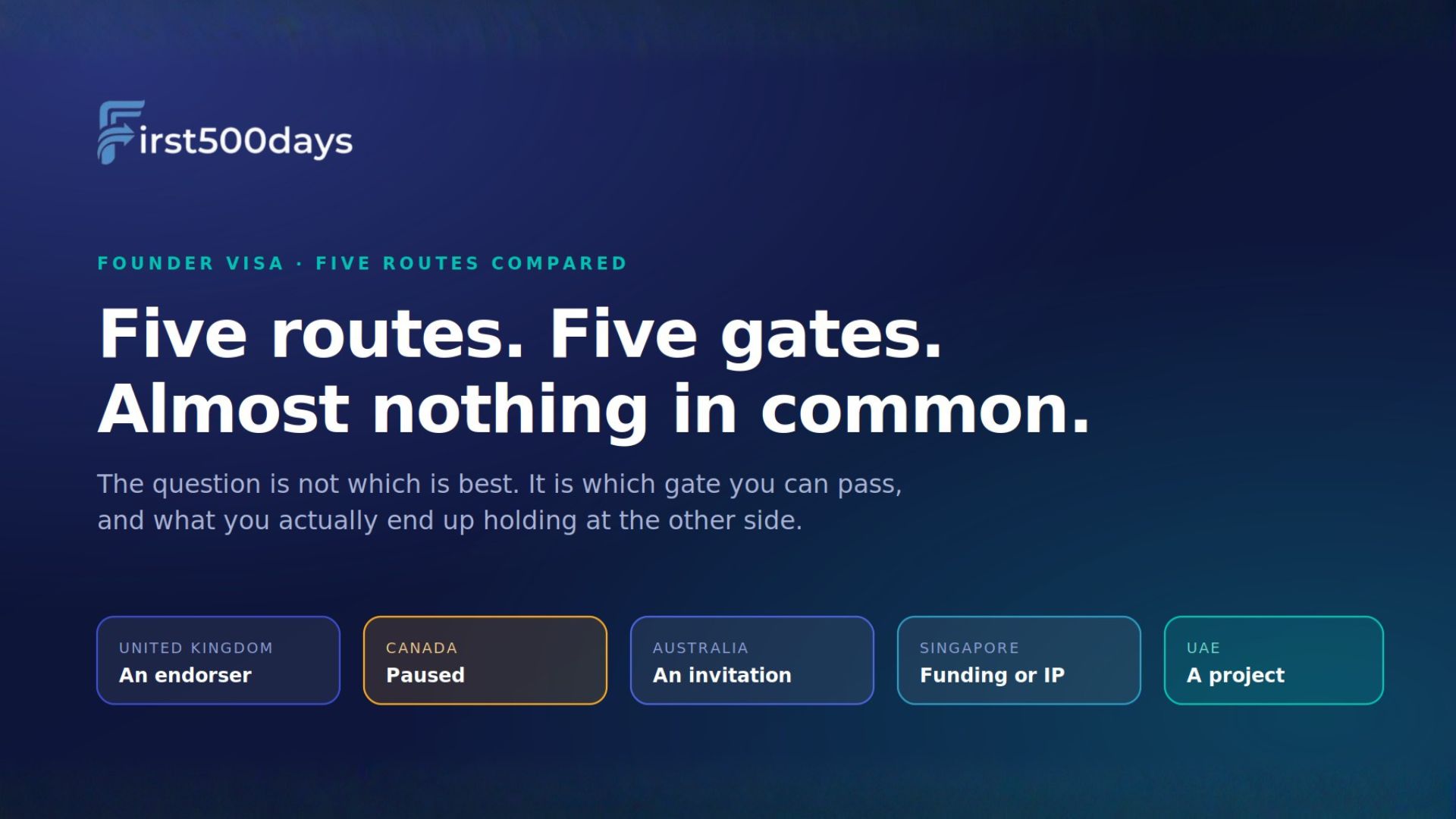
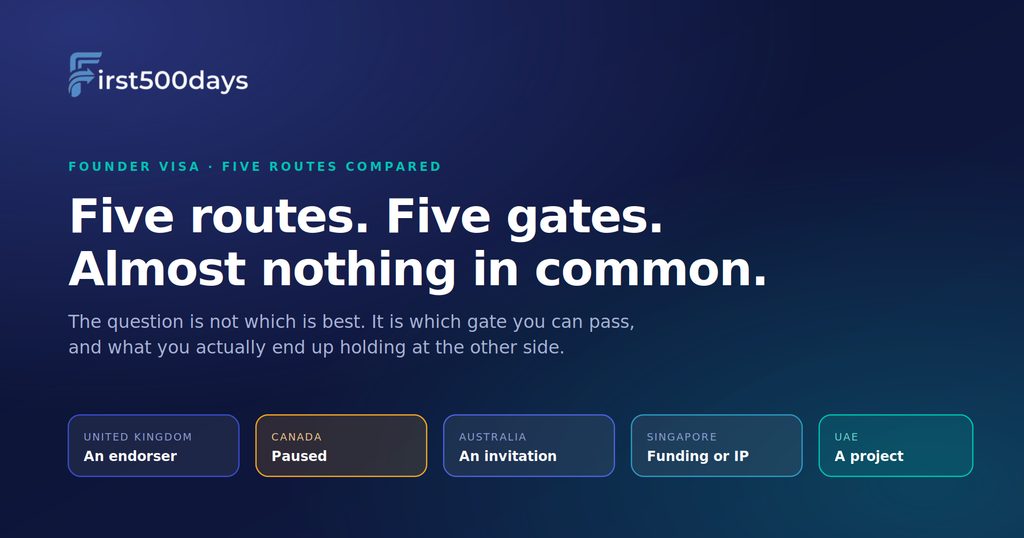
These are not five versions of the same thing. Each gates on something completely different — a judgement, a cheque, an invitation, a threshold, a project — and two of the five have changed materially since most comparisons of them were written.
Two status notes, before the comparison
Canada’s Start-up Visa Program is paused at the time of writing. Australia’s Business Innovation and Investment Program closed permanently to new applications on 31 July 2024; what exists now is a talent visa by invitation. Both facts are sourced below, both change, and a great deal of published comparison content predates them. Check each government’s own pages, and take advice from a qualified adviser in the relevant country.
The UK gates on an endorsing body’s judgement of whether your idea is original. Canada gates on an investor or incubator deciding to back you, and is currently paused. Australia gates on the Department inviting you, on the basis of an already-earned record. Singapore gates on funding, intellectual property or an accelerator place. The UAE gates on a project and a letter. The useful question is not which country is best — it is which of those gates you can realistically pass in the next twelve months, and what you are actually holding once you are through it.
Five routes, side by side
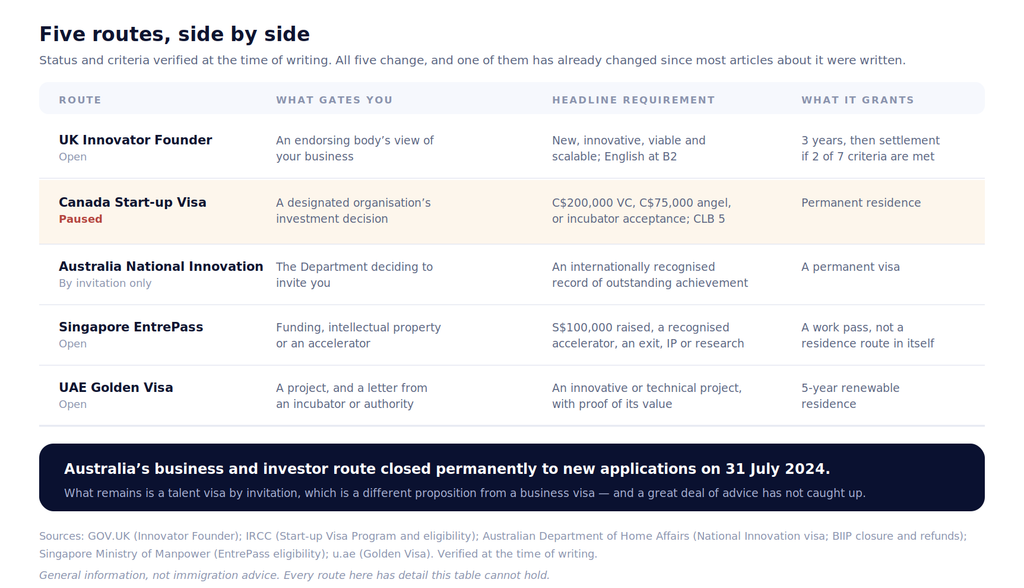
The United Kingdom’s Innovator Founder route requires endorsement from an approved body, which must be satisfied the business is new, innovative, viable and scalable, plus English at B2.[1] It grants three years, after which settlement requires the business to meet at least two of seven criteria.[2]
Canada’s Start-up Visa requires a letter of support from a designated organisation — a venture capital fund investing at least C$200,000, an angel group investing at least C$75,000, or acceptance into a designated incubator — plus Canadian Language Benchmark 5.[4] It leads to permanent residence. It is currently paused.[3]
Australia’s National Innovation visa is a permanent visa for people with an internationally recognised record of exceptional and outstanding achievement, and the Department must invite you before you can apply.[5] The business and investor programme that used to serve founders closed permanently to new applications on 31 July 2024.[6]
Singapore’s EntrePass requires a private limited company registered with ACRA in which you hold at least 30%, that is venture-backed or owns innovative technologies, and you must meet one of five profiles: at least S$100,000 raised in a single funding round; backing from a government-recognised or internationally renowned incubator or accelerator; having founded and sold a venture-backed or innovative technology business; registered intellectual property from an approved national institution; or an active research collaboration with a higher learning or research institution.[7]
The UAE Golden Visa route for entrepreneurs asks for proof of an innovative or technical project, documents proving the project’s value, and a letter from a business incubator or the relevant authority in the emirate. It grants five-year renewable residence.[8]
The gate is the whole decision
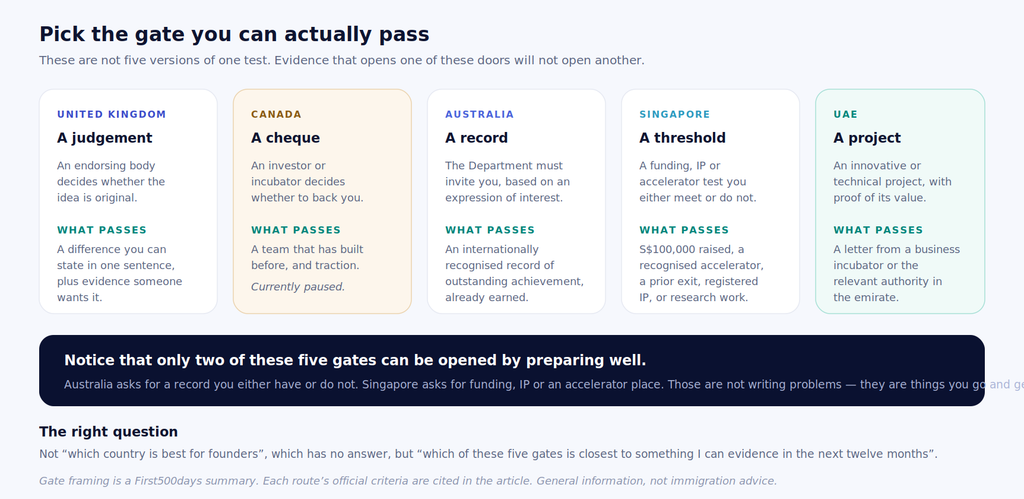
Look at the five gates next to each other and something becomes obvious that a fee comparison never shows: only two of them can be opened by preparing well.
The UK gate is a judgement about originality, and a well-prepared, well-evidenced case genuinely moves it. The UAE gate is a project and a letter, which is a documentation and relationship problem you can work at.
The other three are different in kind. Australia asks for an internationally recognised record you either have or do not, and no amount of drafting produces one. Singapore asks for S$100,000 raised, an accelerator place, a prior exit, registered IP or a research partnership — all real assets you go and acquire, usually over years. Canada asks an investor to write a cheque, which is the hardest of the lot and is currently not even available.
“Which country is best for founders?” has no answer. “Which of these five gates is closest to something I can evidence within twelve months?” has a specific one, and it is usually not the country the person started out wanting.
What you actually end up holding
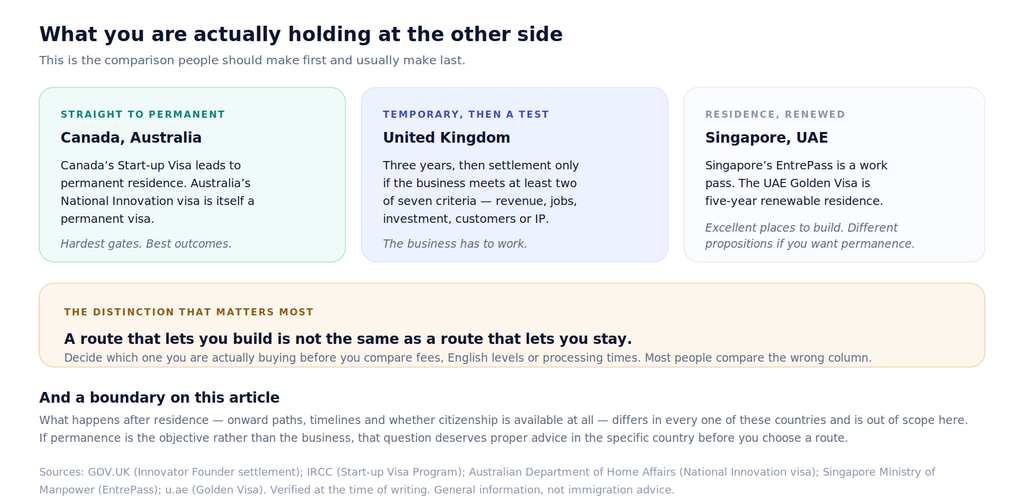
The second half of the decision is what the route grants, and the differences are larger than the entry requirements suggest.
Canada’s Start-up Visa leads to permanent residence, and Australia’s National Innovation visa is a permanent visa. Those are the hardest gates and the strongest outcomes, which is not a coincidence.
The UK gives three years and then a test: settlement only if the business meets at least two of seven criteria — £50,000 invested and spent, customers doubled, significant R&D plus a UK IP application, £1m revenue, £500,000 revenue with £100,000 from exports, ten full-time jobs for settled workers, or five such jobs at a mean salary of at least £25,000.[2] The business genuinely has to work.
Singapore’s EntrePass is a work pass. The UAE Golden Visa is renewable residence. Both are excellent places to build a company and neither is, in itself, the same proposition as permanent residence.
Which leads to the distinction we would put above every other consideration: a route that lets you build is not the same as a route that lets you stay. Decide which one you are buying before comparing fees, English levels or processing times.
What this article deliberately does not cover
What happens after residence — onward paths, timelines, and whether citizenship is available at all — differs in every one of these countries, changes frequently, and is genuinely specialist. We have left it out rather than summarise it badly. If permanence rather than the business is your actual objective, that question deserves proper advice in the specific country before you choose a route.
How to choose, in the right order
- Decide what you are buying. A place to build, or a place to stay. They point at different routes.
- Check what is open. Two of the five have changed materially in the last two years. Check the government pages, not a comparison article — including this one.
- Match the gate to your evidence. Which gate is closest to something you can demonstrate within a year? Be honest, and be specific about what you would have to acquire.
- Then ask whether the market is right for the business. A visa in a market where nobody wants your product is a costly way to relocate.
- Only then compare cost and timeline. They matter, and they are the last filter rather than the first.
Founders almost always run this list backwards, starting with cost and processing times and ending with whether the market suits the business. Running it in this order tends to remove two or three of the five options quickly, which is the point.
One thing all five have in common
Every gate above rewards the same thing: evidence that something is already happening.
Users, revenue, a pilot, a letter of intent from a named organisation, a working product, a prior exit, filed intellectual property. An endorsing body reads it as originality demonstrated rather than claimed. An investor reads it as reduced risk. A government reads it as a record. An accelerator reads it as a business worth a place.
If you are twelve months away from applying anywhere, the highest-return use of those months is not choosing between jurisdictions. It is building something that makes any of them easier.