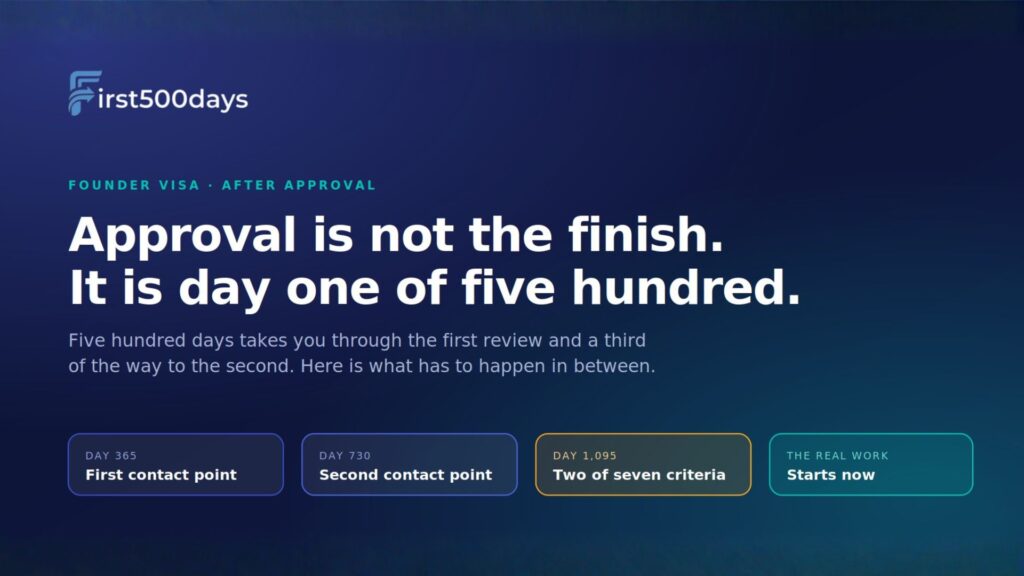
The route removed the old £50,000 investment requirement, which is why it is often described as accessible. Here is every published fee added up honestly — £6,462 for one applicant over three years, £18,294 for a family of four — alongside the requirements and the settlement criteria almost nobody reads before applying.
General information, not immigration advice
Every figure and rule below is sourced to GOV.UK or the Immigration Rules and linked at the end. Fees and rules change, sometimes at short notice, and your position depends on your circumstances. Verify each figure before budgeting, and take advice from a qualified immigration adviser before applying.
The Innovator Founder visa requires endorsement from an approved body, a business that is new, innovative, viable and scalable, English at B2, £1,270 held for 28 days, and a day-to-day role running the business. It is granted for three years, with contact point meetings at 12 and 24 months. Published fees come to £6,462 for a single applicant over three years and £18,294 for two adults and two children — before the English test, advisers, or a pound of funding for the business itself.
What the route requires
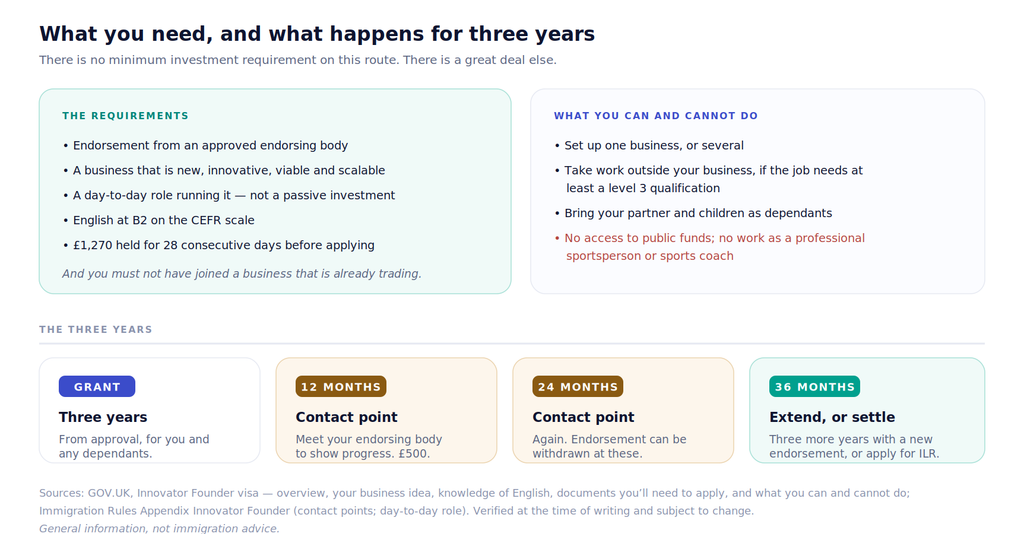
The centre of the route is endorsement. An approved endorsing body must assess your business and be satisfied that it is new, innovative, viable and scalable.[1] That is a business assessment, not an immigration one, and it is where applications succeed or fail. Two other articles in this cluster deal with it in detail.
Around it sit requirements that are more mechanical but not optional. English at B2 on the CEFR scale, provable by a degree taught in English, a UK qualification, or a secure English language test.[2] Bank statements showing £1,270 held for 28 consecutive days before you apply.[3] And a day-to-day role in carrying out the business plan — you must be involved in the day-to-day management and development of the business.[4]
That last one deserves emphasis, because it is what the route is not. It is not a passive investment. You cannot fund a business and have someone else run it. If your intention is to place capital rather than to build and run a company, this is the wrong route and the endorsement process will find that out.
What you can and cannot do
Two provisions are more generous than people expect. You can set up more than one business.[5] And you can take work outside your own business, as long as the job needs at least a level 3 qualification — which materially changes the financial risk of the route, because it means the business does not have to pay you from month one.[5]
You can bring your partner and children as dependants. You cannot access public funds, and you cannot work as a professional sportsperson or sports coach.[5]
What it actually costs
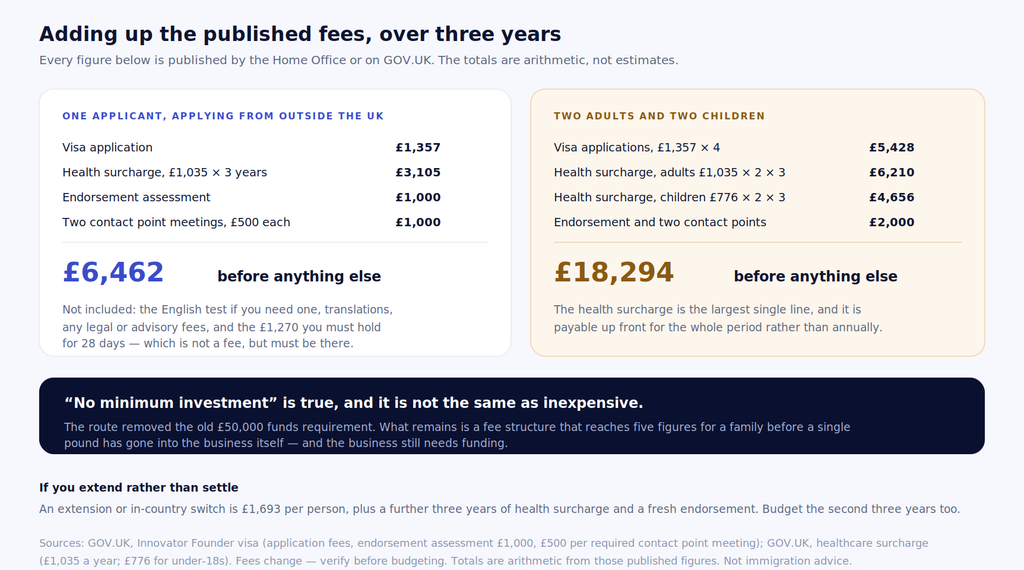
The visa application is £1,357 per person from outside the UK, or £1,693 per person to extend or switch inside it.[1] The endorsing body charges £1,000 to assess your business, and £500 for each required contact point meeting, of which there are at least two.[1] The immigration health surcharge is £1,035 a year for an adult and £776 a year for someone under 18 at the time of application.[6]
Add those up over the three-year grant and a single applicant is at £6,462 before anything else. Two adults and two children reach £18,294.
“No minimum investment” is true, and it is not the same as inexpensive. The £50,000 requirement went; a five-figure fee structure for a family did not.
What those totals exclude is also worth listing plainly: the English test if you need one, document translations, any legal or advisory fees, the £1,270 you must hold (not a fee, but it must be there), and the money the business itself will need. The route asks you to build something new, innovative, viable and scalable, and none of the fees above contribute a penny to that.
One structural detail that catches people: the health surcharge is payable up front for the whole period, not annually. For a family of four that is a single payment of £10,866 at the point of application.
The three years, and what happens in them
The visa is granted for three years. You must meet your endorsing body after 12 months and again after 24 months to show you are making progress with the business.[7] The Immigration Rules require at least two contact point meetings at regular intervals during the permission period.[4]
These are not formalities. Endorsement can be withdrawn at a contact point if the business is not progressing as described, and a withdrawn endorsement has consequences for your permission to remain. The practical implication is that the business plan you submit is not a document you file and forget — it is the thing you will be measured against twice, by people who have read it.
At the end of three years there are two paths. Extend for a further three years with a new endorsement, at £1,693 per person plus another three years of health surcharge. Or apply for settlement.
Settlement: the criteria to read first
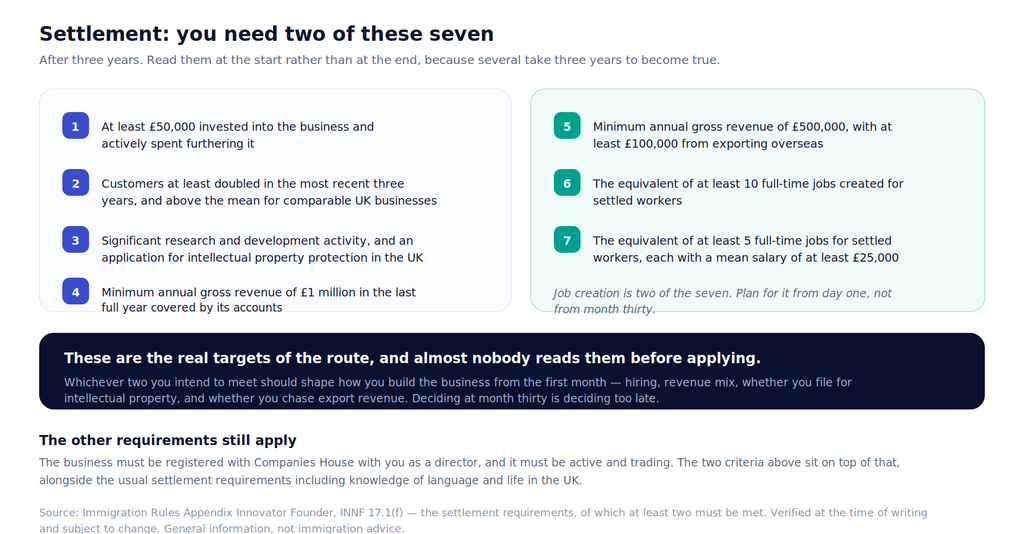
This is the most under-read part of the whole route, and it should be the first thing you look at rather than the last.
To settle, the Immigration Rules require that at least two of seven criteria are met: £50,000 invested and actively spent furthering the business; customers at least doubled in the most recent three years and above the mean for comparable UK businesses; significant research and development activity plus an application for UK intellectual property protection; £1 million annual gross revenue in the last full year of accounts; £500,000 annual gross revenue with at least £100,000 from exporting; the equivalent of at least 10 full-time jobs for settled workers; or the equivalent of at least 5 full-time jobs for settled workers each with a mean salary of at least £25,000.[4]
Look at what those criteria actually ask for. Two of the seven are job creation. Two are revenue at a scale most three-year-old startups do not reach. One requires a filed IP application. One requires investment you have to raise and spend.
Which two you intend to meet should shape how you build the business from the first month: whether you hire or stay lean, whether you chase export revenue, whether you file for intellectual property, whether you raise. Deciding at month thirty is deciding too late, and it is the most common strategic mistake we see on this route.
A realistic timeline
The application itself is not the long part. Here is the honest sequence.
- Getting the business ready: months, not weeks. Evidence of demand, a defensible innovation claim, named conversations in the market. This is where the time goes and where the outcome is decided.
- Choosing and approaching an endorsing body. Bodies publish their own criteria and have different focuses. Reading them and choosing well is worth more than it costs in time.
- Endorsement assessment. Varies by body; expect weeks rather than days, and expect questions.
- The visa application. Once endorsed, the application is comparatively procedural, subject to standard processing.
- Then three years, with two scheduled reviews. Which is the actual product you are buying.
Anyone quoting you a total timeline without first assessing whether the business can be endorsed is quoting on the wrong variable. The paperwork is fast. The business readiness is not.
Before you spend anything
Two questions, answered honestly, save most of the cost of a refusal. Can I state in one sentence what is original about this, in a way someone else could check? And which two settlement criteria am I building towards? If the first has no answer, the endorsement will fail. If the second has no answer, you may be endorsed and then find yourself, three years and £18,000 later, unable to settle.