Almost every article on this subject tells you the free zone is cheaper and tax-free. For a lot of startups both halves of that sentence are wrong. Here is the decision as it actually works, with the rules quoted from the source.
General information, not tax or legal advice
Every rule and figure below is sourced to UAE government material and linked at the end. UAE corporate tax is young, the ministerial decisions are still being amended, and the outcome for your business depends on your activity, your customers and your structure. Take advice on your own facts before you act on any of it.
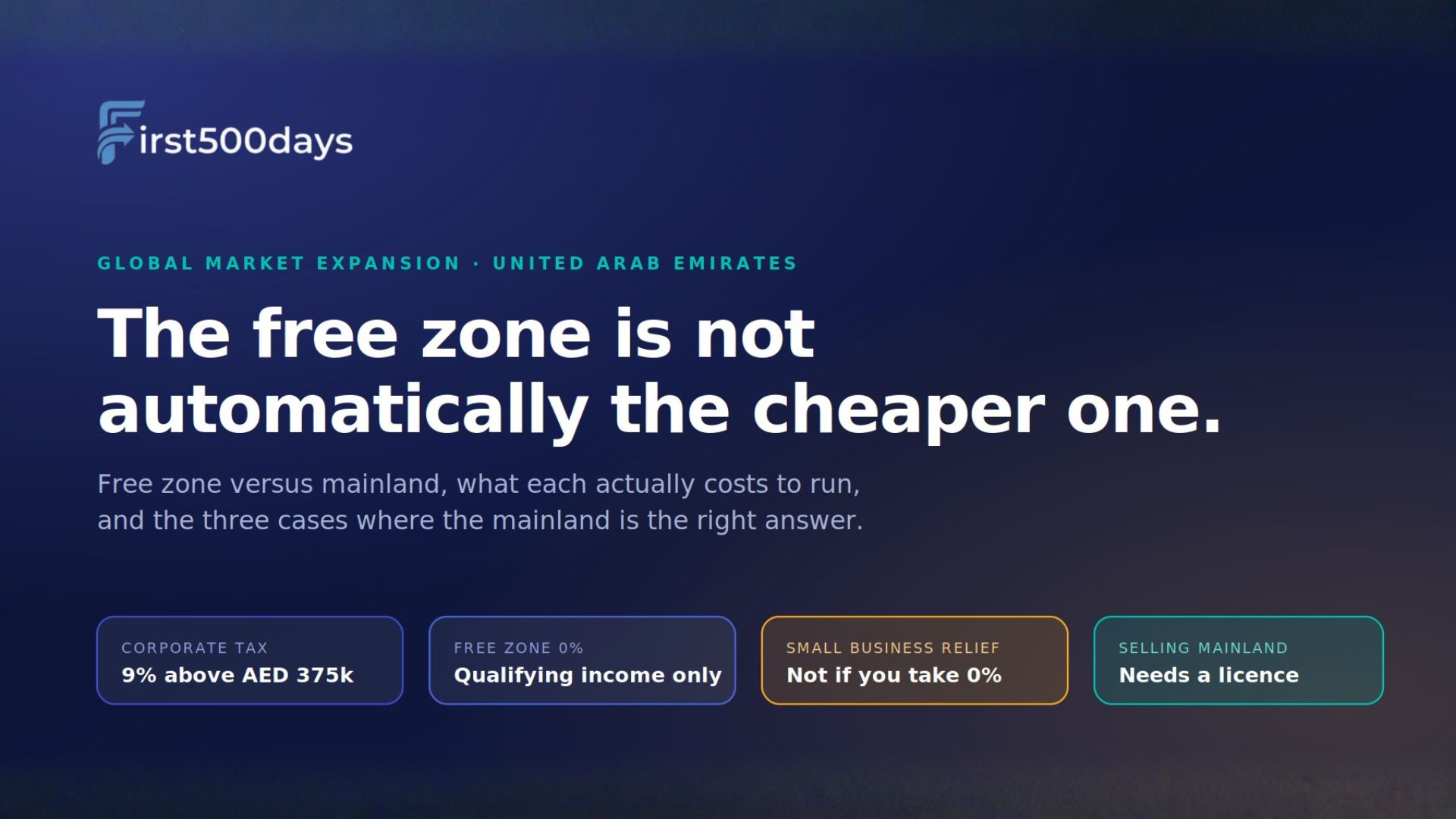
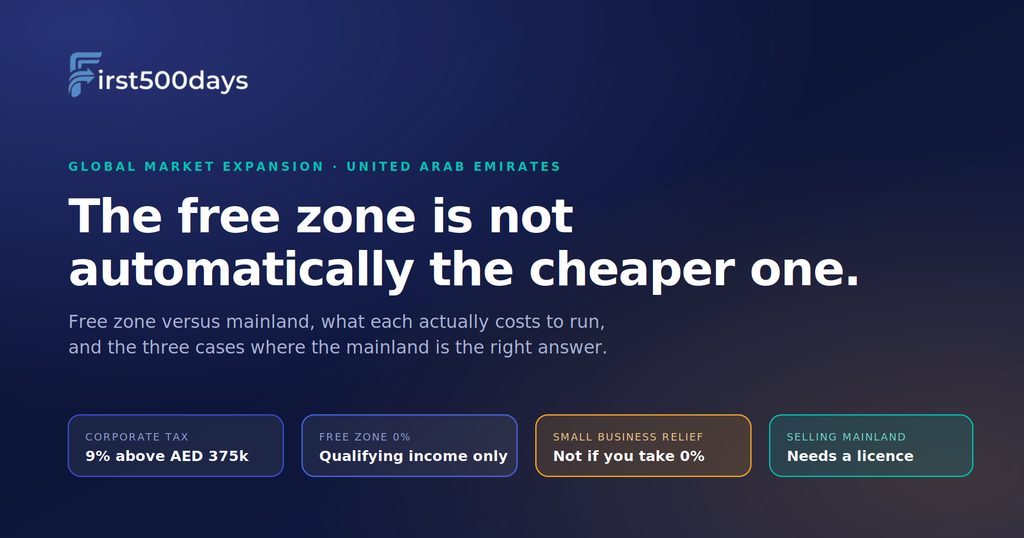
Choose the mainland if your customers are UAE businesses or consumers, if your activity needs a mainland licence, or if you are a small services business that would benefit from Small Business Relief. Choose a free zone if you sell mainly outside the UAE and your activity appears on the Qualifying Activities list. The licence fee should not drive the decision — it is the smallest recurring number in the stack, and the free zone’s 0% headline rate applies to a narrower slice of income than most founders expect.
The one question that decides most of it
Before tax, before cost, before which zone: are your customers on the UAE mainland?
The UAE government’s own guidance is blunt about what a free zone licence permits. “A company registered under a respective free zone is not permitted to carry out business outside the free zone, i.e. on the mainland.”[1] There is a route — approval from the free zone authority, then a licence from the local Department of Economic Development — but it is a second licence with a second set of costs, not a formality.
So if you are building something that sells to UAE companies, UAE government entities or UAE consumers, and you set up in a free zone because a comparison table said it was cheaper, you have bought the wrong licence. That is the single most expensive mistake in this decision, and it is entirely avoidable.
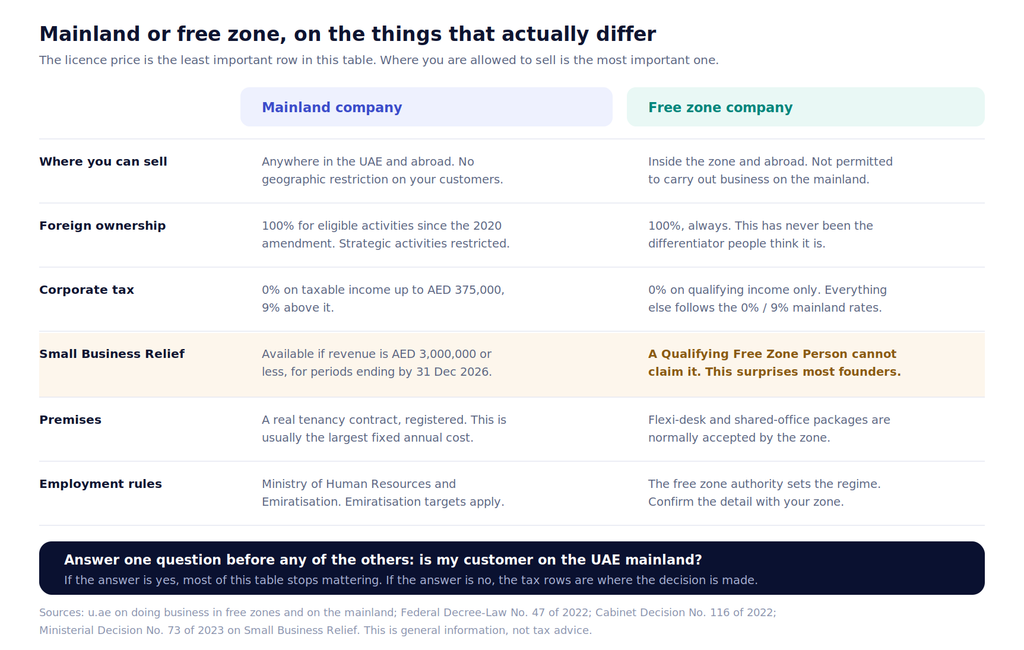
Notice which row has quietly stopped being a differentiator. Full foreign ownership on the mainland has been available since Federal Decree-Law No. 26 of 2020 amended the Commercial Companies Law: the requirement for a majority Emirati shareholder or agent was annulled for eligible activities, and Dubai now permits 100% foreign ownership across more than a thousand commercial and industrial activities.[2] Activities of strategic impact remain restricted, and the list is worth checking against your exact activity. But “you need a local partner on the mainland” is advice from a previous decade, and a surprising amount of content still repeats it.
“Dubai is tax-free” stopped being true in 2023
It is worth being precise, because the imprecision costs people money.
There is still no federal personal income tax on salaries. That is real, it is substantial, and it remains one of the strongest reasons founders move to the UAE. What changed is the tax on company profits. Corporate tax applies at 0% on taxable income up to AED 375,000 and 9% above it.[3] VAT has applied at 5% since 2018, with mandatory registration once taxable supplies and imports exceed AED 375,000 a year.[6]
And there is a trap in the VAT rule that mirrors the UK one: a business with no place of residence in the UAE that makes taxable supplies in the UAE must register regardless of value, where nobody else is obliged to account for the tax.[6] If you are selling into the UAE before you set up there, that is a question to ask early rather than late.
What the free zone 0% actually covers
This is the section that changes decisions, so it is worth reading slowly.
A free zone company does not get 0% on its profits. A Qualifying Free Zone Person gets 0% on its Qualifying Income, and 9% on everything else. Qualifying Income is defined: income from transactions with other Free Zone Persons (unless the activity is an Excluded Activity), income from a defined list of Qualifying Activities whoever the customer is, and income from qualifying intellectual property.[4]
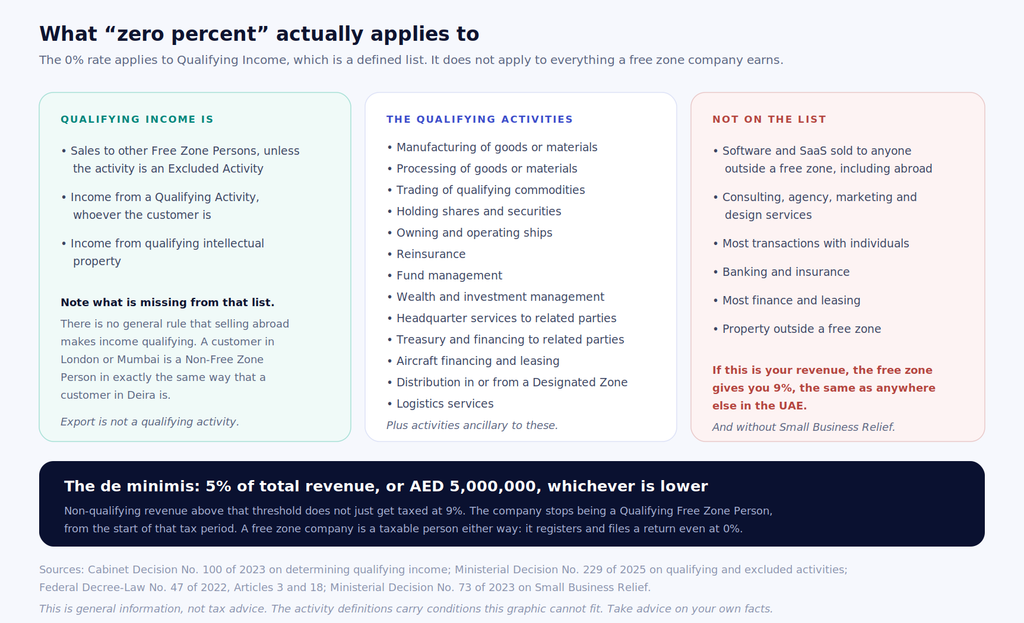
Read the middle column, then read it again with your own revenue in mind. Manufacturing, processing, commodity trading, holding securities, shipping, reinsurance, fund and wealth management, headquarter and treasury services to related parties, aircraft leasing, distribution in or from a Designated Zone, logistics.[5] That is a list built around trade, finance and physical goods.
It is not built around a SaaS company, a development agency, a design studio, a marketing consultancy or a recruitment business. And here is the part that catches people hardest: selling abroad does not make income qualifying. A customer in London is a Non-Free Zone Person in exactly the same way a customer in Deira is. The income qualifies because of what the activity is, not because of where the customer sits.
Export is not a qualifying activity. If your revenue is services sold to customers outside a free zone, the 0% rate may be covering almost none of it.
There is a threshold that keeps small amounts of non-qualifying revenue from destroying the position: non-qualifying revenue must not exceed 5% of total revenue or AED 5,000,000, whichever is lower.[5] Exceed it and the consequence is not a bigger tax bill on that slice — the company ceases to be a Qualifying Free Zone Person from the beginning of that tax period.[3]
One more thing that surprises people: a free zone company is a taxable person either way. It registers for corporate tax and files a return even when the rate that applies to it is 0%. Zero percent is a rate, not an exemption from the paperwork.
The relief a free zone company gives up
Small Business Relief lets a resident business with revenue of AED 3,000,000 or less in the tax period elect to be treated as having no taxable income. It runs for tax periods beginning on or after 1 June 2023 and ending on or before 31 December 2026.[7]
A Qualifying Free Zone Person cannot claim it. The decision names the exclusion explicitly.[7]
Put those two facts side by side. A small consultancy on the mainland, turning over AED 2.4m, can elect into Small Business Relief and pay nothing on its profits for the periods that qualify. The same consultancy in a free zone finds that its revenue is not Qualifying Income, so the 0% headline rate does not reach it — and if it holds Qualifying Free Zone Person status, the relief that would have helped is closed to it.
The honest limit of this section
There is real subtlety underneath that comparison. A free zone company that is not a Qualifying Free Zone Person is taxed like any other company, and the Small Business Relief exclusion is written for Qualifying Free Zone Persons. Whether that helps or hurts you depends on facts specific to your business, and it is exactly the kind of question an adviser earns their fee on. The purpose of this section is not to give you an answer. It is to stop you assuming the free zone answer is obviously the cheaper one, because for a services business under three million dirhams it very often is not.
What it really costs
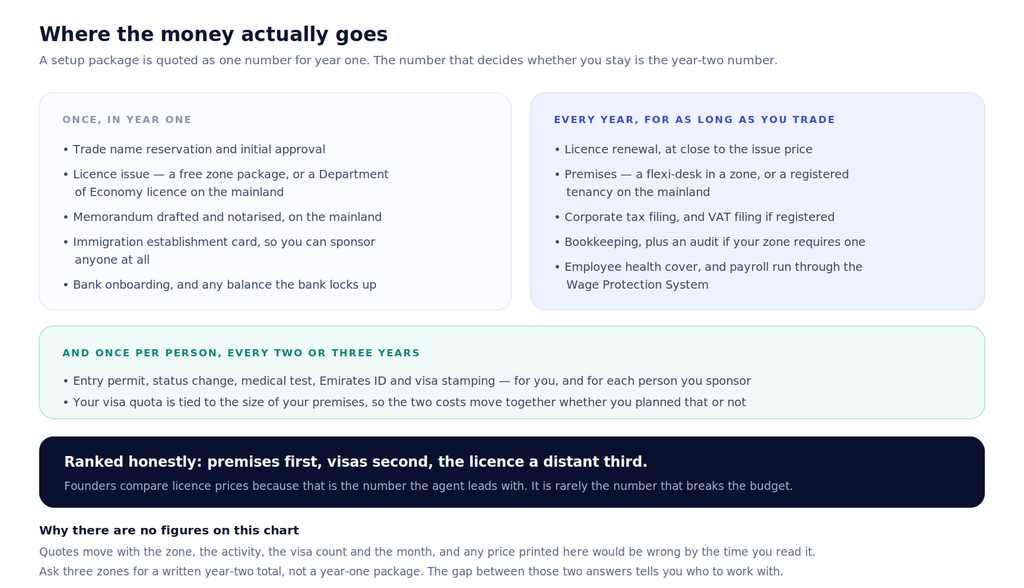
We do not publish a price table for UAE setup, and you should be a little suspicious of the ones that do. Quotes move with the zone, the activity, the visa count and the month; setup packages are discounted in year one and are not in year two; and any figure printed in an article will be wrong by the time it is read. What does not change is the shape of the cost, and the shape is what you can plan against.
Three things about that shape are worth internalising.
- Premises is the biggest line, not the licence. On the mainland you need a real, registered tenancy. In a free zone a flexi-desk package is usually accepted, which is a genuine and often decisive cost advantage — but it is tied to the next point.
- Visa quota is a function of premises. The number of people you can sponsor is linked to the space you hold, so “how cheap can the office be” and “how many people can I bring” are the same question asked twice. Founders discover this when they try to hire their third person.
- Year two has no discount. Ask every zone you shortlist for a written year-two total: renewal, premises, visa renewals, accounting and audit. The gap between the year-one package price and the year-two total tells you a great deal about who you are dealing with.
Three cases where the mainland is the right answer
- Your customers are in the UAE. Selling to mainland businesses, government entities or consumers is what a mainland licence is for, and a free zone licence is not permitted to do it. If UAE revenue is the plan, this decides it on its own.
- Your activity is licensed on the mainland, or needs physical presence. Retail, food and beverage, clinics, some professional services, anything with walk-in customers or a regulated local activity. Check your exact activity, not the category it sounds like it belongs to.
- You are a small services business inside the Small Business Relief window. Under AED 3,000,000 of revenue, with income that would not be Qualifying Income anyway, the mainland can be the lower-tax structure for periods ending on or before 31 December 2026. Take advice on this one specifically.
And where the free zone genuinely wins
- Your activity is on the Qualifying Activities list. Trading, manufacturing, logistics, fund management, group headquarter and treasury functions. This is who the regime was designed for, and for them the advantage is substantial and real.
- You are a holding or IP structure. Holding shares and securities for investment, and qualifying intellectual property income, are both inside the definition.
- You need speed and a low fixed base. Flexi-desk premises, a packaged licence and a well-worn visa process make a free zone the fastest route to a functioning entity and a residence visa, particularly for a founder relocating before revenue exists.
- Your customers are other free zone companies. Income from transactions with Free Zone Persons is qualifying by default, subject to the Excluded Activities. If you sell into the zones, the zones are where you should be.
Choosing between free zones
There are many, spread across all seven emirates, and they are not interchangeable. Six questions separate them faster than any comparison table:
- Is my activity licensed here, described the way I will actually do it? Activity lists are specific and the licence must match the work. A mismatch surfaces at the bank, or at an audit, not at signup.
- What is the year-two total, in writing? Covered above. Ask three zones and compare like for like.
- How many visas does this include, and what does the next one cost? Including the premises upgrade it may trigger.
- Does this zone require audited accounts? Some do. It is a real annual cost and a real deadline.
- Which banks are onboarding companies from this zone right now? Ask for names, not reassurance. Banking is the practical bottleneck in the UAE as it is everywhere else, and zones differ in how easily their companies get accounts.
- If I later need to sell on the mainland, what is the route from here and what does it cost? Ask before you need it, because the answer occasionally changes the choice of zone.
Two things you can safely stop worrying about
Some zones are Designated Zones, a VAT concept that affects how the tax applies to certain movements of goods. Ask whether yours is and whether it makes any difference to what you sell — for most services businesses it does not. Separately, the domestic minimum top-up tax you may have read about applies to multinational groups with global revenues of €750 million or more in at least two of the four preceding financial years, for financial years starting on or after 1 January 2025.[8] It is not about your startup.
People: visas, staff and Emiratisation
The licence permits the business; the residence visa permits you. Most founders take one through the company, because it is what makes a bank account, a tenancy and sponsoring staff workable in practice. Budget it per person and per renewal cycle rather than as a one-off: entry permit, status change, medical, Emirates ID and stamping recur every two or three years for you and for everyone you sponsor.
On hiring, the regimes differ. Mainland companies sit under the Ministry of Human Resources and Emiratisation, and Emiratisation targets apply: companies with 50 or more employees must achieve 2% annual growth of Emiratis in skilled positions, and companies with 20 to 49 employees in designated sectors must employ at least one UAE national.[9] Free zone companies fall under their own zone authority, and the position should be confirmed with the zone rather than assumed from a blog. Neither regime is a reason to choose one over the other at five people; both are a reason to understand what happens at fifty.
Six mistakes we see in this market
- Choosing on licence price. It is the third-largest recurring cost at best, and the one most likely to be discounted in year one to win your business.
- Assuming free zone means 0%. It means 0% on Qualifying Income. Check your revenue against the list before the structure, not after.
- Assuming exporting makes income qualifying. It does not. This is the most common misunderstanding in the whole regime.
- Setting up in a free zone with UAE customers. A free zone company is not permitted to carry out business on the mainland. If that is your market, you have bought the wrong licence.
- Forgetting that 0% still files. Registration and returns are obligations regardless of rate, and the penalties for missing them are not discounted for small companies.
- Buying the package before the plan. The activity, the customer location and the headcount plan determine the structure. Working the other way round is how founders end up paying to restructure in year two.