
This is usually presented as a cost comparison. It is not. It is a question about who is legally the employer, whether your contractor arrangement is a job in disguise, and whether the person you hire quietly gives your company a taxable presence in their country.
General information, not legal, tax or employment advice
Employment law, employment status tests and permanent establishment definitions are national and differ substantially between markets. The UK examples below are sourced to GOV.UK and HMRC and are used to illustrate how these questions work, not as a guide to any other jurisdiction. Take local advice before hiring anywhere.
Use a contractor when the work is genuinely independent and defined. Use an employer of record when you are testing a market with one or two people and want the option to stop. Set up your own entity when the market is proven and the team is growing. The two risks that decide this are misclassification — which follows from how the relationship operates, not what the contract says — and permanent establishment, which follows from what the person does and is not solved by an employer of record.
The three routes
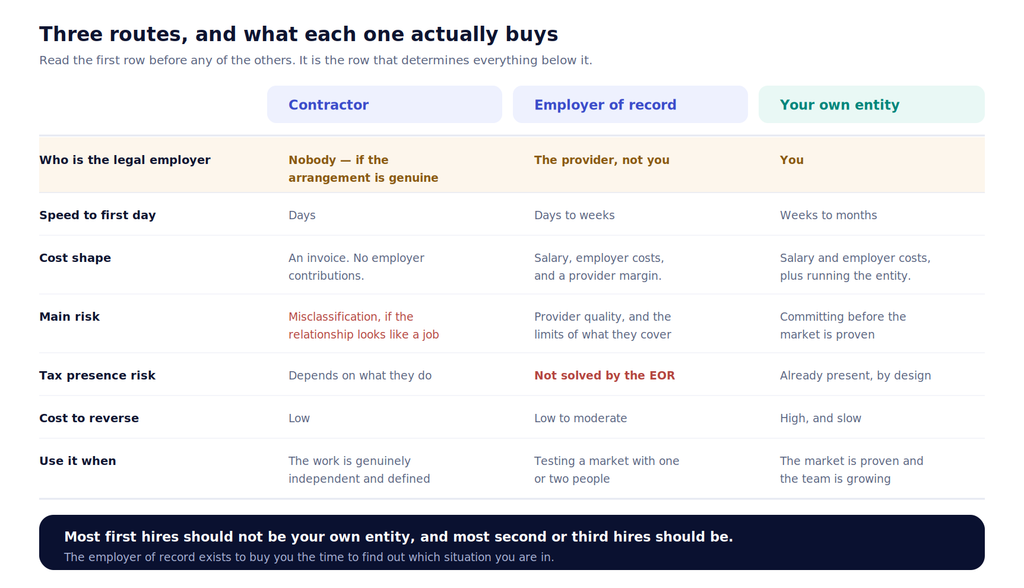
The first row is the whole comparison. With a contractor, nobody is the employer — provided the arrangement is genuinely a contract for services. With an employer of record, the provider is the legal employer and you direct the work. With your own entity, you are the employer and you carry everything that comes with it.
Everything else — speed, cost, risk, reversibility — follows from that. And the cost comparison people lead with is the least decision-relevant part, because the EOR margin that makes it look expensive is buying you the ability to stop in a market you have not proven.
Most first hires should not be your own entity. Most second or third hires should be. The employer of record exists to buy you time to find out which situation you are in.
The contractor question, which is not a contract question
The most common mistake in international hiring is engaging a full-time person as a contractor because it is quick, and assuming the contract settles the matter.
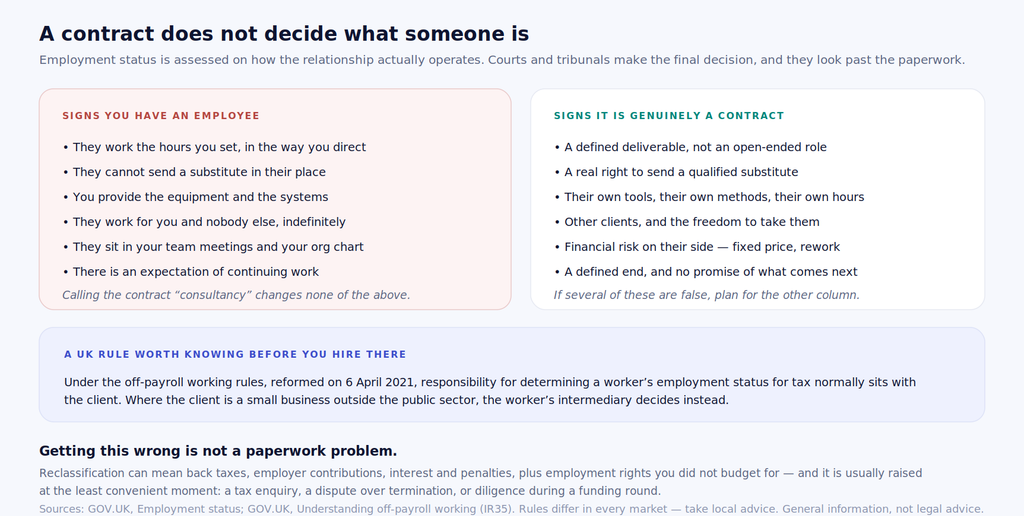
It does not. Employment status is assessed on how the relationship actually operates, and in the UK, courts and tribunals make the final decision.[1] Every market has its own test, and while the details differ the logic is remarkably consistent: control, substitution, integration, mutuality of obligation, and who carries the financial risk.
Run the honest check. Does this person work the hours you set, in the way you direct? Could they send a qualified substitute? Whose equipment do they use? Do they have other clients? Is there a defined deliverable and an end date, or an open-ended role with an expectation of continuing work? If most of those answers point one way, the label on the document is not going to save you.
One UK specific worth knowing before you hire there. Under the off-payroll working rules, reformed on 6 April 2021, responsibility for determining a worker’s employment status for tax normally sits with the client — but where the client is a small business outside the public sector, the worker’s intermediary decides instead.[2] Knowing which side of that line you are on changes who carries the assessment.
And getting it wrong is not a paperwork problem. Reclassification can bring back taxes, employer contributions, interest and penalties, plus employment rights you never budgeted for — and it typically surfaces at the worst moment: a tax enquiry, a termination dispute, or diligence during a funding round.
The risk an EOR does not remove
This is the section that justifies the article, because it is the thing almost nobody raises at the point of hiring.
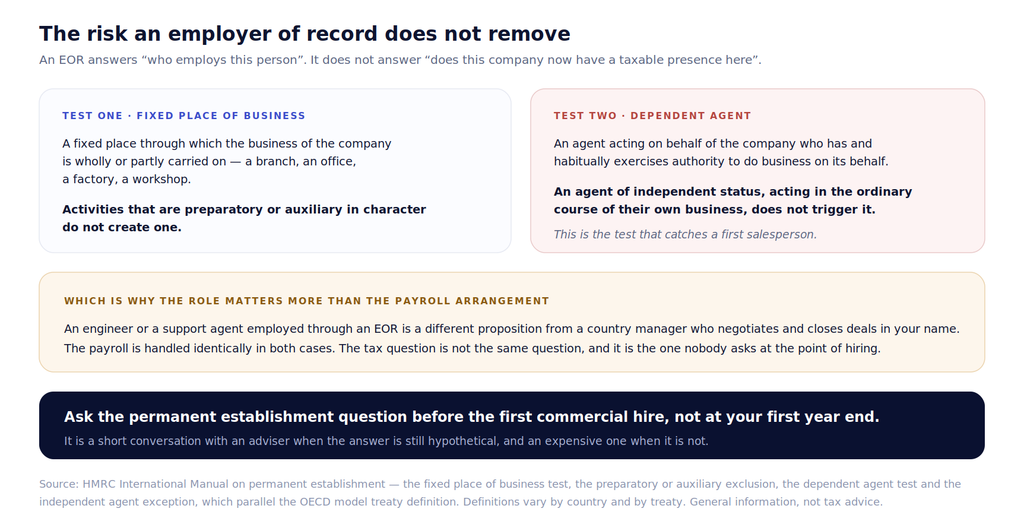
An employer of record answers “who employs this person”. It does not answer “does my company now have a taxable presence in this country”. Those are different questions decided by different rules.
A non-resident company can have a permanent establishment through a fixed place of business through which its business is wholly or partly carried on — a branch, an office, a factory — though activities that are preparatory or auxiliary in character do not create one.[3] Separately, a permanent establishment can arise where an agent acting on behalf of the company has and habitually exercises authority to do business on its behalf, unless that agent is of independent status acting in the ordinary course of their own business.[3]
Read that second test again with a country manager in mind. Someone whose job is to negotiate and close deals in your name, in their country, habitually, is exactly the fact pattern the rule describes. And the EOR arrangement does not change what they do — it changes only who runs their payroll.
The practical consequence is a hierarchy of risk by role rather than by contract type:
- An engineer, a designer or a support agent abroad is usually the lowest-risk hire, because their work does not involve concluding business on the company’s behalf.
- A marketer sits in between, and depends heavily on what they actually do.
- A salesperson or country manager with authority to agree terms is the one to ask about, in advance, specifically.
Ask the question before the first commercial hire rather than at your first year end. It is a short conversation with an adviser while the answer is still hypothetical.
How to actually choose
- Is the work genuinely independent, defined and time-limited? If yes, a contractor is appropriate. If you had to argue with yourself to say yes, it is not.
- Is this a test, or a commitment? If you might stop within a year, an EOR preserves that option cheaply relative to unwinding an entity.
- How many people will be there in eighteen months? Past two or three, the EOR margin starts to compete with the cost of running your own entity, and the entity starts to win.
- Does the role involve closing business? If yes, get the permanent establishment question answered first — it may change your structure, not just your payroll.
- Do you already have an entity there for another reason? If a market entry has already produced a company, hiring through it is usually simplest.
If you use an employer of record, ask these
EOR is a genuinely useful product and the market varies more than the marketing suggests. Five questions separate providers:
- Are you the employer in this country, or are you subcontracting to a local partner? Both models exist. Know which you are buying, and who is accountable if something goes wrong.
- What exactly do you take responsibility for, and what remains ours? Get it in writing, particularly around termination and any statutory dismissal process.
- What happens if we want to transfer this person to our own entity later? Continuity of service and notice entitlements can carry across, and the answer affects your exit cost.
- What is the total employer cost, itemised? Salary, employer contributions, mandatory benefits, provider margin — separately, not as one number.
- What is the notice period to end the arrangement, on both sides? The flexibility is the product. Check that it is real.
One more thing about the first hire
Whichever route you choose, the first person in a market is disproportionately important and disproportionately hard to manage. They have no local colleagues, no local culture to absorb, and a head office in another time zone that mostly forgets they exist. Whatever you save on structure, spend some of it on management attention — a weekly conversation with someone senior, a clear scorecard, and a realistic view of what one person can do alone in a market where nobody has heard of you.
Six mistakes
- Engaging a full-time employee as a contractor. Fast, cheap, and the most common source of retrospective liability in international hiring.
- Choosing on headline cost. The EOR margin is buying optionality. Price the optionality, not the invoice.
- Assuming an EOR handles permanent establishment. It handles employment. The tax presence question follows the role.
- Setting up an entity for one person. A permanent structure, with annual filings, for a hypothesis you have not tested.
- Hiring a country manager first. The highest-cost, highest-PE-risk, hardest-to-judge hire, made at the point of least information.
- Forgetting the person is alone. The structure question is easier than the management question, which is why it gets all the attention.