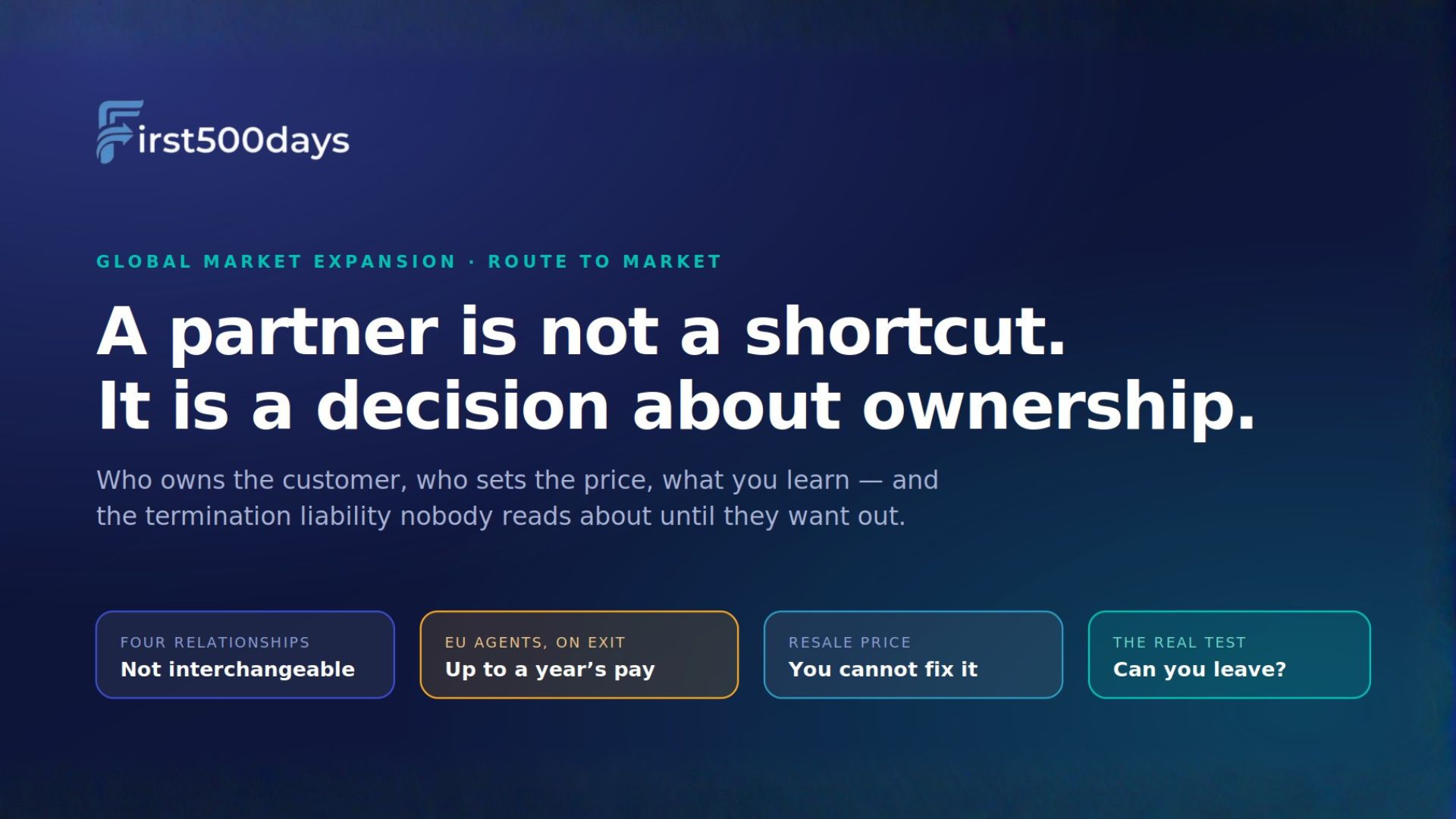
A local partner looks like a shortcut into a market. It is really a decision about who owns the customer, what you get to learn, and what it costs to change your mind — and in Europe, ending an agency can cost up to a year of the agent’s remuneration.
The EU rules cited below are summarised from the directive and regulation themselves and linked at the end. Member states implement them differently, competition law is fact-specific, and agency and distribution law outside the EU differs again — several Gulf and Asian markets have their own protective regimes for registered agents. Take advice in the specific market before appointing anyone.
Use a referral partner to test whether anyone in a market wants what you have. Use direct sales, even one person, if you can afford the time, because it is the only route that teaches you the market. Use a distributor when the product needs local stock, service or licensing that you cannot provide — and accept that they will own the customer. And before signing anything in Europe, price the exit: a commercial agent can be entitled to an indemnity of up to one year’s average annual remuneration when the relationship ends.
Four words that are not synonyms
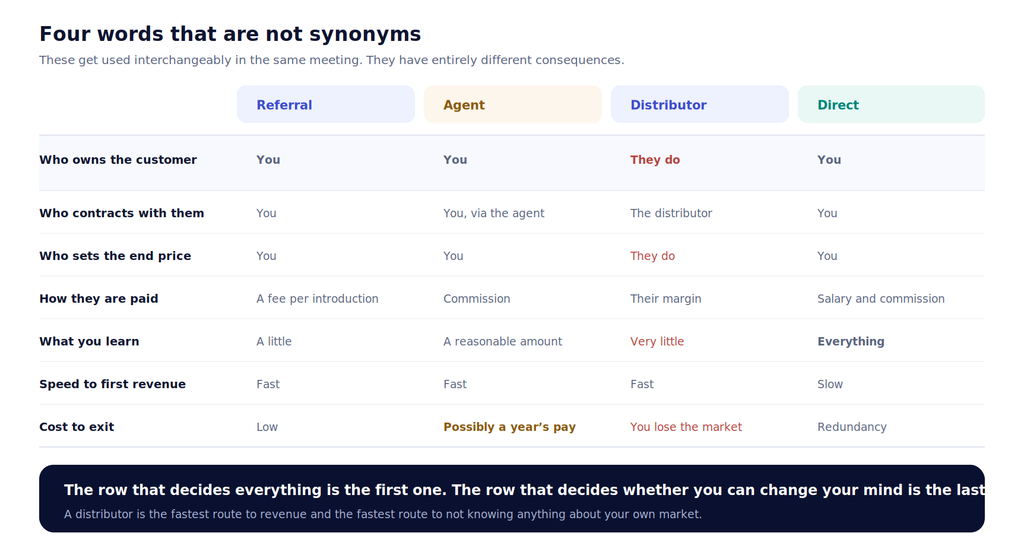
The confusion is not pedantic. “We’ve found a partner in Germany” can mean four completely different arrangements, and the difference determines whether you have a market or someone else does.
A referral partner introduces you and you do everything else. You own the customer, you set the price, you learn what happens. It is the lowest-commitment arrangement and the one most under-used, because it produces less revenue faster and founders reach for the option that sounds bigger.
A commercial agent negotiates on your behalf. The customer contracts with you, you set the price, and the agent takes commission. It preserves ownership and gives you real market presence — and in the EU it carries the termination consequence below.
A distributor buys from you and resells. They own the customer relationship, they set the end price, and their margin is their compensation. It is the fastest route to revenue and the fastest route to knowing nothing about your own market.
Direct sales is slow, expensive, and the only one that teaches you anything. Every objection, every lost deal and every pricing conversation reaches you unfiltered.
The first row of that table decides everything. The last row decides whether you can change your mind.
The clause nobody reads until they want out
This is the part of the topic that reliably surprises people, and it is worth knowing before rather than after.
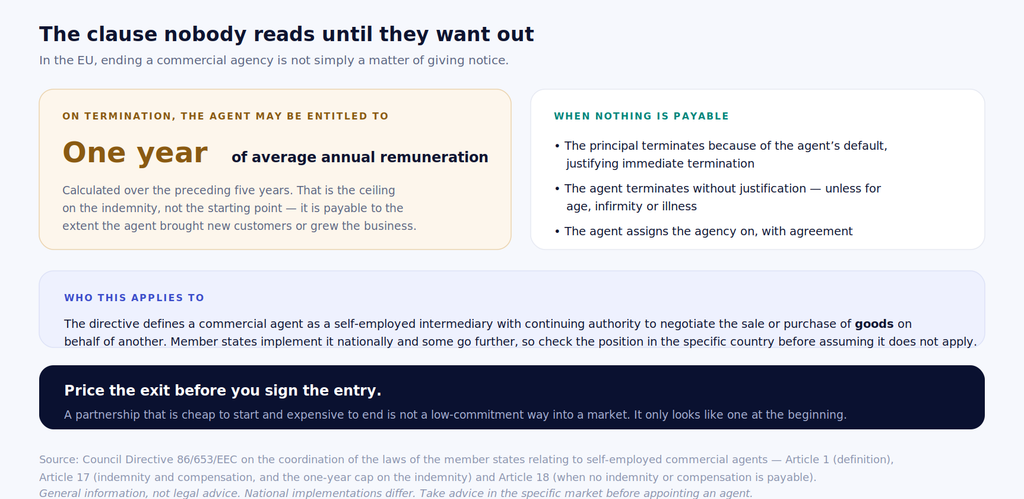
Under the EU directive on self-employed commercial agents, an agent may be entitled on termination to an indemnity, if and to the extent that they brought the principal new customers or significantly increased the volume of business and the principal continues to derive substantial benefit. The indemnity cannot exceed a figure equivalent to one year calculated from the agent’s average annual remuneration over the preceding five years.[1]
Nothing is payable where the principal terminates because of the agent’s default justifying immediate termination, where the agent terminates without justification other than for reasons of age, infirmity or illness, or where the agent assigns the agency on with agreement.[1]
Two things to note carefully. The directive defines a commercial agent as a self-employed intermediary with continuing authority to negotiate the sale or purchase of goods, so the position for services businesses depends on national implementation — some member states go further than the directive requires.[1] And the entitlement is not something you can simply draft away, which is exactly why it deserves attention at the start rather than at the end.
The practical lesson generalises well beyond Europe. Several markets protect local agents and distributors in ways that make termination slow, expensive or conditional. Price the exit before you sign the entry. An arrangement that is cheap to start and expensive to end is not a low-commitment way into a market; it only looks like one at the beginning.
“We’ll control it through the contract”
The second surprise is that several of the terms founders instinctively reach for are not permitted.
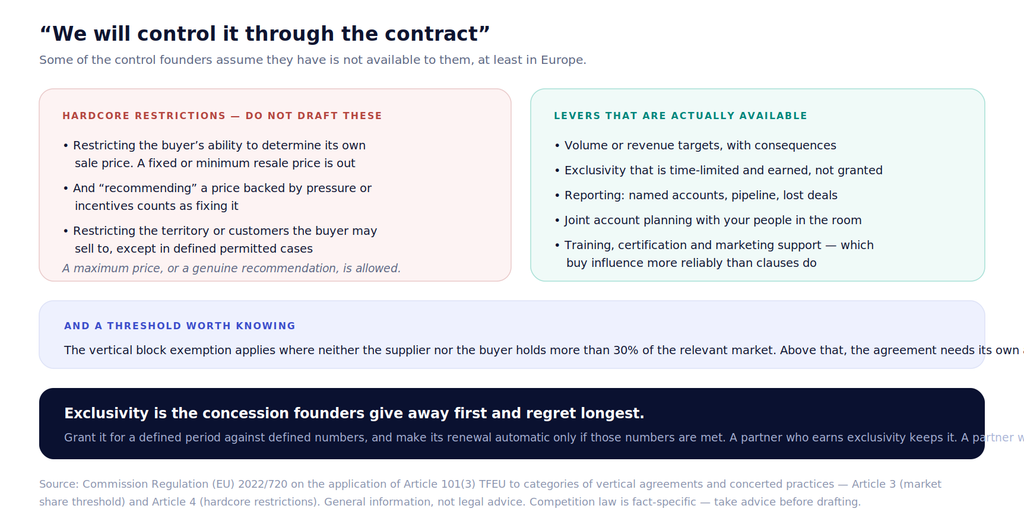
Under the EU vertical block exemption, restricting the buyer’s ability to determine its own sale price is a hardcore restriction. A supplier may impose a maximum sale price or recommend a price, provided that does not amount to a fixed or minimum price as a result of pressure or incentives from either party.[2] Restricting the territory into which, or the customers to whom, the buyer may sell is also restricted, subject to defined exceptions.[2] The exemption itself applies where neither party holds more than 30% of the relevant market.[2]
So “we’ll stop them undercutting our direct pricing” is often not available as a contractual solution. What is available is a set of commercial levers that work better anyway: volume or revenue targets with consequences attached, reporting obligations that name accounts and show lost deals, joint account planning with your people in the room, and training and marketing support that make you genuinely useful to the partner.
And one specific piece of advice about the concession founders give away first: exclusivity should be earned and time-limited, never granted and open-ended. Grant it for a defined period against defined numbers, and make renewal automatic only if those numbers are met. A partner who earns exclusivity keeps working. A partner who was handed it has no particular reason to.
How a partner quietly captures your market
The failure mode is rarely dramatic. It looks like this.
Year one produces some revenue, which feels like validation. Year two is flat, and the explanation is always local and always plausible — the market is slow, budgets are tight, a competitor is aggressive. You cannot check any of it, because every customer relationship, every lost deal and every pricing conversation sits with the partner.
By year three you have a market you cannot see into, cannot forecast, and cannot enter directly without either terminating an agreement that is expensive to terminate or competing with your own channel. The partner has not done anything wrong. You simply outsourced learning at the exact point in your expansion where learning was the thing you needed most.
Three questions that expose this early
Can you name their five largest prospects? If not, you have no pipeline visibility, whatever the reports say. Do you know why the last three deals were lost? If not, you are not learning anything about the market. What would happen if you ended this next quarter? If nobody can answer, or the answer is “we lose the market”, you are further in than you think. Ask all three at twelve months, not at thirty-six.
When a partner is genuinely the right answer
- The product needs local physical presence you cannot provide. Stock, installation, servicing, spare parts, certified engineers.
- The market requires a local licence or registration you do not have, and the partner does.
- The buying process is relationship-led and closed. In some sectors and countries, the incumbent relationships are decades old and access is the product.
- The deal sizes are small and the market is large. Direct coverage is uneconomic and channel is the only structure that reaches the volume.
- You are testing, cheaply, with a referral arrangement. The lowest-commitment version, and the one most likely to be skipped in favour of something grander.
Structuring one that works
- Start narrow. One segment, one region, one product line. Widen on evidence.
- Make exclusivity conditional and dated. Numbers, a period, and automatic renewal only on performance.
- Buy visibility in the contract. Named accounts, pipeline stages, lost-deal reasons, and a joint quarterly review with your people present.
- Keep one direct thread. Even one direct customer, or one joint account you work together, preserves your own read on the market.
- Invest in enablement. A partner who cannot demo your product will sell whatever they can demo. Training is cheaper than a clause.
- Write down what winding down looks like. Customer transition, data, stock, notice, and what each side owes the other. Agreeing it while everyone is optimistic is far easier than agreeing it later.