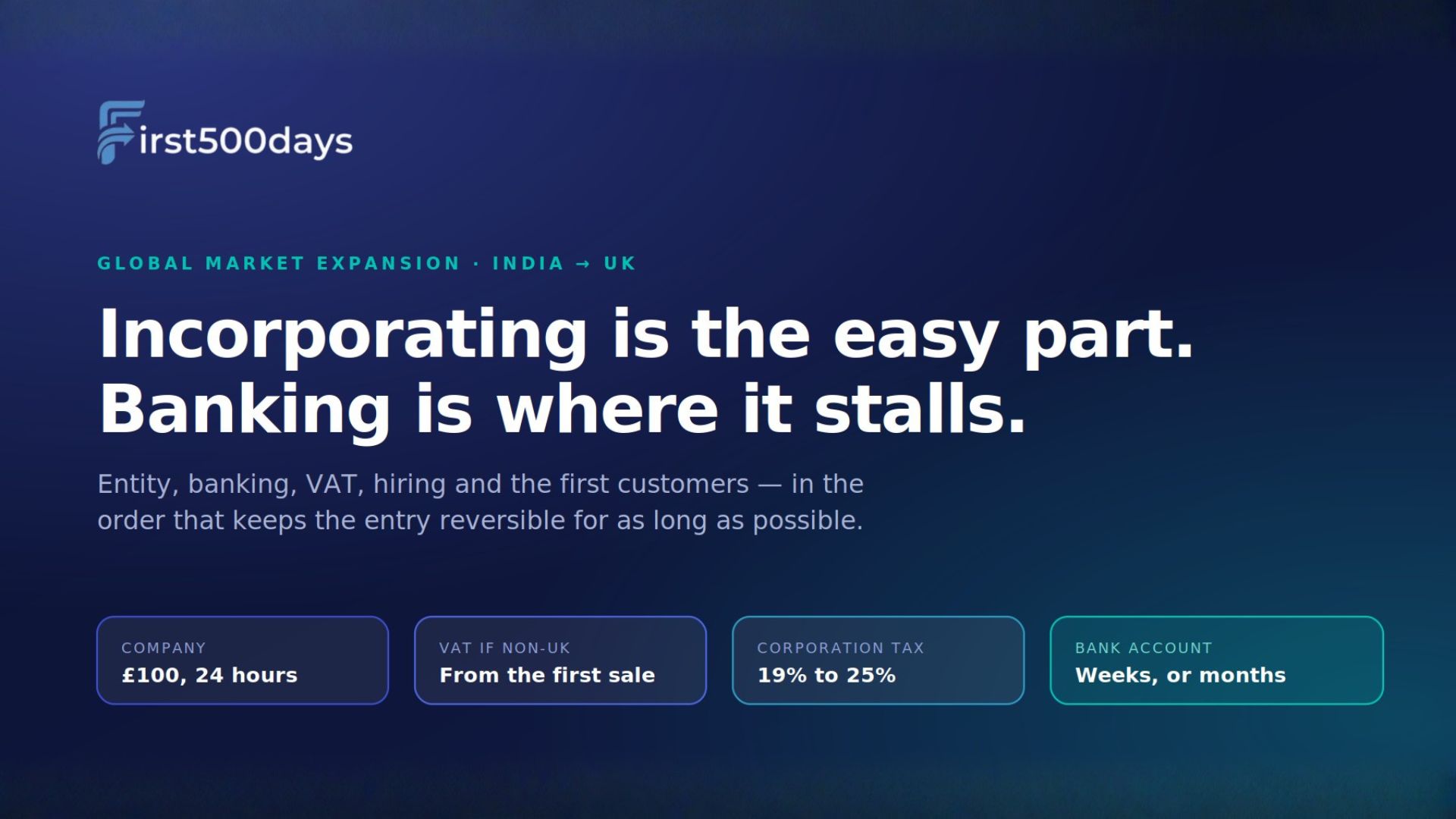
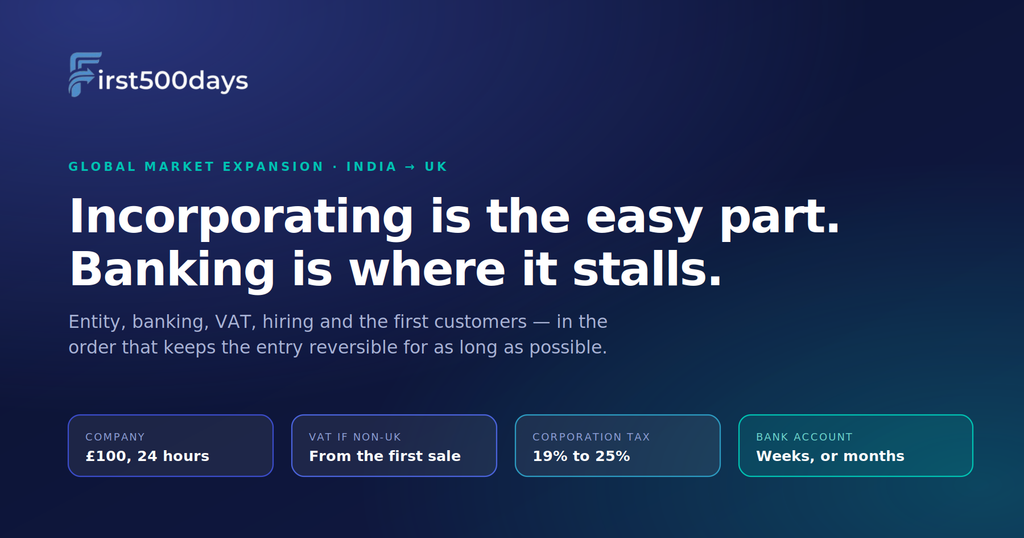
Registering a UK company takes a day and costs £100. Everything after that — banking, VAT, hiring, and actually finding customers — is where the corridor gets expensive. Here is the sequence that keeps it cheap for as long as possible.
General information, not tax or legal advice
Every figure below was checked against GOV.UK at the time of writing and is linked in the sources. Thresholds and rates change with each Budget, and your position depends on your specific circumstances. Verify before acting, and take professional advice on tax, employment and immigration.
To enter the UK from India: validate with twelve UK buyers, sell cross-border from your Indian entity to prove demand, then incorporate, open banking, and register for VAT and PAYE as required — and only then hire. A UK company costs £100 and registers in about 24 hours. Opening a bank account with no UK-resident director is the step that actually determines your timeline.
The four numbers
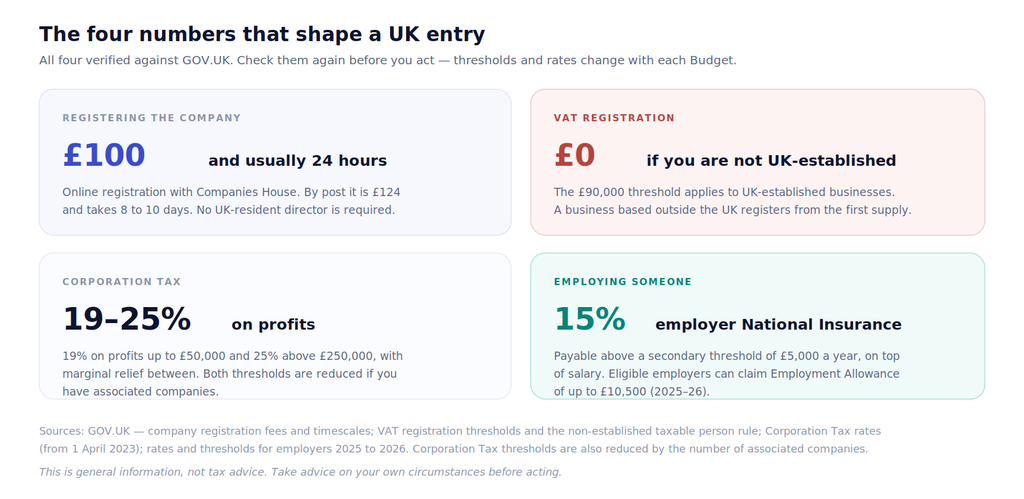
The one that surprises people is the second. The £90,000 VAT registration threshold applies to businesses established in the UK. If your business is based outside the UK and you supply goods or services to the UK, HMRC’s guidance is that you must register regardless of turnover — effectively from the first supply.[2] Indian companies selling into the UK from India routinely assume they have £90,000 of headroom and do not.
The rules for non-established taxable persons have their own detail and exceptions, so this is one to check against HMRC’s own notice or with an adviser rather than to assume in either direction.
Company or branch?
| UK limited company | UK establishment of the Indian company | |
|---|---|---|
| What it is | A separate UK legal entity you own | A registered presence of the existing Indian company |
| Liability | Contained within the UK company | Sits with the parent |
| How buyers read it | A UK supplier | A foreign supplier with a UK address |
| Filing burden | UK accounts for the UK company | Parent accounts may become publicly filed in the UK |
| Usually chosen when | You intend to trade, hire and build locally | A limited, temporary or representative presence |
For most Indian startups selling into the UK, a private limited company is the straightforward answer. It is cheap, fast, well understood by buyers and banks, and it contains risk. The branch route occasionally suits businesses with specific tax or group reasons — and those reasons should come from an adviser who has seen your structure, not from an article.
Two practical points on incorporation. There is no requirement for a UK-resident director, so an all-India board can register a UK company. And you will need a UK registered office address, which can be a service address — though as the next section explains, that choice affects more than your post.
Banking: the step that decides your timeline
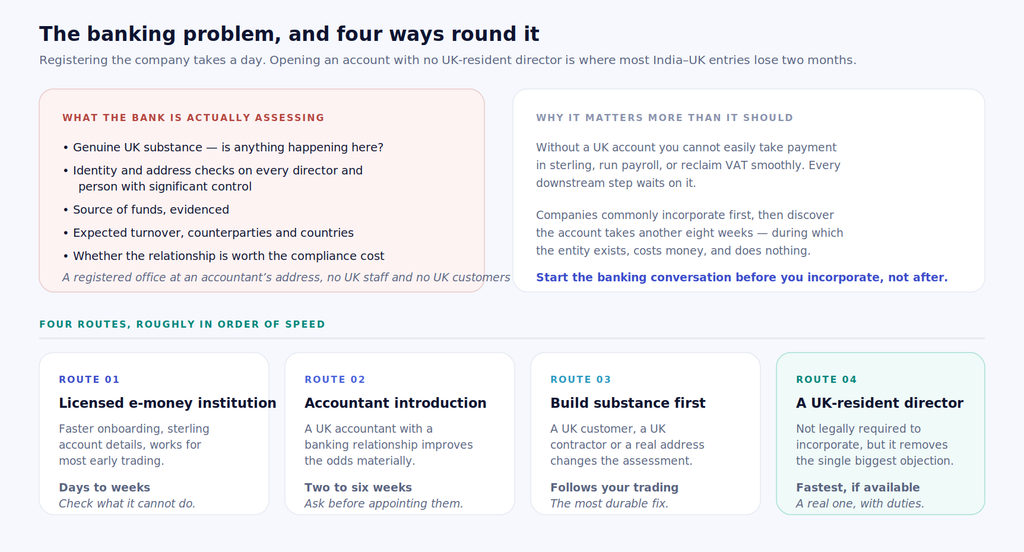
This is the single most common stall in the India–UK corridor, and it catches competent, well-funded companies. The company exists, the accountant is appointed, the website says “UK” — and there is nowhere for sterling to land.
What changes the outcome is substance. A company with a UK customer, a UK contractor, a real address and a coherent explanation of where money comes from is a different proposition from a shell with a mail-forwarding address and no UK activity. This is the strongest practical argument for the sequence in this article: sell first, and the banking conversation becomes much easier, because you can point at an invoice.
Start the banking conversation before you incorporate. An entity waiting eight weeks for an account is a cost with no offsetting activity.
The sequence
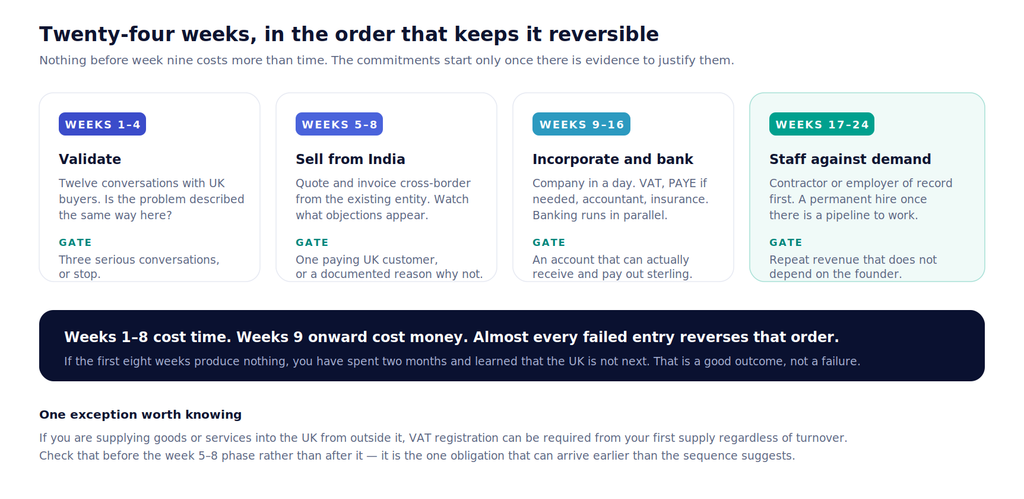
The part founders resist is weeks 5–8: selling into the UK from the Indian entity before any UK presence exists. Two objections come up, and both are worth testing rather than assuming.
“UK buyers won’t contract with an Indian company.” Sometimes true, and highly variable by sector, deal size and buyer. Enterprise procurement and the public sector often do require a local entity; smaller businesses and many technology buyers frequently do not. You find out by trying, and the answer shapes everything downstream.
“We’ll look less credible.” Possibly. But a UK entity with no customers, no staff and a mail-forwarding address is not obviously more credible — and it costs money every month. Credibility comes faster from a named UK reference customer than from a company number.
What year one actually costs
Setting aside people and marketing, the compliance and infrastructure base for a UK entity is modest and predictable: incorporation, a registered office and service address, an accountant for statutory accounts and corporation tax, VAT filing if registered, payroll if you employ anyone, and business insurance where your contracts require it.
The costs that move the total are the ones founders under-model: the first UK salary including 15% employer National Insurance above the £5,000 secondary threshold, and UK customer acquisition, which is almost always more expensive than the India equivalent because nobody has heard of you.
The two-country tax question
Once you have entities in both countries, transfer pricing, permanent establishment and withholding all become live questions — particularly if the UK company sells while the Indian company does the work. The India–UK double taxation agreement governs much of this. It is genuinely complex, entirely manageable with advice, and expensive to retrofit. Raise it with an adviser at incorporation rather than at your first UK year end.
Hiring your first UK person
Three routes, in ascending order of commitment. A contractor is fastest and appropriate for genuinely independent work — but employment status in the UK is determined by how the relationship actually operates rather than by what the contract says, and getting it wrong carries liability. An employer of record employs the person compliantly on your behalf and suits testing a market with one or two people. Your own payroll makes sense once you have several people or need the direct relationship, and requires PAYE registration with HMRC.
On what to hire first: for most India–UK entries it is a commercial person rather than a technical one, because engineering usually stays in India and the gap is local credibility and access to buyers. That person is easier to hire, easier to judge, and easier to justify once there is a pipeline for them to work.
Finding the first UK customers
The mechanics are the same as any early customer acquisition, with three corridor-specific adjustments.
- Read the politeness correctly. British business communication is indirect. “That’s very interesting, let me come back to you” is frequently a no. Ask for a specific next step with a date, and treat its absence as the answer.
- Expect procurement and security questions earlier. Data location, GDPR posture, insurance and references come up sooner in UK B2B than many Indian founders expect. Prepare the answers before the question, because being unprepared reads as risk.
- Use associations and events as the route in. Industry bodies, trade associations and sector events are more established as commercial channels in the UK than cold outreach, which converts poorly relative to a warm introduction from a body the buyer already belongs to.
Six mistakes specific to this corridor
- Incorporating first. The entity is the cheap part and the least useful. It should follow evidence, not precede it.
- Assuming the £90,000 VAT headroom applies. If you are not UK-established, it generally does not.
- Treating the bank account as an afterthought. It is the constraint on your timeline. Start it early and build substance in parallel.
- Pricing by conversion. Converting your India price into sterling at spot rate produces a number that is either implausibly cheap or accidentally expensive. Price against what the problem costs a UK buyer.
- Ignoring the tax relationship between the two entities. Transfer pricing and permanent establishment are cheap to get right at the start and costly to fix later.
- Hiring a UK country head before there is demand. An expensive way to discover whether buyers want the product, and their failure will be indistinguishable from the market’s.