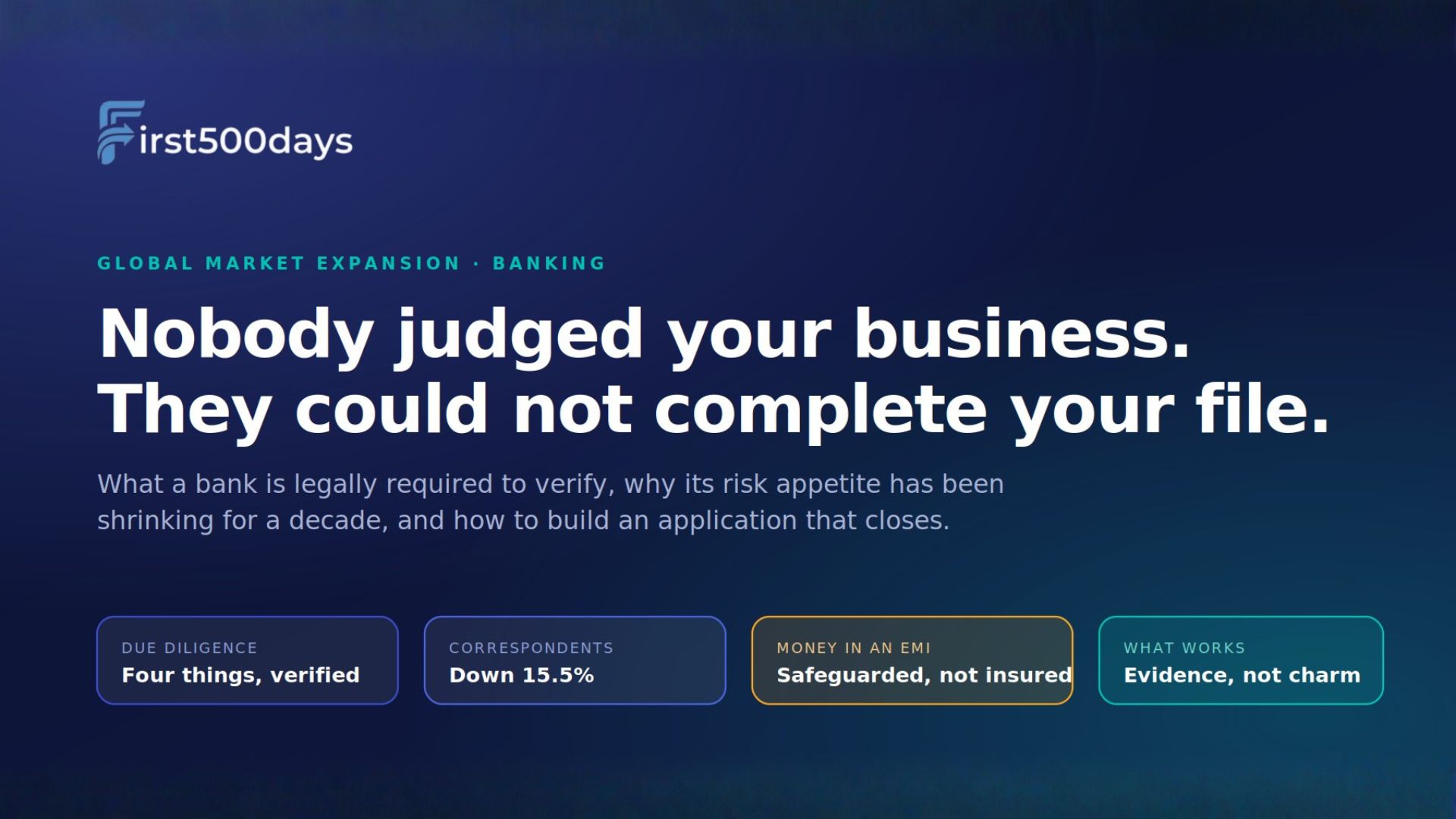
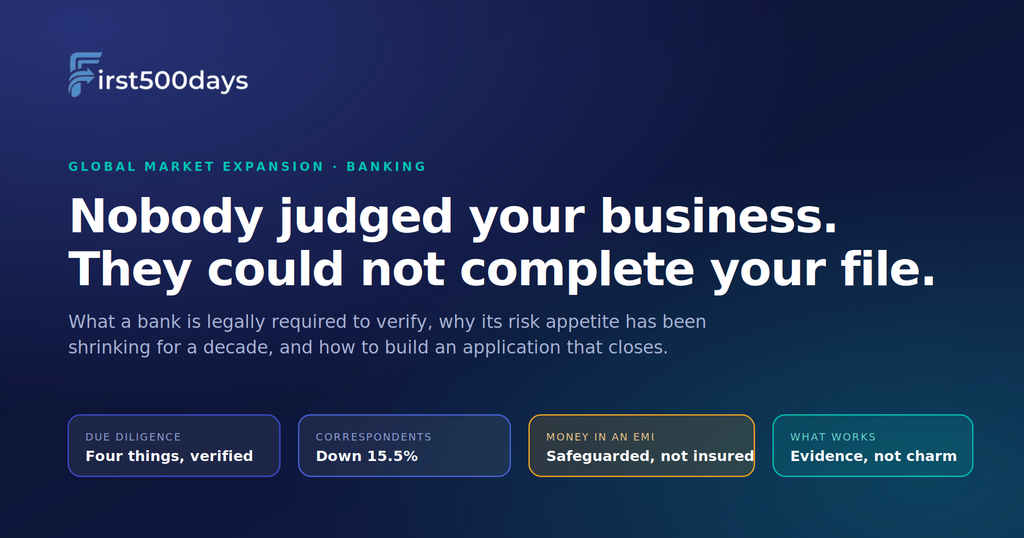
Almost nobody rejected your business. They failed to complete a file they are legally required to complete, in a market where the number of institutions willing to hold that file has been shrinking for over a decade.
General information, not legal or financial advice
The requirements below come from the FATF standards, national implementation of them, and each institution’s own risk policies — which differ and are not published. Nothing here is a promise that a particular application will succeed, and no arrangement described here should be entered into to obscure who owns or controls a business.
Banks are required to identify and verify you, identify your beneficial owners, understand what the account is for, and monitor whether your behaviour matches what you told them. If they cannot complete those measures, the standard says they should not open the account. Meanwhile the number of correspondent banking relationships worldwide has fallen sharply, so the institutions that remain can be selective. The fix is almost never persuasion. It is building a file that can be completed, and having enough genuine local substance to make completing it worthwhile.
What is actually happening on the other side
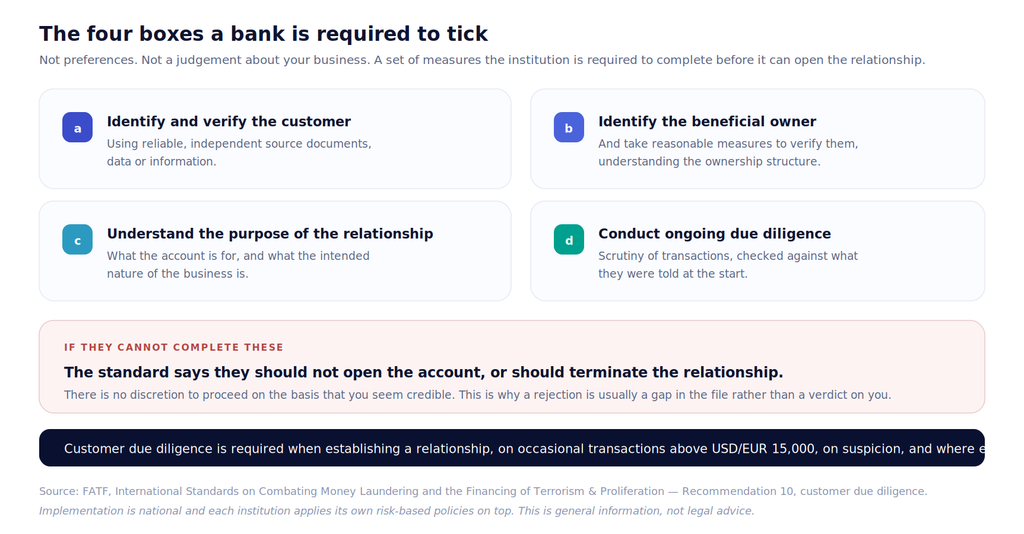
The FATF standards require financial institutions to undertake customer due diligence comprising four measures: identify and verify the customer using reliable, independent source documents; identify the beneficial owner and take reasonable measures to verify them, including understanding the ownership structure; understand the purpose and intended nature of the business relationship; and conduct ongoing due diligence, scrutinising transactions against what the institution knows about the customer.[1]
Those measures are required when establishing a business relationship, on occasional transactions above USD/EUR 15,000, where there is suspicion of money laundering or terrorist financing, and where the institution doubts data it obtained earlier.[1]
And the consequence of not being able to complete them is explicit: the institution should not open the account or commence the relationship, or should terminate it, and should consider filing a suspicious transaction report.[1]
There is no box on the form for “seems like a real business, we’ll proceed.” If a measure cannot be completed, the answer is no by default.
This is why rejection letters are so unhelpfully vague, and why founders read them as a judgement on the business. In most cases the letter is describing a file that could not be closed, and the institution is not obliged — and in some circumstances not permitted — to tell you which part failed.
And why the door was narrower than you expected
The second half of the explanation has nothing to do with your application at all.
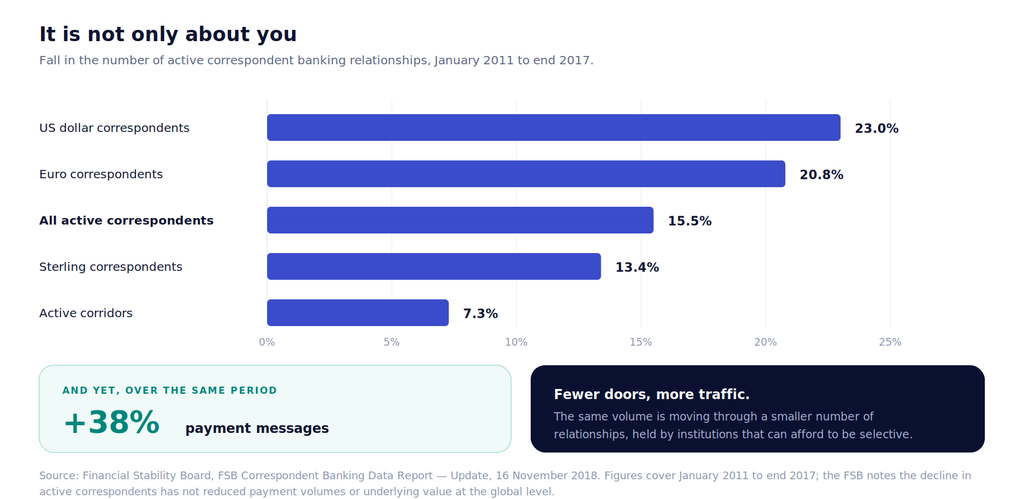
Between January 2011 and the end of 2017, the number of active correspondent banking relationships worldwide fell by 15.5%, and the number of active corridors by 7.3%. The decline was steepest in exactly the currencies a cross-border business needs: US dollar correspondents fell 23%, euro correspondents 20.8%, and sterling correspondents 13.4%.[2]
Over the same period the volume of payment messages rose 38%.[2] The same traffic, moving through fewer doors.
The industry term for this is de-risking: institutions exiting relationships, corridors and customer categories whose compliance cost or risk profile is no longer worth the revenue. It is a decision made about a category, not about you, and the practical consequence is that a bank assessing a first-time foreign applicant with modest expected volumes is often weighing a real compliance cost against a small and uncertain return.
Two things follow from that, and both are useful.
First, your file is competing against the bank’s cost of processing it. Anything that makes the file cheaper to complete — a clean ownership chart, documents that do not expire next month, answers given before they are asked — genuinely improves your odds. This is not a trick; it is the actual economics of the decision.
Second, the corridor matters as much as the company. Some country combinations carry more scrutiny than others regardless of the business, and no amount of polish changes the category. Knowing that early lets you pick institutions with a track record in your corridor rather than working through a list alphabetically.
The file that gets approved
Most rejected applications are not missing something exotic. They are missing something ordinary, requested by email, supplied three weeks later, by which point the file has aged and something else has expired.
Assemble the whole pack before you apply.
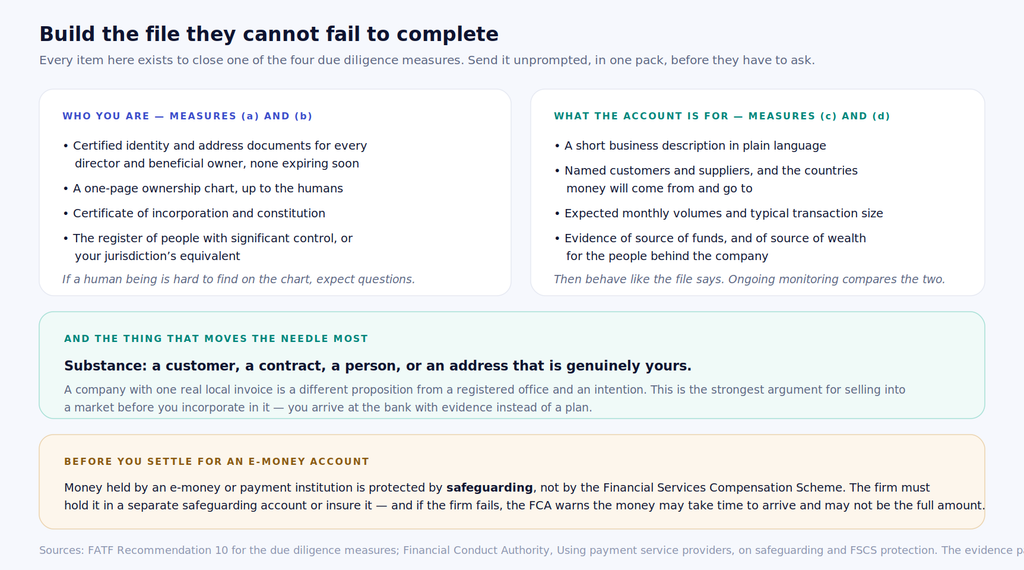
For measures (a) and (b) — who you are. Certified identity and address documents for every director and beneficial owner, none close to expiry. A one-page ownership chart that resolves all the way up to named human beings. Certificate of incorporation and constitutional documents. Your register of people with significant control, or whatever your jurisdiction calls its equivalent. If a human being is hard to find on your ownership chart, expect questions, and prepare the answer rather than hoping the chart is not read closely.
For measures (c) and (d) — what the account is for. A short description of the business in plain language, not marketing copy. Named customers and suppliers, and the countries money will actually come from and go to. Expected monthly volumes and typical transaction sizes. Evidence of source of funds, and where relevant source of wealth for the individuals behind the company.
Then behave the way the file says you will. Measure (d) is ongoing monitoring, and it compares your actual transactions with what you described at onboarding. An account that was opened to receive payments from three named UK customers and immediately starts receiving from a dozen unrelated jurisdictions will attract attention, and the attention arrives after your money is already in the account.
The thing that moves the needle most
Substance. A real customer, a real contract, a real person, a real address.
A company with one genuine local invoice is a materially different proposition from a company with a registered office and an intention, because the invoice answers questions (c) and (d) in a way a business plan cannot. This is the strongest practical argument for the sequence we recommend across every market in this series: sell first, incorporate second. You arrive at the bank with evidence rather than with a plan.
Before you settle for an e-money account
The usual workaround for a stalled bank application is an account with an electronic money institution or payment institution. They onboard faster, they are used to foreign-owned companies, and for a great many early-stage businesses they work perfectly well. Two things are worth understanding before you treat one as your bank.
The protection is different. Money held by an EMI or payment institution is protected by safeguarding rather than by the Financial Services Compensation Scheme. The firm must either hold your money in a separate safeguarding account with a bank or protect it with insurance or a comparable guarantee. If the firm fails, the FCA’s own guidance notes that the money may take some time to reach you and may not be the full amount, because costs can be taken by the administrator or liquidator.[3]
The capabilities are different. Ask specifically what the account cannot do — direct debits, certain payment schemes, cash, lending, holding client money if your business requires it. Discovering a gap after you have built billing around the account is expensive.
Used deliberately, an EMI is a good bridge: it lets you trade while a bank relationship is built. Used by default, it is a decision nobody made.
What not to do
Three shortcuts circulate in founder communities, and all three make the underlying problem worse.
- Nominee shareholders to simplify the ownership chart. The requirement is to identify the beneficial owner. An arrangement whose purpose is to make the beneficial owner harder to see is the specific thing the standard exists to prevent, and being on the wrong side of it is far worse than a rejected application.
- Applying everywhere at once. Multiple simultaneous applications produce inconsistent files and multiple records of declines, and inconsistency is itself a flag.
- Adjusting the description of the business to match what you think they want. Ongoing monitoring compares behaviour to the file. A description you cannot live up to creates a problem that surfaces later, with your money inside.
A practical sequence
- Start before you incorporate. Ask two or three institutions what they need from a company like yours, in your corridor, before the entity exists.
- Choose on corridor experience, not brand. Ask directly: do you onboard companies owned from this country, in this sector, at this size? A specific no now is worth more than a slow no later.
- Ask a local accountant for an introduction. In several markets this materially changes the outcome, and it is worth asking about before you appoint one.
- Build substance in parallel. A local customer or contractor while the application is pending is the highest-leverage thing you can do.
- Bridge with an EMI, deliberately. Keep trading while the bank relationship is built, knowing what it does and does not protect.
- Keep the pack fresh. Documents expire, structures change, and a stale file restarts the process.