Every formation agent competes on how quickly they can register your company. It is the wrong race. Three clocks run in a market entry, the legal one is the shortest, and fast means overlapping them rather than compressing any of them.
What is sourced here, and what is not
The registration times below are official and are sourced in the market articles they link to. The end-to-end ranges and the reference plan are First500days planning estimates from our own engagements — they are not published research, and we have labelled them as estimates wherever they appear. Your timeline will depend on your sector, your deal size and your structure.
Registering a company takes about a day in the UK and Singapore and a few days in the US and UAE. A realistic end-to-end entry — from decision to repeat local revenue — is three to six months in almost all of them. The difference is not the registration; it is banking, which takes weeks to months, and finding customers, which takes as long as it takes. Fast entries start the slow clocks early. Slow entries run them in sequence.
Three clocks, running at once
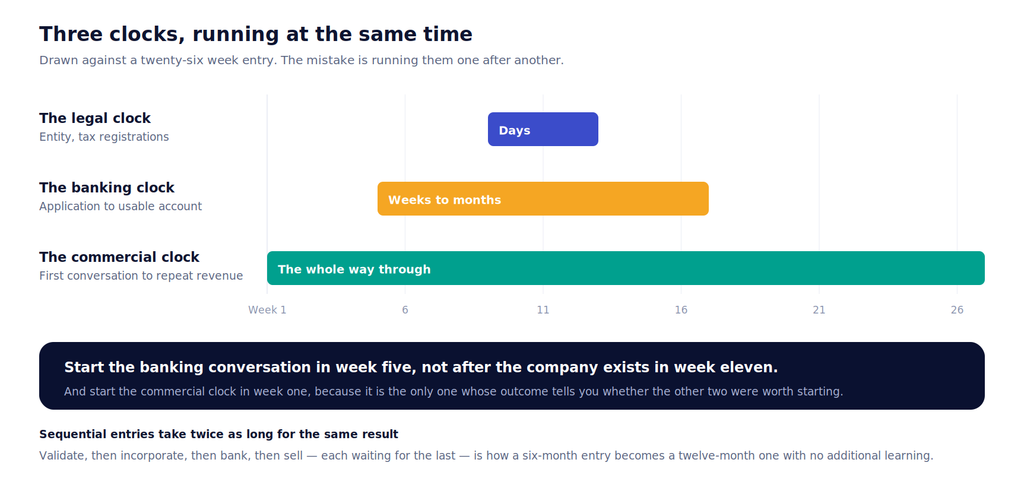
The legal clock is the one everyone measures. Entity, tax registrations, statutory appointments. It runs in days once the inputs are ready, and it is the only clock a formation agent can affect.
The banking clock runs in weeks to months and gates your ability to receive money. It is the constraint on most entries, and the crucial fact about it is that it does not have to start after the legal clock finishes. The conversation can begin before the entity exists.
The commercial clock runs from your first conversation with a buyer to repeat revenue that does not depend on the founder. It is the longest, the only one that matters, and the one most often started last — after the entity is registered, the bank account is open, and several months of costs have been incurred against no evidence at all.
Start the banking conversation in week five, not in week thirteen. And start the commercial clock in week one, because it is the only one whose outcome tells you whether the other two were worth starting.
Market by market
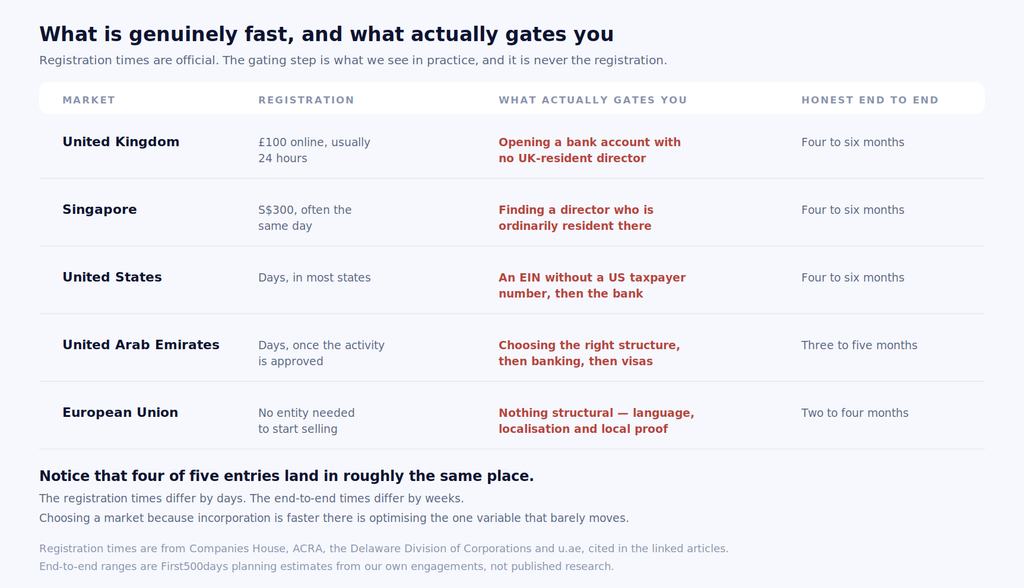
The United Kingdom is the fastest to register: £100 online and usually within 24 hours. What gates a foreign-owned entry is banking with no UK-resident director, which is where entries in this corridor routinely lose two months.
Singapore incorporates for S$300, often the same day — but only once you have a director who is ordinarily resident there. For a founder with no Singapore connection, that requirement, not the filing, is the timeline.
The United States registers in days in most states. Then a foreign-owned company needs an EIN, which cannot be obtained through the online tool without a US taxpayer number, and a bank account that waits on the EIN.
The UAE issues a licence in days once the activity is approved. The real sequence is structure first — free zone or mainland, which determines who you can sell to — then banking, then visas, each dependent on the last.
The European Union is the outlier, because you do not need an entity to start selling into it at all. Nothing structural gates you. What gates you is language, localisation and having a customer there who will speak for you.
The pattern is worth stating plainly: four of the five land in roughly the same place. Registration times differ by days; end-to-end times differ by weeks. Choosing a market because incorporation is faster there is optimising the one variable that barely moves.
A reference plan
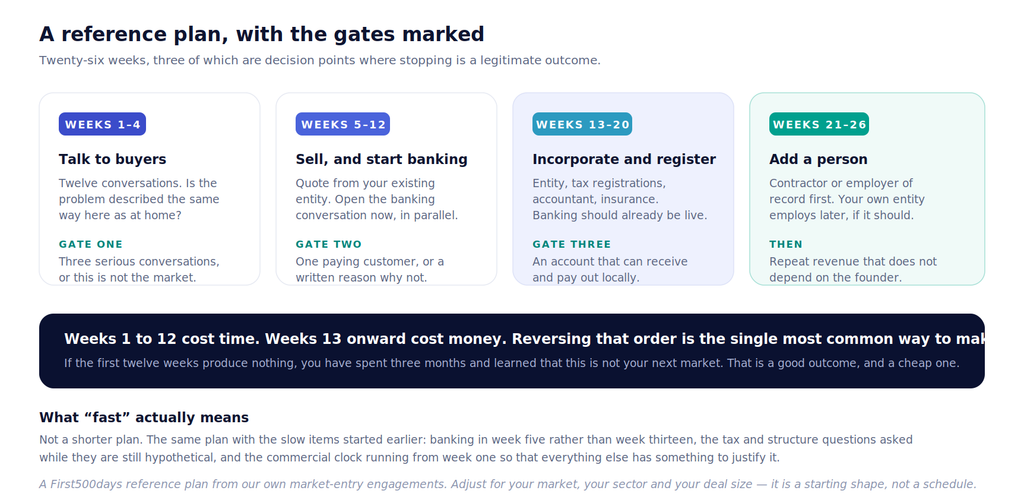
The shape matters more than the specific weeks. Weeks one to twelve cost time; weeks thirteen onward cost money. Reversing that order — incorporating first, then looking for customers — is the single most common way to make an entry both slow and expensive.
Notice what happens at each gate. If the first four weeks produce no serious conversations, this is not your next market, and you have spent a month finding that out. If weeks five to twelve produce no paying customer and no written explanation for why not, the same conclusion applies with more confidence. Stopping at either point is a good outcome. It is only a failure if you have already bought the entity.
What actually makes an entry slow
- Sequential thinking. Waiting for each step to finish before starting the next. Banking, tax advice and customer conversations can all run in parallel with everything else.
- Deciding structure late. In markets where the structure determines who you can sell to — the UAE most obviously — a late structural decision invalidates the work that preceded it.
- Discovering a requirement after committing. A resident director, a taxpayer number, an activity that needs a different licence. All knowable in week one and expensive in week ten.
- Waiting for a perfect first hire. The search takes months and often delays revenue that did not need a local employee to begin with.
- Nobody owning the entry. Distributed across three people who each have another job, an entry drifts, and drift is the largest single cause of slowness in our experience.
And what genuinely speeds it up
- Selling before you incorporate. It starts the longest clock first and produces the evidence that makes banking easier.
- Opening the banking conversation before the entity exists. Ask two or three institutions what they need from a company like yours, in your corridor, in week five.
- Asking the structure and tax questions while they are hypothetical. Permanent establishment, transfer pricing and entity choice are cheap conversations in advance and expensive ones in arrears.
- One named owner, with time allocated. Not a committee, and not somebody’s twenty per cent.
- Written gates with dates. Agreed in advance, so that stopping is a decision the team already sanctioned rather than an admission.
Why we publish ranges rather than a number
The end-to-end figures in the table are ranges from our own engagements, and we have labelled them as estimates deliberately. A single number would be more persuasive and less true: entry timelines vary with your sector, your deal size, whether you need a licence, whether anyone on your team already knows the market, and how quickly your own organisation makes decisions. Use the ranges to set expectations internally, then build your own plan against the gates rather than against the calendar.