
Converting your home price at the spot rate is not a pricing decision. It is the absence of one. Here are the four approaches that exist, the two constraints that decide whether yours survives, and how to change a price without punishing the customers you already have.
Price against what the problem costs a buyer in each market, not against your own cost or your home price. Four approaches exist — one global price, a purchasing-power adjustment, value in the market, and regional bands — and each is right in different circumstances. Two things constrain whichever you pick: arbitrage, and the customers you already have. And in the EU there is a rule about how you differentiate, though not about how much.
Why the same number is not the same price
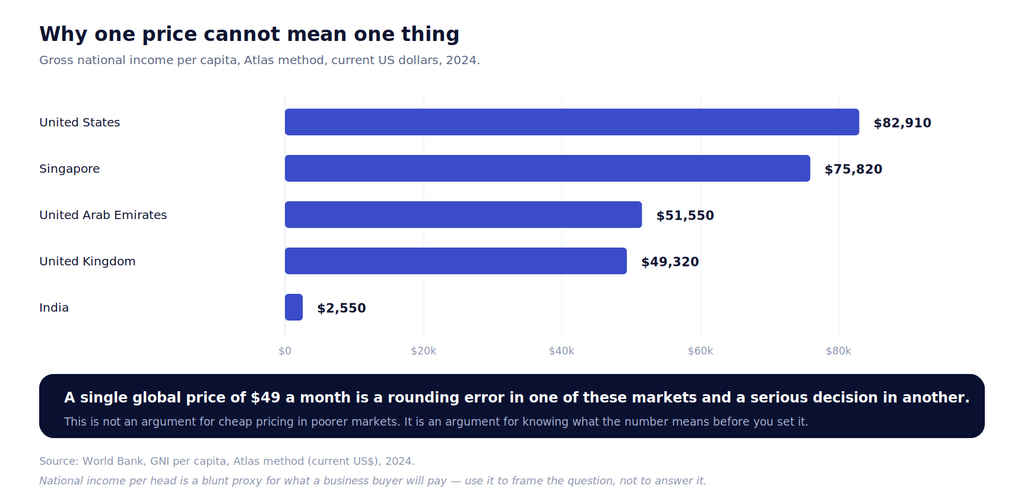
Gross national income per capita in 2024 was $82,910 in the United States, $75,820 in Singapore, $51,550 in the UAE, $49,320 in the UK and $2,550 in India.[1]
The US figure is roughly thirty-two times the Indian one. That does not tell you what to charge — national income per head is a poor proxy for what a business will pay, particularly a well-funded software company buying a tool that saves engineering time. What it does tell you is that a single global number lands in wildly different places, and that anyone treating “$49 a month” as a fixed quantity is treating a variable as a constant.
This is not an argument for cheap pricing in poorer markets. It is an argument for knowing what the number means in each of them before you set it.
The four approaches
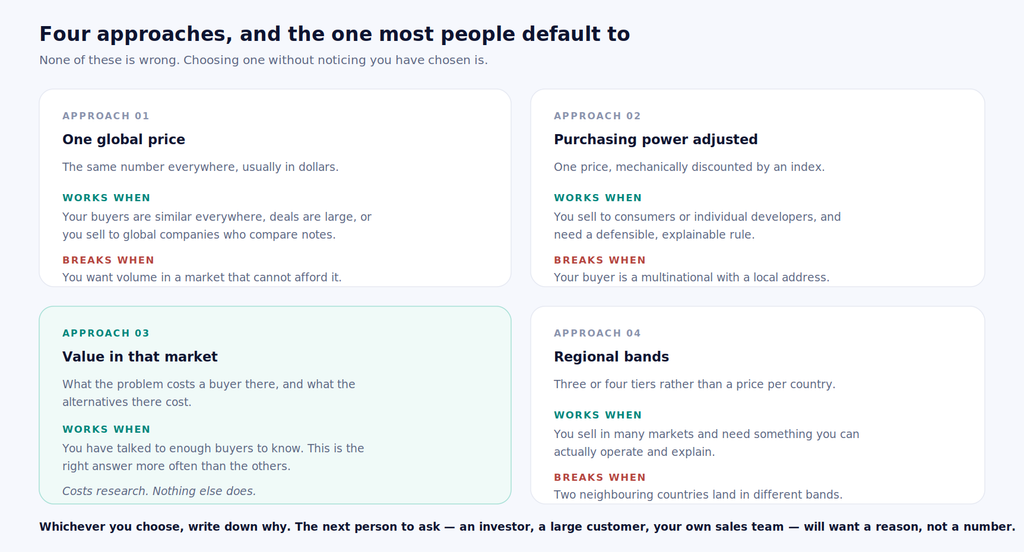
One global price is the default, and it is genuinely right for some businesses. If your buyers look similar everywhere, if deals are large, or if you sell to multinationals whose procurement teams compare notes across subsidiaries, a single price is simpler, more defensible, and eliminates the arbitrage problem entirely. It breaks when you want volume in a market that cannot support the number.
Purchasing power adjustment applies a mechanical index to a base price. It is explainable, feels fair, and works reasonably well for consumer products and for tools bought by individuals. It breaks when your buyer is a multinational with a local billing address, because the index says “India” and the buyer’s budget says something else entirely.
Value in that market is the right answer more often than the other three, and the least used, because it requires research rather than a formula. What does this problem cost a buyer here? What do the alternatives here cost? What does a purchase of this size require by way of approval? Ten conversations with local buyers will get you closer than any index.
Regional bands — three or four tiers rather than a price per country — are the pragmatic compromise once you are in more markets than you can research individually. They are operable and explainable. They break at the borders, when two neighbouring countries land in different bands and someone notices.
Whichever you choose, write down why. An investor, a large customer, or your own sales team will eventually ask, and a reason is worth more than a number.
The two constraints
Arbitrage
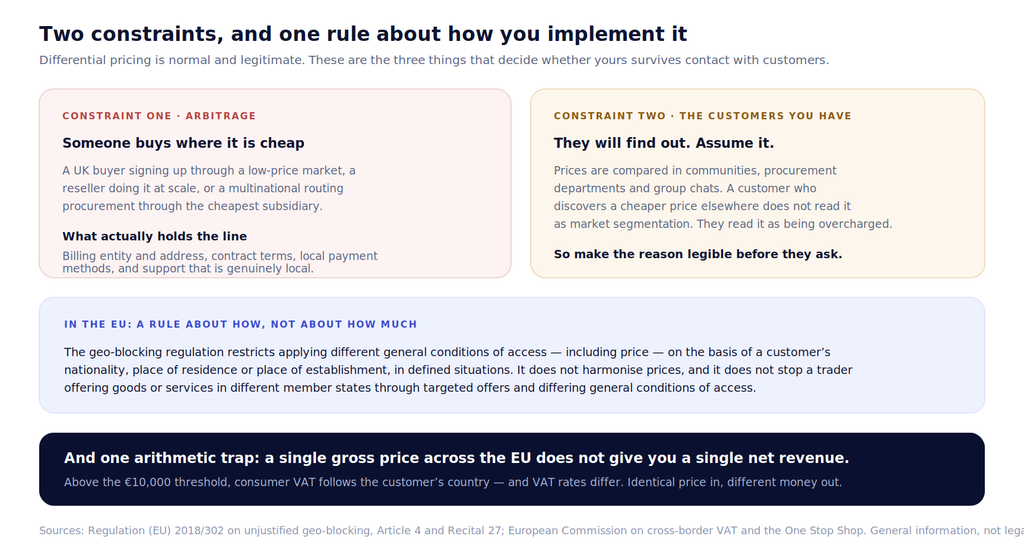
If the same product is materially cheaper somewhere, someone will buy it there. A UK buyer signing up through your India pricing page. A reseller doing it at volume. A multinational routing procurement through whichever subsidiary sits in your cheapest band.
Geographic gates alone do not hold. What actually holds the line is a combination of things that are hard to fake: the billing entity and its address, contract terms that specify where the product may be used, local payment methods that a foreign buyer cannot easily use, and support that is genuinely local and genuinely part of the value.
The most robust defence is to make the cheaper offer genuinely different rather than merely cheaper. Different support hours, different terms, different feature set, different contracting process. Then the price difference is a product difference, which is both easier to defend and easier to explain.
The customers you already have
Assume they will find out, because they will. Prices circulate in communities, in procurement departments and in group chats, and a customer who discovers a lower price in another market does not experience it as segmentation. They experience it as having been overcharged.
The defence is the same: make the reason legible before they ask. If the difference reflects genuinely different terms, support or scope, say so on the pricing page rather than waiting to explain it in an awkward email. If it does not reflect anything except willingness to pay, expect the conversation to be difficult, because the honest answer is one nobody enjoys hearing.
The EU rule about how, not how much
The geo-blocking regulation restricts applying different general conditions of access — which includes price — on the basis of a customer’s nationality, place of residence or place of establishment, in a set of defined situations.[2]
What it does not do is harmonise prices. The regulation is explicit that the prohibition should not be understood as preventing traders from offering goods or services in different member states through targeted offers and differing general conditions of access.[2]
In practice: you may run different prices in different EU markets. What you should take advice on is the mechanism — how a customer reaches each offer, whether they are blocked or redirected on the basis of where they are, and what happens when someone in one member state wants to buy from another country’s site. That is a legal question with real detail, and it is worth an hour of a lawyer’s time before you build the pricing page rather than after.
A piece of arithmetic that catches people
A single gross price across the EU does not produce a single net revenue. Above the €10,000 EU-wide threshold, VAT on cross-border consumer sales follows the customer’s country — and rates differ between member states. If you display one tax-inclusive number everywhere, your margin varies by country without you deciding that it should. Decide whether you are holding the gross price constant or the net revenue constant, because you cannot hold both.
Changing a price without damaging trust
Most pricing work in an expansion is not setting a new price. It is changing an existing one, usually upwards, usually after discovering the first number was too low.
- Grandfather existing customers, and say so loudly. The cost is a smaller price rise. The return is that your earliest customers — the ones who took the risk — are visibly rewarded rather than punished.
- Give notice in months, not weeks. Anyone with a budget cycle needs time, and the ones who need time most are the ones you least want to lose.
- Change one thing at a time. A price rise and a repackaging in the same release makes it impossible to tell which caused the churn.
- Explain what changed on your side. More support, more capability, a local presence. “Our costs went up” is not a reason a customer is obliged to care about; “you now get this” is.
- Expect a churn spike, and measure it against your model. A rise that loses some customers and increases revenue is a success. Judge it on the aggregate, not on the loudest email.
Six mistakes
- Converting at the spot rate. Produces $49 → some arbitrary local number that means nothing to anyone.
- Pricing from cost. Your costs are not the buyer’s problem, and they do not vary the way the market does.
- Discounting to enter. Whatever you launch at is the reference price for that market. Discounting entry buys volume you cannot keep.
- Assuming a lower price is what a market needs. Often the missing thing is local proof, local terms or a local invoice, not a lower number.
- Running different prices with identical products. Difficult to defend and easy to arbitrage. Make the offer different, not just the price.
- Never revisiting it. A price set at entry, when you knew least about the market, should not still be running two years later.