
Every government fee in this article is public, sourced and linked. None of them is what compliance costs. The number that matters is the recurring one, and this is an honest explanation of why nobody publishes it — including us.

General information, not tax or legal advice
Every figure below is sourced to a government website and linked at the end. Rates, thresholds and filing fees change, sometimes annually. Your own obligations depend on your entity type, registrations, activity and headcount. Verify before acting and take local advice.
Registering a company costs £100 in the UK, S$315 in Singapore, and a variable amount in Delaware and the UAE. Those figures are real and almost irrelevant. Year-one compliance cost is dominated by three things nobody publishes: mandatory appointments, recurring professional services, and anything triggered by employing a person. This article gives you the verified public numbers, then the structure of the rest, and explains how to get a real quote instead of a guess.
The part that is public
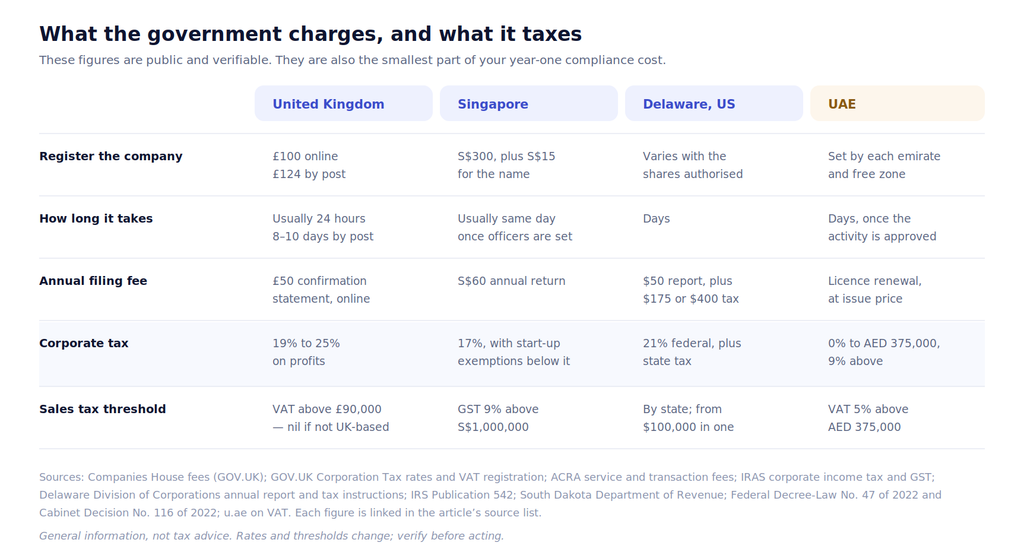
A few of these deserve comment, because the headline number is not the useful one.
The UK is the cheapest and fastest to register — £100 online, usually within 24 hours, or £124 by post taking eight to ten days.[1] The annual confirmation statement is £50 online.[1] Corporation tax runs from 19% on profits up to £50,000 to 25% above £250,000, with marginal relief between.[2]
The UK VAT threshold has an exception that matters more than the threshold. The £90,000 figure applies to UK-established businesses; if your business is based outside the UK and you supply goods or services to the UK, registration can be required regardless of turnover.[3] Budgeting for “no VAT until £90,000” is a common and expensive planning error.
Singapore looks cheap and has a mandatory appointment attached. S$15 for the name, S$300 to incorporate, S$60 a year for the annual return.[4] But at least one director must be ordinarily resident in Singapore, and a locally resident company secretary must be appointed within six months.[5] For a foreign founder, that requirement is usually a larger annual line than every government fee combined.
Delaware’s cost is annual rather than upfront. $50 for the annual report plus franchise tax from $175 under the authorised shares method or $400 under the assumed par value capital method, due by 1 March, with a $200 penalty and 1.5% monthly interest if missed — plus a registered agent, which is compulsory.[6][7]
The UAE genuinely has no published figure, and it is worth saying so rather than inventing a range. Licence costs are set by each emirate and each free zone, vary by activity and visa count, and are discounted in year one in a way they are not in year two. What is public is the tax: 0% on taxable income up to AED 375,000 and 9% above, and VAT at 5% with mandatory registration above AED 375,000.[8][9]
The part that is not
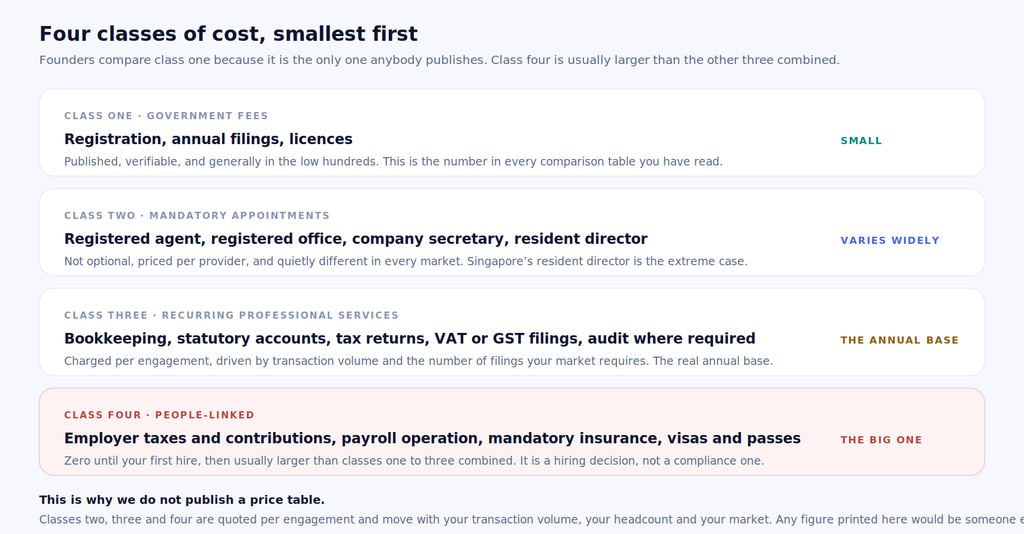
There are four classes of compliance cost, and they are wildly different in size.
Class one is government fees. Published, verifiable, low hundreds. This is the entire content of most comparison articles.
Class two is mandatory appointments. A registered agent in Delaware. A resident director and a company secretary in Singapore. A registered office nearly everywhere. These are not optional and not free, they are priced per provider, and they differ enormously between markets in a way that never shows up in a fee table.
Class three is recurring professional services. Bookkeeping, statutory accounts, the corporate tax return, VAT or GST filings, and an audit where one is required. This is the real annual base, and it scales with your transaction volume and with how many separate filings your market demands.
Class four is anything triggered by employing someone. Employer taxes and contributions, payroll operation, mandatory insurance, visas and work passes. It is zero until your first hire and then usually larger than the other three combined.
Class four is a hiring decision, not a compliance decision. Which is exactly why it should not be buried inside a compliance budget where nobody argues with it.
Count the obligations, not the fees
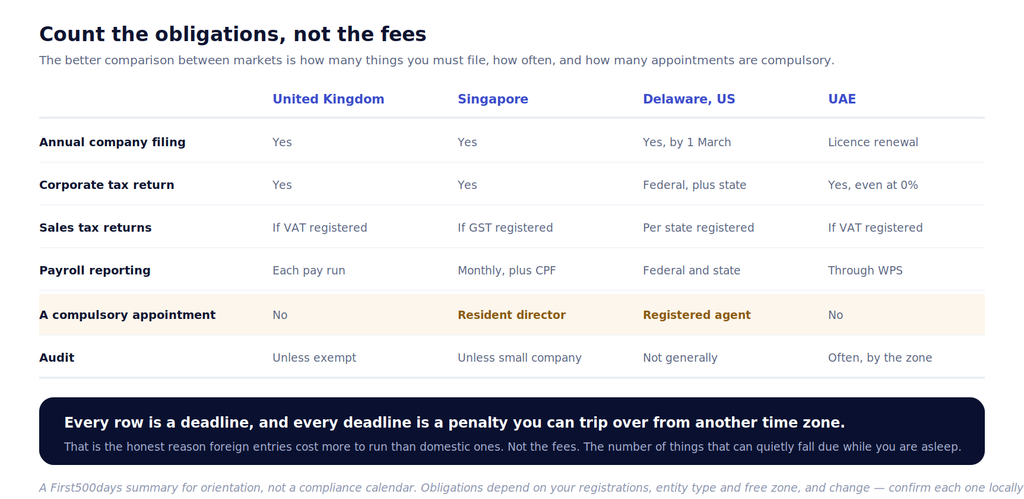
If you want one comparison that predicts the annual cost better than any fee table, count the recurring obligations. Every filing is a deadline, every deadline carries a penalty, and every penalty is one you can trip over from another time zone while you are asleep.
That is the honest reason foreign entities cost more to run than domestic ones. Not the fees. The number of separate things that can quietly fall due in a jurisdiction where you have no one watching the calendar.
Two rows in that comparison are worth pulling out. Singapore’s resident director is the single most consequential mandatory appointment in this set, because it can be the reason an entry does not happen. And corporate tax filing at a 0% rate in the UAE catches people who assume a zero rate means nothing to submit — it does not.
Why we do not publish a price table
Every article you find with a title like this one ends in a table of numbers. We have not written one, and the reason is not modesty.
Classes two, three and four are quoted per engagement. They move with your transaction volume, your headcount, your activity, your free zone, the month you ask, and whether the provider is discounting to win the work. A number printed here would be someone else’s quote, from some point in the past, presented as if it were yours. It would be more confident than a range and less useful.
What is worth publishing is the government layer, because it is public and stable enough to be checked — which is what the first graphic does, with every figure linked.
How to get a real number instead
Ask three providers in your target market the same five questions, in writing:
- What is the year-two total, itemised? Not the setup package. Year two has no launch discount and is the number you will live with.
- Which appointments are compulsory here, and what does each cost annually? Registered agent, registered office, company secretary, resident director — whichever apply.
- How many filings will we make in a year, and what is the fee for each? This is the question that exposes the difference between markets.
- At what point do we need an audit, and what would it cost? Thresholds differ, and in some free zones it is required from the start.
- What changes when we hire our first person here? Ask them to quantify it, because this is class four and it dwarfs the rest.
Three written answers to those five questions will tell you more than any published table, and the variance between the three answers tells you something useful about who to work with.
Where the money actually goes in year one
Setting aside the people you hire and the marketing you buy, a first-year budget for a foreign entity has a predictable shape:
- Small and fixed: registration, annual filings, licence renewal.
- Medium and unavoidable: the mandatory appointments your market requires, plus bookkeeping and the annual return cycle.
- Variable and volume-driven: VAT or GST filings, transaction volume, an audit if you cross a threshold or your zone requires one.
- Large and discretionary: everything that follows the first employee, and it is discretionary right up until you hire.
- Unbudgeted and avoidable: penalties. Every market in this article has automatic penalties for late filing, and they are the only line here that is purely self-inflicted.
The last one deserves the emphasis. Late-filing penalties are the most common unnecessary cost in a foreign entity’s first year, and they are entirely a function of nobody owning the calendar. Assign it to a person by name before you incorporate.
Six ways this goes wrong
- Comparing markets on registration fees. It is the smallest class of cost and the least variable.
- Buying a year-one package. The discount is real and so is year two.
- Missing a mandatory appointment. The resident director requirement in Singapore is the one most likely to be discovered late.
- Assuming a zero rate means no filing. Registration and returns are obligations regardless of the rate.
- Planning around a domestic VAT threshold you may not get. If you are not established in the market, it may not apply to you.
- Nobody owning the compliance calendar. This is where the avoidable money goes.