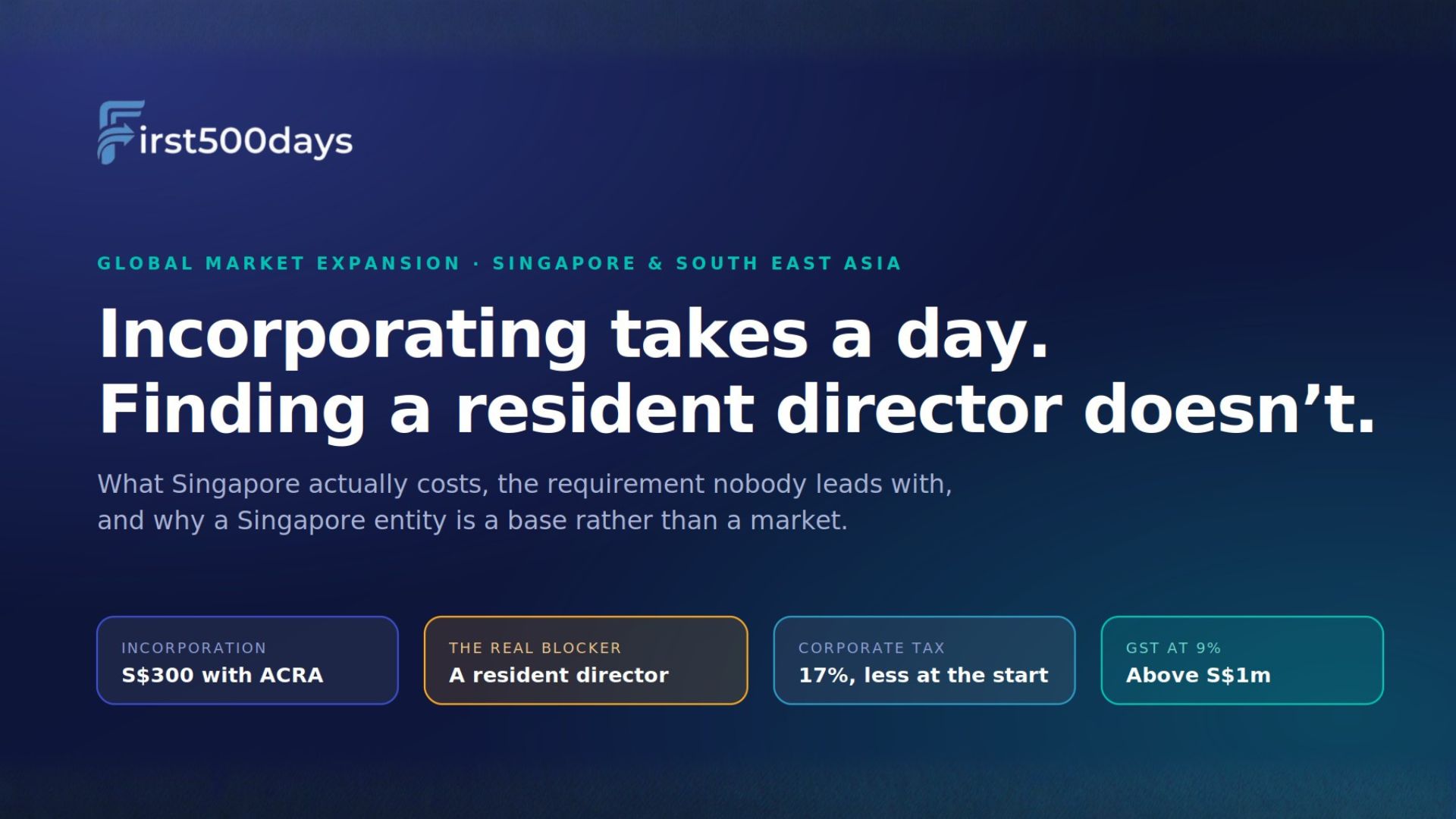
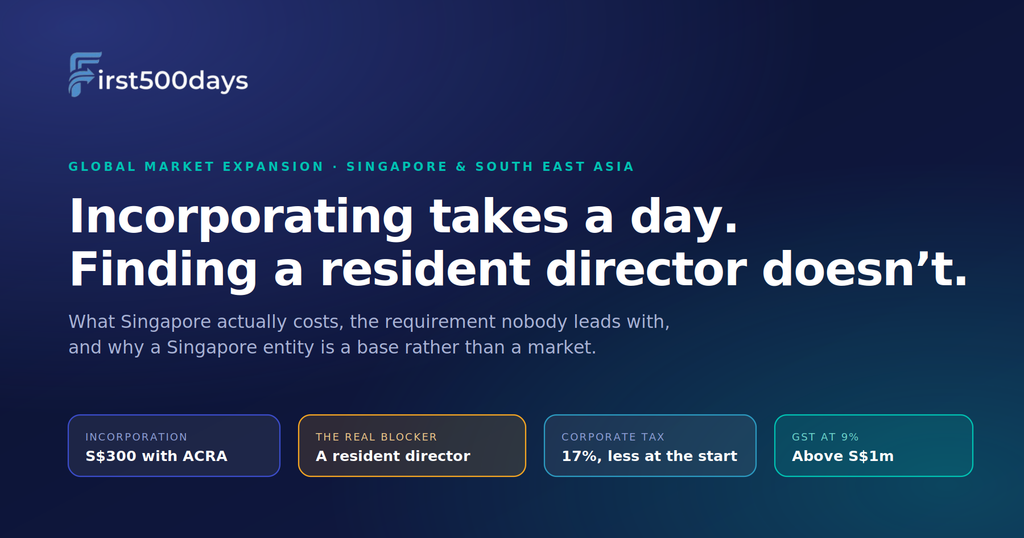
Registering the company takes a day and costs S$300. The requirement that actually determines your timeline is that one of your directors has to be ordinarily resident in Singapore — and most articles on this subject mention it in passing, if at all.
General information, not tax, legal or immigration advice
Every figure and rule below is sourced to ACRA, IRAS, MOM, CPF Board or the Singapore Department of Statistics and linked at the end. Thresholds, pass criteria and rebates change — Employment Pass salary floors are already scheduled to rise. Verify before acting and take advice on your own circumstances.
A Singapore private limited company costs S$15 to reserve a name and S$300 to register with ACRA, and can be incorporated in a day. It must have at least one director ordinarily resident in Singapore, a locally resident company secretary appointed within six months, and a registered office in Singapore. Corporate tax is 17%, but exemption schemes bring an early-stage company’s effective rate closer to 6%. The honest framing of the whole decision: Singapore is an excellent regional base and a very small domestic market.
The requirement that actually gates you
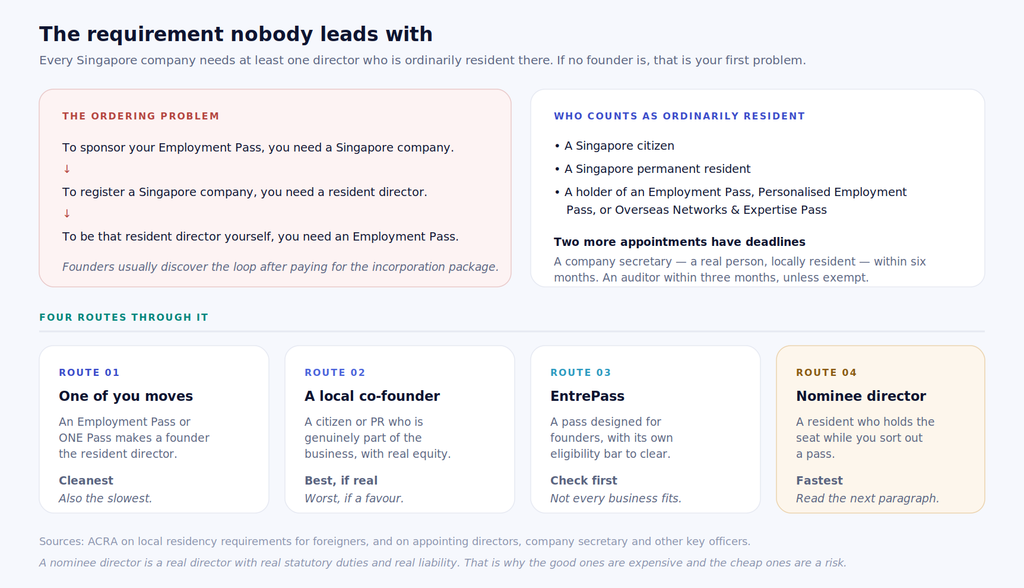
Every Singapore company must have at least one director who is ordinarily resident in Singapore. ACRA defines that as a Singapore citizen, a Singapore permanent resident, or the holder of an Employment Pass, Personalised Employment Pass or Overseas Networks & Expertise Pass.[1]
Read that list again if you are a foreign founder with no Singapore connection, because it produces a loop. To sponsor an Employment Pass you generally need a Singapore company. To register a Singapore company you need a resident director. To be that resident director yourself, you need the pass. Founders routinely discover this after they have paid for an incorporation package, which is a bad moment to discover it.
Two other appointments carry deadlines: a company secretary, who must be a real person and locally resident, within six months of incorporation; and an auditor within three months unless the company is exempt.[2]
On nominee directors
The fastest way out of the loop is to appoint a resident nominee director, and a whole industry exists to sell you one. It can be an entirely legitimate arrangement. It is also the part of Singapore incorporation that deserves the most care, for a reason that has nothing to do with tax.
A nominee director is a real director. The statutory duties and the liability attach to the person in the seat, whatever the side letter says.
That cuts both ways. A serious provider will want to understand your business, will ask questions before signing, will require indemnities, and will charge accordingly — because they are accepting genuine exposure. A provider who asks nothing and charges very little is either not reading your filings or does not intend to be findable when something goes wrong. Ask who the individual is, what else they are a director of, what happens if they resign, and how the arrangement ends when your own pass comes through. Treat it as a temporary bridge with a defined exit, not a permanent feature of the company.
What incorporation actually involves
| Item | What it is | Fee |
|---|---|---|
| Name application | Reserving the company name with ACRA | S$15 |
| Incorporation | Registering the new entity | S$300 |
| Annual return | Filed with ACRA each year | S$60 |
| Resident director | Citizen, PR or pass holder | Your largest variable |
| Company secretary | A real person, locally resident, within 6 months | Usually outsourced |
| Registered office | A Singapore address | Usually bundled |
The government fees are trivial and public.[3] Everything that costs real money is a service: the corporate secretarial provider, the nominee arrangement if you need one, accounting, tax filing, and eventually payroll. Budget for the services, not the filing fees, and ask for annual pricing rather than a setup quote — the same discipline that applies in Dubai applies here.
The tax picture, with the arithmetic shown
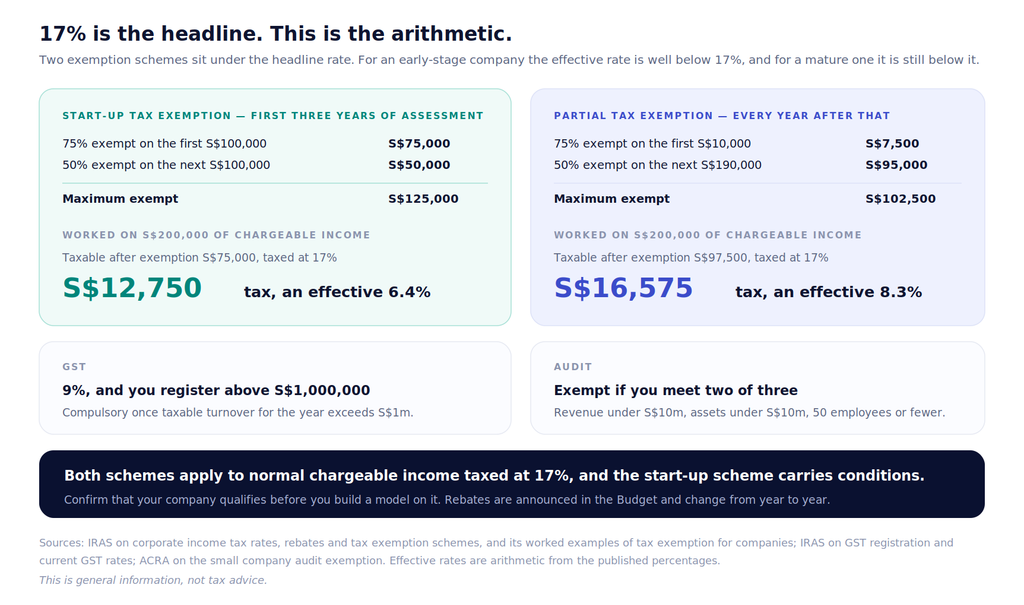
Singapore’s corporate income tax rate is 17%.[4] Very few young companies pay anything close to it, because two exemption schemes sit underneath.
For a qualifying new company, the Start-up Tax Exemption exempts 75% of the first S$100,000 of normal chargeable income and 50% of the next S$100,000, for the first three years of assessment — up to S$125,000 exempt.[5] After that the Partial Tax Exemption exempts 75% of the first S$10,000 and 50% of the next S$190,000, up to S$102,500.[5]
Work it through on S$200,000 of chargeable income. Under the start-up scheme, S$75,000 remains taxable, which at 17% is S$12,750 — an effective rate of 6.4%. Under partial exemption, S$97,500 remains taxable, which is S$16,575, or 8.3%. Those are the numbers that make Singapore attractive, and they are considerably more interesting than the headline rate that gets quoted.
Two caveats worth stating plainly. The start-up scheme has conditions and excludes certain kinds of company, so confirm yours qualifies before building a model on it. And corporate income tax rebates are announced in the Budget and change from year to year — treat any rebate you read about as something to verify for the current year of assessment rather than as a standing feature.
Beyond corporate tax: GST is 9%, with compulsory registration once taxable turnover exceeds S$1,000,000.[6] Audit is not required if the company is private and meets at least two of three criteria — revenue of S$10m or less, assets of S$10m or less, and 50 or fewer employees — for the past two consecutive financial years.[7] For most startups that means no audit, which is a real saving.
People, and why nobody in Singapore is cheap
This is where the cost base bites, and the system is deliberately designed to make you think about it.
If you hire a foreigner, an Employment Pass currently requires a minimum qualifying salary of S$5,600 a month for the youngest applicants, or S$6,200 in financial services, rising with age. Those floors go up for new applications from 1 January 2027 — to S$6,000 and S$6,600 at the youngest band, reaching S$11,500 and S$12,700 at age 45 and above — and for renewals from 1 January 2028.[8] Salary is only the first stage: candidates must also score 40 points under the COMPASS framework, which weighs qualifications, the firm’s workforce diversity and its share of local employment.[8]
If you hire a Singapore citizen or permanent resident, there is no pass to obtain, but employer CPF contributions apply — 17% for employees aged 55 and below, on ordinary wages up to a monthly ceiling of S$8,000 from 1 January 2026.[9] Employers do not pay CPF for foreign employees on work passes.[10]
Put those together and the design intent is clear. Hiring a foreigner means clearing a salary floor and a points test that rewards employing locals. Hiring a local means CPF on top of salary. There is no configuration in which Singapore is the cheap option, and expansion plans built on the assumption that it might be are the ones that stall in month nine.
Singapore is a base, not a market
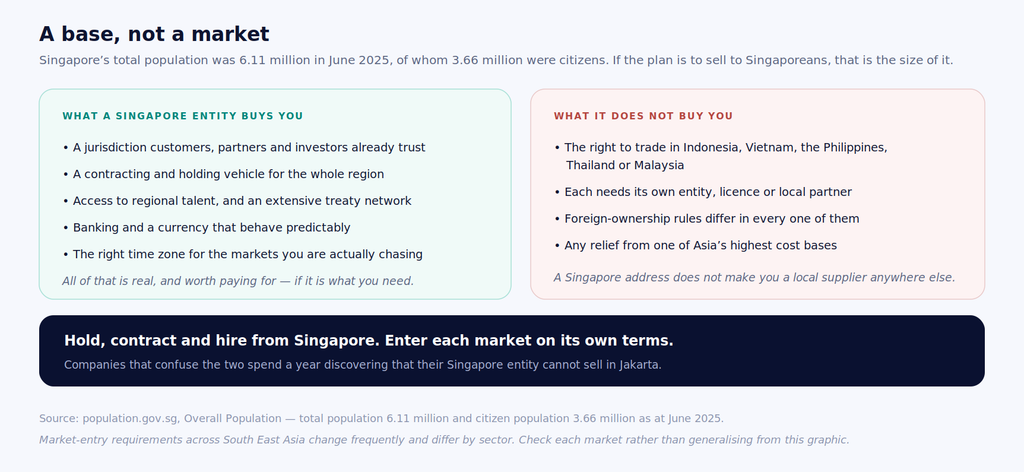
Singapore’s total population was 6.11 million in June 2025, of whom 3.66 million were citizens.[11] It is a wealthy, sophisticated, English-speaking market and there are businesses for which it is a genuinely good target. But if your plan says “expand to Singapore” and means “sell to Singaporeans”, you should know the size of the prize before you commit to one of Asia’s highest cost bases to chase it.
The reason serious companies incorporate there is different: it is a base. A jurisdiction that customers, partners and investors already trust. A contracting and holding vehicle for the region. Access to regional talent and an extensive treaty network. Banking that works. The right time zone for the markets you are actually chasing.
What it is not is a licence to trade anywhere else. A Singapore entity gives you no right to operate in Indonesia, Vietnam, the Philippines, Thailand or Malaysia. Each of those requires its own entity, licence or local partner, each has its own rules on foreign ownership, and each has to be entered on its own terms. Companies that confuse the base with the market spend a year discovering that their Singapore company cannot sell in Jakarta.
A sequence that keeps this reversible
Sell into the region from your existing entity first, and find out which market responds. Incorporate in Singapore when you have a reason that survives being written down — a contract that requires a local counterparty, an investor who requires the jurisdiction, a hire who requires sponsorship. Then treat each downstream market as its own entry decision, with its own validation, rather than as a rollout from the hub. The order matters more than the jurisdiction.
Six mistakes we see in this corridor
- Incorporating before solving the director question. It is the actual constraint. Solve it first, on paper, before anyone pays a fee.
- Buying the cheapest nominee arrangement available. You are asking a stranger to accept statutory liability for your company. Price is the wrong primary filter.
- Modelling on the 17% headline rate. It overstates the tax for an early-stage company by a wide margin and makes your projections wrong in the direction of pessimism.
- Assuming a rebate you read about still applies. Rebates are Budget measures. Check the current year of assessment.
- Budgeting Singapore salaries at regional rates. Pass floors and CPF both push the real cost up, deliberately.
- Treating the hub as market access. The Singapore entity is a base. Every South East Asian market is a separate entry, with its own rules and its own validation.