
Companies enter new markets with products that work, teams that are competent and budgets that are adequate, and fail anyway. The causes are consistent, they are visible early, and almost all of them could have been caught for the cost of a few weeks and some uncomfortable conversations.
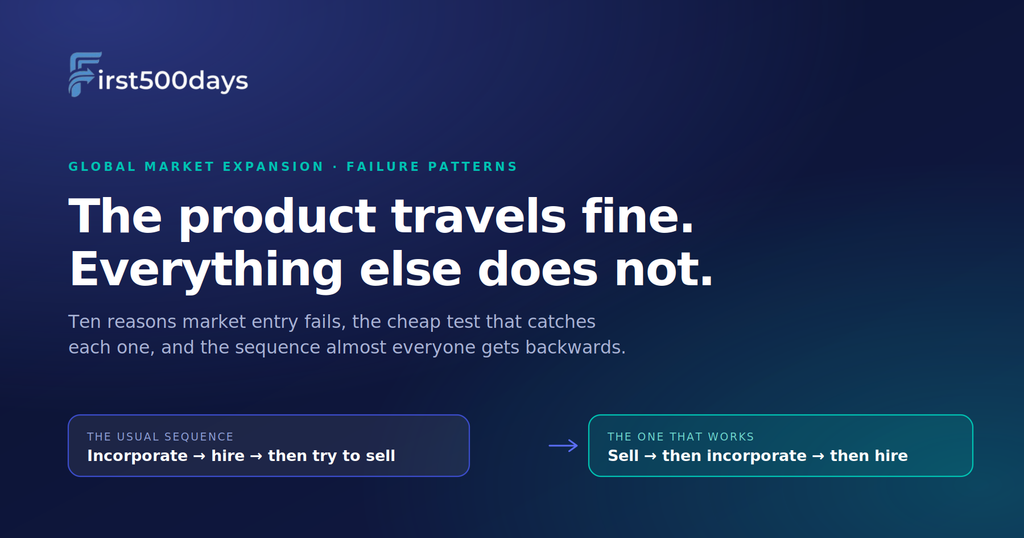
International expansion fails on market selection, customer understanding, regulatory surprises, pricing, distribution, acquisition cost, local hiring, premature scaling, fragmented execution, and an inability to raise problems internally — roughly in that order of frequency. The product is rarely the issue. What fails is everything the product sits inside, and the reason it fails so expensively is that most companies commit before they test.
That sequencing error is the thing worth fixing. Nearly every failure below is survivable if it surfaces before an entity, a lease and a country manager exist.
The ten failures, and what would have caught each one
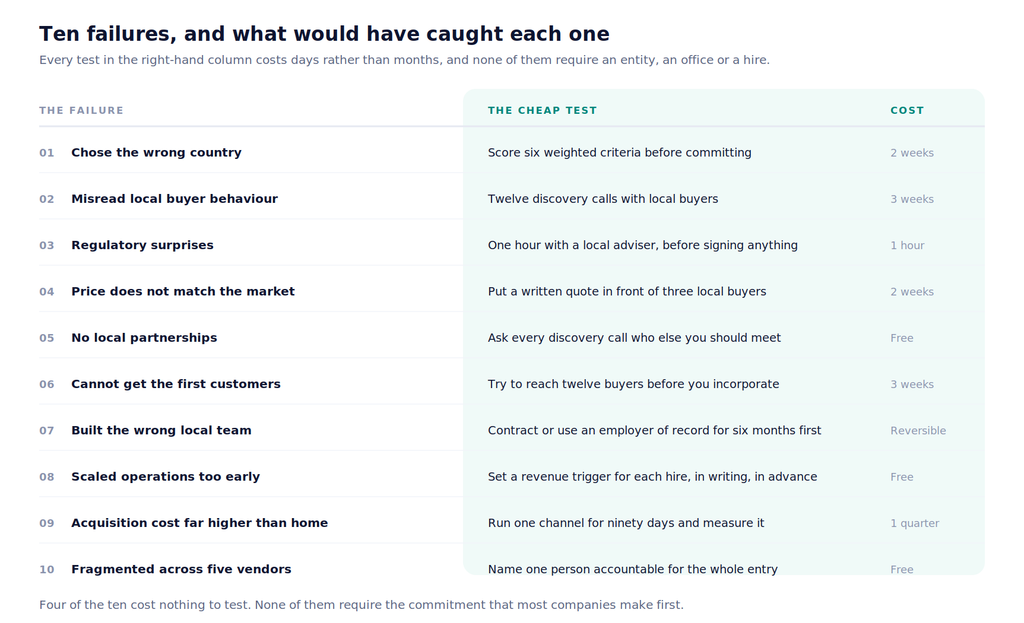
Three of these are worth expanding, because they behave differently abroad than at home.
Misreading local buyer behaviour (2). The most dangerous version is not that buyers say no. It is that they say something that sounds like yes. Politeness norms differ sharply: in some markets a soft “we’ll look at it” is a firm refusal, while in others directness that would be rude at home is simply how business is done. Companies build pipelines from misread signals and only discover it at the forecast review two quarters later.
Acquisition cost far above home (9). Founders model revenue by market carefully and acquisition cost barely at all, assuming their home conversion rates travel. They usually do not. Brand recognition, channel maturity, trust in foreign suppliers and local competitive intensity all move the number, and a channel that pays back in three months at home can take a year in a market where nobody has heard of you.
Fragmented execution (10). Five vendors — a lawyer, an accountant, a recruiter, an agency, a developer — each doing their piece competently, with no one accountable for whether the entry works. Every one of them can deliver and the entry can still fail, because the gaps between them are where the decisions live.
The failure is rarely in the work anyone did. It is in the work nobody owned.
What it looks like at scale
The clearest documented example is not a startup, which is precisely why it is instructive: the mechanism is identical at every size, the numbers simply have more zeros.
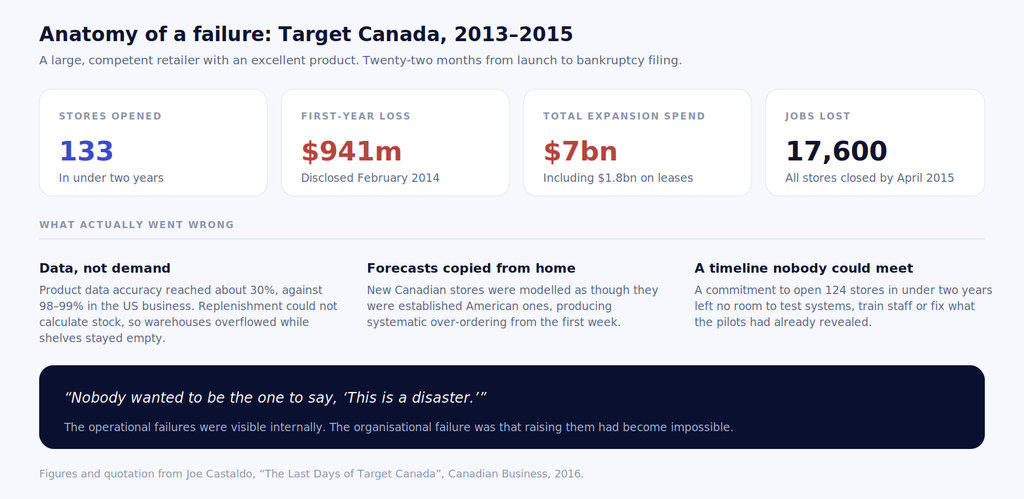
Target entered Canada in March 2013 and filed for bankruptcy protection in January 2015, closing all 133 stores by that April. It had paid $1.8 billion for the Zellers leases in 2011, spent roughly $7 billion in total, disclosed a first-year loss of US$941 million, and 17,600 people lost their jobs.[1]
The product was not the problem. Canadians knew the brand and wanted it. What failed was operational: product data accuracy reached about 30% against 98–99% in the US business, so the replenishment system could not calculate stock and warehouses overflowed while shelves stayed empty. Sales forecasts modelled brand-new Canadian stores as though they were established American ones. And the whole thing ran against a commitment to open 124 stores in under two years, which left no room to fix what testing had already revealed.
The line from that account worth remembering is the organisational one: “Nobody wanted to be the one to say, ‘This is a disaster.’” The operational failures were visible internally. What had broken was the ability to say so.
The eleventh failure
It is not on the list of ten because it is not really about the market. Expansion decisions are announced — to a board, to investors, to staff — and announcements make reversal expensive in reputational terms long before they are expensive in financial ones. Name a review date and a set of conditions when you announce, so that stopping is a planned option rather than an admission.
The sequence almost everyone gets backwards
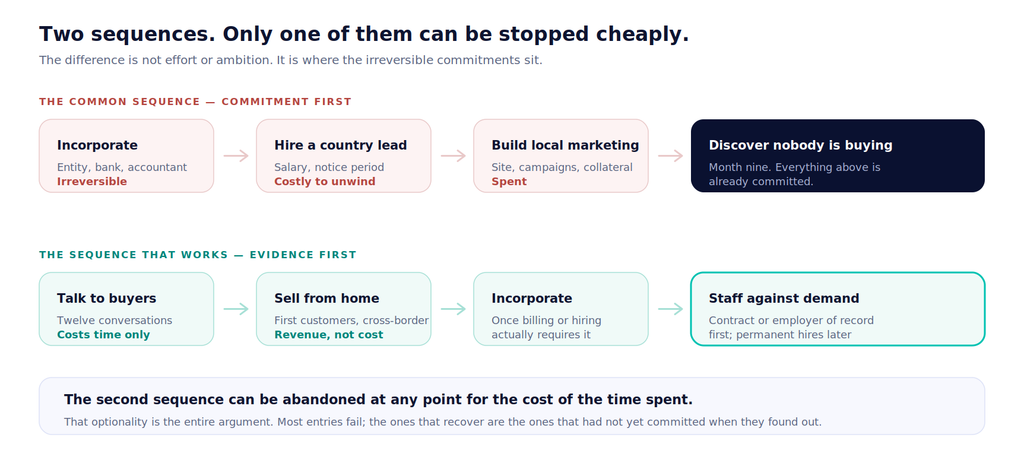
The common sequence puts every expensive, hard-to-reverse decision before the only thing that produces information: trying to sell to someone. By the time a company learns whether buyers in that market want this, it has an entity, an employee with a notice period, and marketing spend it cannot recover.
The alternative is not slower in any meaningful sense. Selling cross-border from your home entity for the first few customers is legal and normal in most markets, and it produces the evidence that makes every subsequent decision cheaper. Incorporation follows when something specific requires it — local billing, a buyer who will not contract with a foreign supplier, or a hire.
The objection is usually that customers will not buy from a foreign entity. Sometimes true, and worth testing rather than assuming: it varies enormously by sector, deal size and buyer type, and in many segments it simply does not come up.
The three questions that predict failure
Asked of any expansion plan, these three surface most problems before they cost anything:
- “Who has said they will buy?” Not who has expressed interest. Who has named a price, a timeframe, or a next step. If the answer is nobody, the entry is a hypothesis with a budget attached.
- “What would make us stop?” If there is no answer, the plan cannot fail — it can only continue. That is not confidence, it is an absence of criteria.
- “Who owns this, and what else are they doing?” Expansion run part-time by someone with a full-time job fails on attention rather than on strategy, and it fails slowly enough that nobody diagnoses it.
What recovery looks like
Most expansions that are struggling are not dead. In our experience three moves account for most turnarounds.
Narrow the segment. Companies enter a country and target the same broad market they serve at home. The recovery is almost always to pick one narrow segment where the fit is strongest and rebuild the entry around it — the same correction that works for product–market fit generally.
Change the route, not the product. When acquisition is failing, teams reach for product changes because that is what they control. Far more often the problem is the route to the buyer — direct where a partner was needed, or advertising where the market buys through relationships.
Get someone local with authority. Not an adviser, not a consultant reporting into headquarters — someone in the market who can make decisions. Entries run entirely from another time zone accumulate small misreadings that nobody is positioned to correct.
Six things to do before committing
- Score the market before you choose it. Weighted criteria, decided in advance, scored by two people.
- Talk to twelve local buyers. The single highest-value fortnight in the whole process.
- Put a price in front of three of them. Willingness to pay does not transfer across borders automatically.
- Buy one hour of local regulatory advice. Before signing anything. It is the cheapest insurance in expansion.
- Name one accountable owner. One person, with the mandate and the time, responsible for the entry as a whole.
- Write down the stop conditions. With a review date, agreed while everyone is still optimistic.