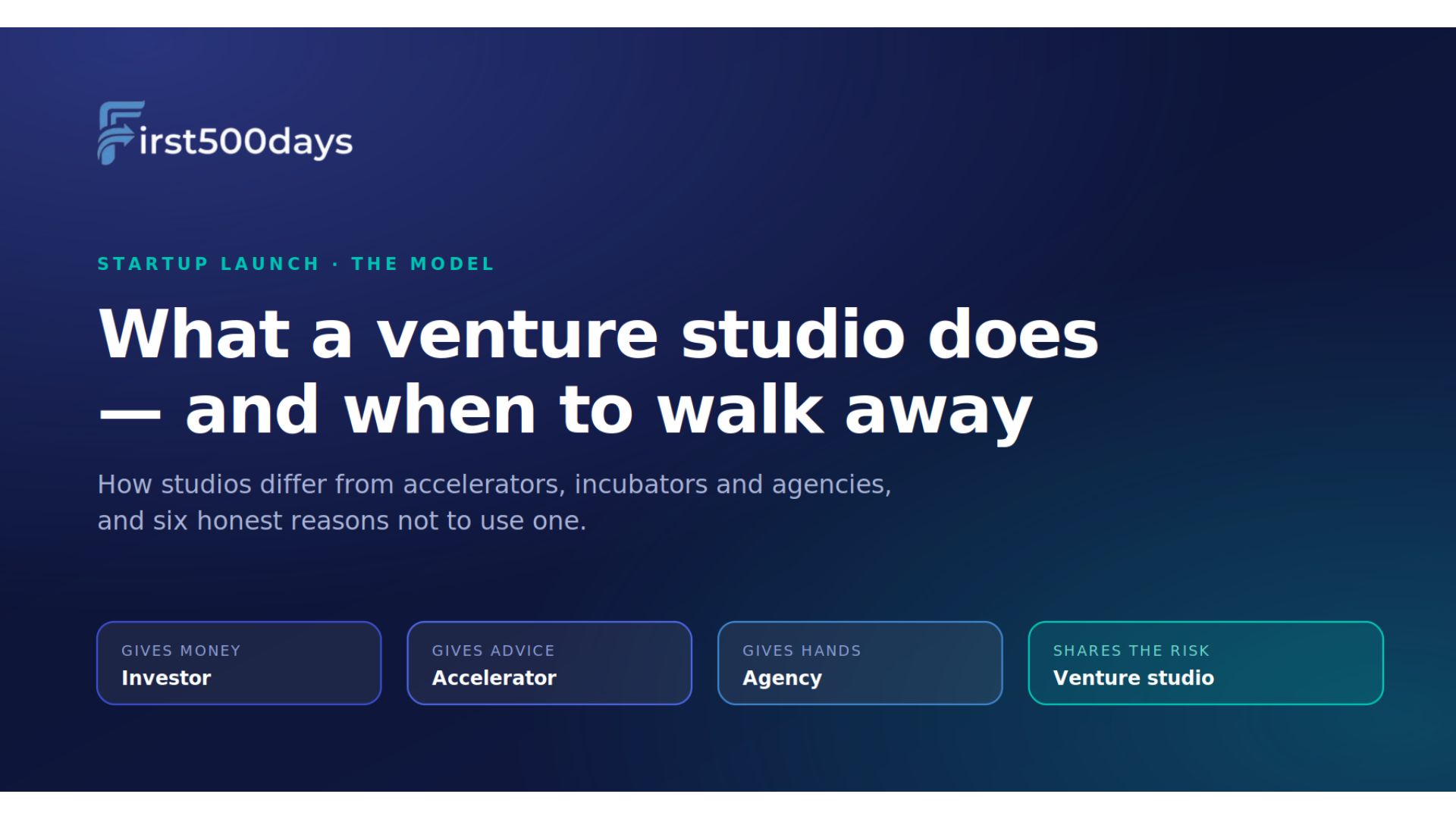
“Venture studio” has been applied to accelerators, agencies and consultancies with a rebrand. Here is what the model actually is, how it differs from the three things it gets confused with, and six honest reasons not to use one — written by a firm that operates as one.
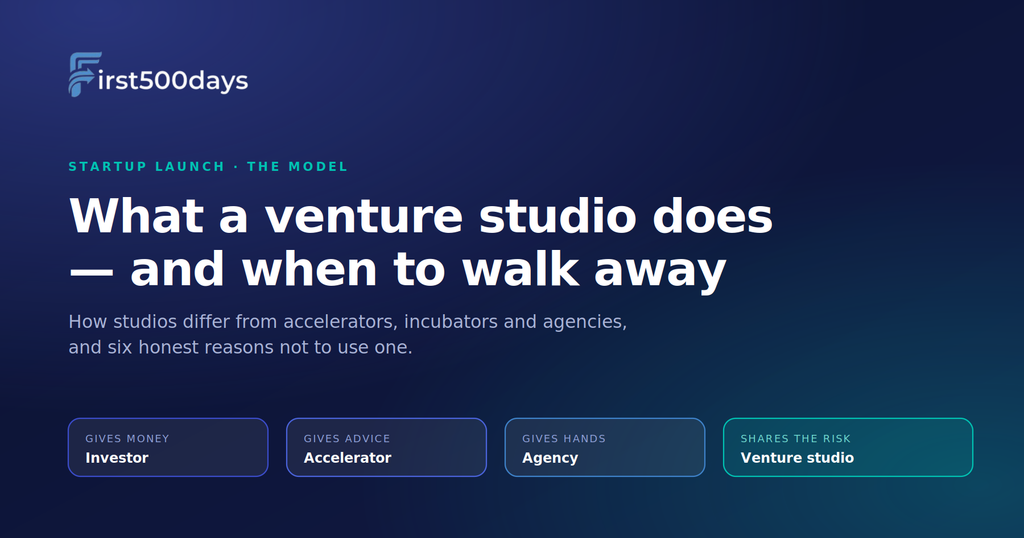
A venture studio builds companies alongside founders rather than advising them or executing a brief for them. It supplies the operating capability a founder lacks — product, engineering, go-to-market, legal coordination, finance — and takes fees, equity, or a combination, which means it is exposed to whether the venture works. That exposure is the whole distinction. An accelerator gives you money and a network. An agency gives you hands. A studio gives you a team that will disagree with you.
We should declare the obvious: we operate this model. That is a reason to read this sceptically, and also the reason the disqualifiers section exists and is specific.
Four models that get confused
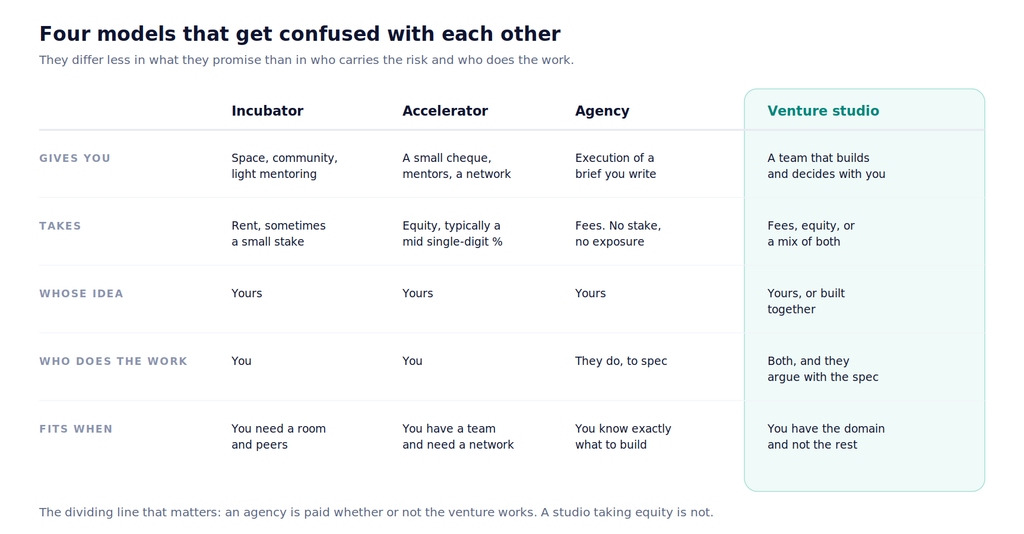
The clearest way to tell these apart is to ask what happens if the venture fails. An incubator has already collected rent. An accelerator holds a small stake and has moved on to the next cohort. An agency was paid on delivery. A studio holding meaningful equity has lost most of the value of the engagement — which is why studios argue about scope, and agencies do not.
Accelerator terms are usually public and worth understanding as a reference point. Y Combinator’s standard deal is $500,000: $125,000 for a fixed 7% on a post-money SAFE, plus $375,000 on an uncapped SAFE with most-favoured-nation terms, with pro rata rights and no fees charged to companies.[1] That is a well-defined product: capital, network and reputation, in exchange for a defined slice, for companies that already have a team.
Accelerators are for teams that need a network. Studios are for people who have a domain and are missing the team.
What a studio actually does, day to day
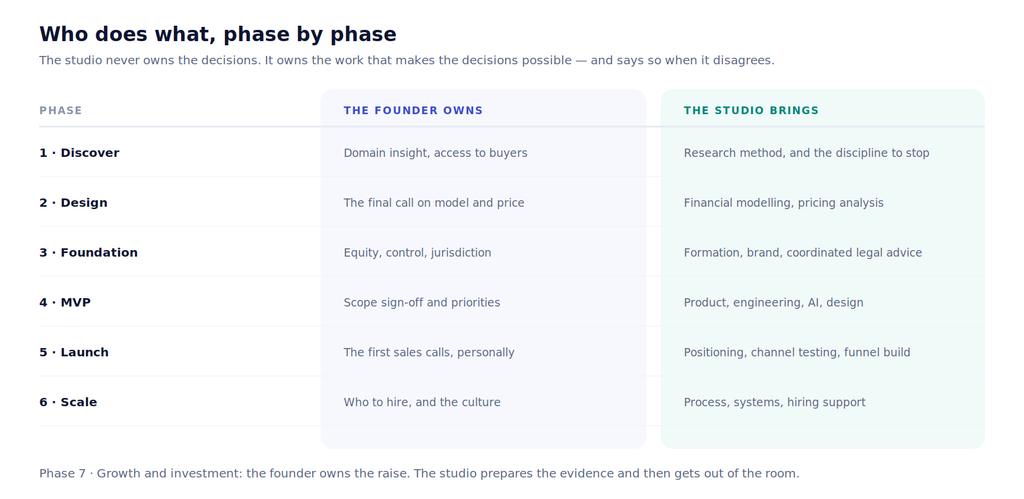
Two aspects of that division are worth stating plainly, because they are where studio engagements most often go wrong.
The founder makes the calls. A studio that takes over decision-making has produced a company with a hollow founder at the centre, which fails at the first moment the studio steps back — typically during a fundraise, when investors ask the founder a question and get a studio answer.
The founder does the first sales calls. Not the studio. Early selling is research, and research cannot be delegated without the founder losing the understanding of why people buy. A studio that offers to run your first customer conversations is offering you a short-term convenience with a long-term cost.
How studios charge
| Structure | How it works | What to watch |
|---|---|---|
| Fees only | Paid for work delivered, no stake taken | The studio has no exposure; incentives resemble an agency’s |
| Equity only | Work in exchange for a stake, no cash | Large stakes; check the percentage against what is actually delivered |
| Fees plus equity | Reduced fees with a smaller stake alongside | The most common structure; make sure the discount is real |
| Studio-originated | The studio has the idea and recruits a founder in | You are joining a company, not founding one. Different deal entirely. |
Whatever the structure, three questions are worth asking before signing: what specifically is delivered for the fee or the stake, what happens if you want to stop after three months, and who owns the intellectual property at every stage — not just at the end. Any studio that cannot answer those precisely is not ready to be given a stake in your company.
On the performance claims you will see
You will encounter figures claiming studio-built companies outperform traditionally founded ones — faster to Series A, higher returns, better survival. Read the provenance before quoting them. Most originate from the studio industry itself or from bodies representing it, and there is no substantial independent dataset of the kind that exists for accelerators or venture funds. We are not going to cite numbers about our own model that we could not defend the sourcing of. Judge a studio on its named clients and their outcomes instead.
When a studio genuinely fits
Four situations where the model earns its cost:
- A domain expert with no company-building experience. A clinician, researcher or industry specialist with real insight and no idea how to turn it into a business. This is the archetypal fit, and it is why studios cluster around deep-tech and health.
- A professional making the transition. Someone leaving a senior corporate role who understands an industry problem intimately but has never built product, hired, or sold to strangers.
- An established business launching something structurally different. A company whose existing team is fully occupied and whose processes are wrong for a zero-to-one venture.
- A founder entering an unfamiliar market. Where the missing capability is local — regulatory, operational, commercial — and hiring for it takes longer than the opportunity allows.
When you should not use one
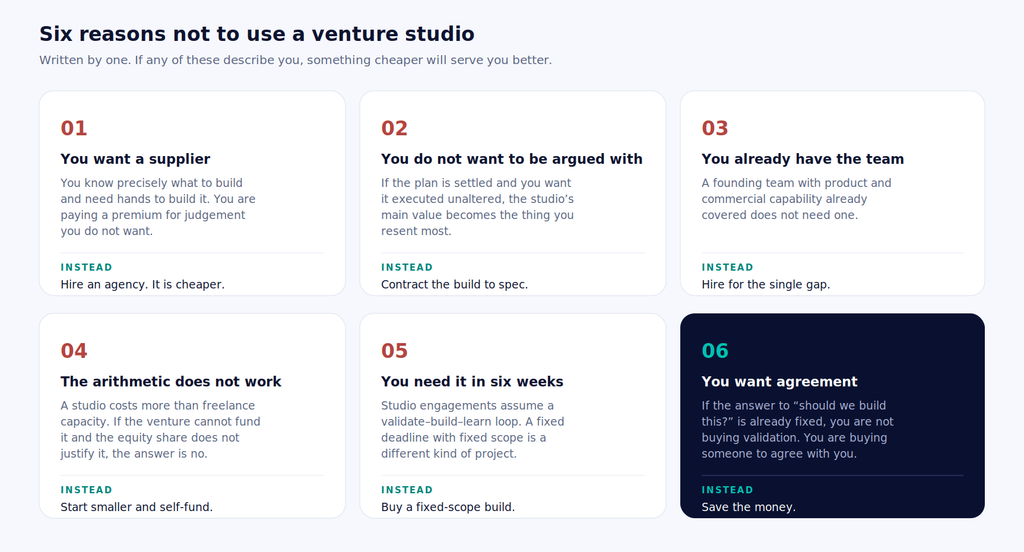
Number two deserves the most attention, because it is the least obvious and the most common. Founders arrive wanting a partner and discover that partnership means someone telling them the segment is too broad, the price is too low, or the feature they are attached to should not be built. If that prospect is unwelcome, the money is better spent on execution to spec — and there is no shame in wanting that.
Number six is the one nobody says out loud. A meaningful proportion of enquiries any studio receives are from people who have already decided and want a credible third party to agree. That is an expensive way to buy reassurance, and a good studio will tell you so in the first call.
How to evaluate one
Questions worth asking, and what a good answer sounds like:
- “Which ventures have you built, and can I speak to those founders?” A good studio makes the introduction without managing the conversation. Hesitation here tells you most of what you need to know.
- “What have you stopped?” A studio that has never told a client not to proceed is either extraordinarily lucky or not exercising judgement.
- “Who exactly will do the work?” Meet them. Senior people winning the engagement and juniors delivering it is the oldest problem in professional services.
- “What happens if we disagree?” Listen for a real mechanism rather than a reassurance that it will not happen.
- “How does this end?” A studio should be able to describe the point at which you no longer need them. One that cannot has designed a dependency.
- “What does the IP position look like at month three, if we stop?” The answer should be that you own everything. If it is more complicated than that, understand exactly why.
The honest summary
A venture studio is a way of buying operating capability you do not have and cannot yet hire, from people who are exposed to whether it works. It costs more than an agency and less than the eighteen months you would spend learning the same things badly. It is worth it when the gap between your expertise and company-building is genuinely large, and it is a poor purchase when the gap is small, when the plan is fixed, or when what you actually need is capacity rather than judgement.
The clearest signal, in either direction, is how the first conversation goes. If it is mostly a pitch, you are talking to a supplier. If half of it is questions you had not thought about — and at least one you would rather not answer — that is the model working.