
“Do you know anyone who could be my technical co-founder?”
It is one of the first questions we hear from students and recent graduates with a startup idea. It usually comes before a single customer conversation, before a price, and before anyone has said “I’d pay for that.”
That order is understandable. Building alone feels risky, and a co-founder looks like the fastest way to fill the gaps. But a co-founder chosen too early, for the wrong reasons, is one of the most expensive mistakes a first-time founder can make. You are not hiring for a project. You are choosing someone to make hard decisions with for years.
This guide is for international Master’s students, recent graduates and first-time founders in the UK. It covers:
- whether you actually need a co-founder yet
- what to look for beyond skills
- where to find co-founders in the UK
- how to test the partnership before you commit
- how to approach roles, equity and a founder agreement
- the red flags worth walking away from
Do you actually need a co-founder yet?
Before you look for a partner, be clear about what problem a co-founder would solve. Many early founders want a co-founder for one of three reasons:
- “I can’t build the product.” You need technical skills.
- “I don’t want to do this alone.” You need momentum and someone to share the weight.
- “Investors prefer teams.” You think a team looks more credible.
All three are real. None of them, on their own, is a good reason to give away a large share of your company in month one.
At the idea stage, the most valuable work is learning whether the problem is real: talking to customers, testing whether anyone will pay, and narrowing down who your first customer is. You can do most of that without writing code. Many first versions can be tested with a landing page, a form, a spreadsheet, a manual service or a clickable prototype.
A useful rule: find the evidence first, then find the person who fits what the evidence says you need. If your customer conversations show the hard part is distribution, you may need a commercial partner, not a developer. If they show the product must be technically deep from day one, a technical co-founder becomes much more important.
Co-founder, early hire or freelancer?
| Option | Best when | Watch out for |
|---|---|---|
| Co-founder | The role is core to the business for years, and you need a shared owner of big decisions | Hard to undo; equity is permanent |
| Early hire (salary + small equity) | The role is clear and you can define what success looks like | Needs cash or a clear plan to pay |
| Freelancer or agency | You need a defined piece of work, like a prototype | You own the outcome, they own the task |
| Advisor | You need judgment and introductions, a few hours a month | Advice is not execution |
What to look for in a co-founder
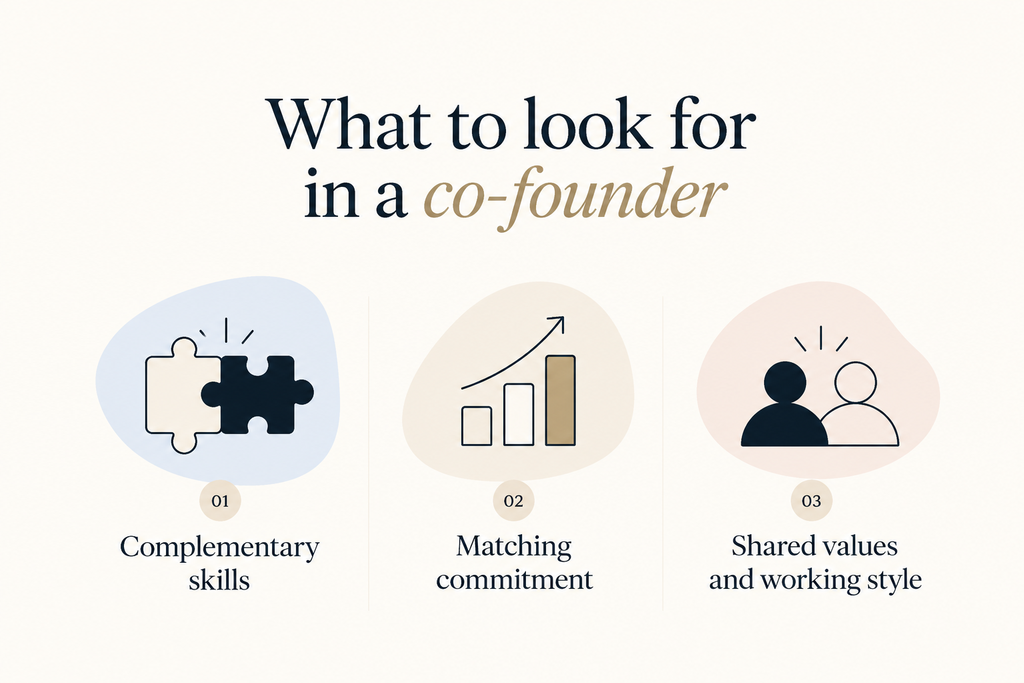
Skills are the easiest part to see and the least likely to break a partnership. Most co-founder problems come from mismatched commitment, expectations or values. Look at all three layers.
1. Complementary skills
The classic split is one person who builds and one person who sells. In practice, ask: what are the two or three jobs this business must do well in its first year? Then check whether, between you, those jobs are covered.
- If you are strong on customers and sales, look for product or technical depth.
- If you are technical, look for someone who will happily spend their week talking to customers.
- Two people with the same skill set can work, but only if you both accept that one of you must learn the missing job fast.
2. Matching commitment
This is where student and graduate partnerships often break. Ask directly:
- How many hours a week can you give this, realistically, for the next six months?
- What happens after graduation: a job, a visa route, a move, further study?
- Are you willing to go without a salary for a period, and for how long?
- What would make you walk away?
One person working 40 hours a week and the other working five is not a partnership. It is a future argument.
3. Shared values and working style
You do not need to be friends, but you need to trust how the other person behaves under pressure. Talk about:
- Ambition: a lifestyle business or a venture-scale company?
- Risk: how much of your own money and time are you each willing to put in?
- Decisions: who has the final say in which areas?
- Conflict: how do you each disagree, and how do you resolve it?
- Honesty: will you each say the uncomfortable thing early?
A good co-founder is not the most talented person you know. It is the person you can disagree with on a Tuesday and still build with on Wednesday.
Where to find a co-founder in the UK
The best co-founders are usually found by working on something together, not by browsing profiles. Use the places below to meet people, then use a small project to test fit.
Inside your university
This is the most underused option for students and recent graduates.
- Enterprise or entrepreneurship teams: many UK universities run startup support, workshops and founder programmes, and some extend access to recent graduates.
- Startup and entrepreneurship societies: student-run events are a low-pressure way to meet people who already want to build.
- Hackathons and pitch competitions: you see how someone works under a deadline, which tells you more than any CV.
- Other departments: if you study business, spend time in computer science, engineering or design spaces, and the other way round.
Founder programmes and matching platforms
- Co-founder matching platforms, such as Y Combinator’s Co-Founder Matching, let you filter by skills, location and commitment.
- Talent-first programmes, such as Entrepreneur First, are built around meeting a co-founder before you have a final idea.
- Accelerators and incubators often run open events and community sessions even for people not yet accepted.
Eligibility, costs and terms vary and change, so check each programme’s own website before you apply.
Communities and events
- Local startup meetups, tech community events and industry networking evenings in your city
- Founder communities and online groups focused on early-stage or international founders
- Open-source projects, if you are looking for a technical partner and can contribute yourself
Your existing network
- Former colleagues from internships, placements or jobs
- Classmates from previous degrees, in the UK or your home country
- People who already work in the industry you are building for: they bring customer access, not just skills
Tip: when you reach out, lead with the problem and the evidence, not the title. “I’ve spoken to 15 small clinic owners who all struggle with X, and three asked to pilot a fix” attracts serious people. “Looking for a CTO for my app idea” usually does not.
How to test a co-founder before you commit
You would not sign a three-year lease after one viewing. Treat a co-founder the same way. Run a short, structured trial before anyone talks about titles or equity.
The 30-day co-founder trial
| Week | Shared goal | What you are really testing |
|---|---|---|
| Week 1 | Agree the problem, the first customer and the questions you need answered | Can you align on priorities quickly? |
| Week 2 | Run customer conversations together and share notes | Do they show up, follow through and listen? |
| Week 3 | Build or mock up the smallest possible test | How do they handle trade-offs and scope? |
| Week 4 | Review evidence honestly and decide the next step | Can you disagree well and still decide? |
At the end of the trial, each of you answers three questions separately, then compares:
- Did the other person do what they said they would do, when they said they would?
- Did working together make the decisions better or just slower?
- Do I want to do the next 12 months of hard work with this person?
If either of you hesitates on the third question, take that seriously. It is far easier to part ways after four weeks than after four months and a registered company.
Roles, equity and the founder agreement conversation
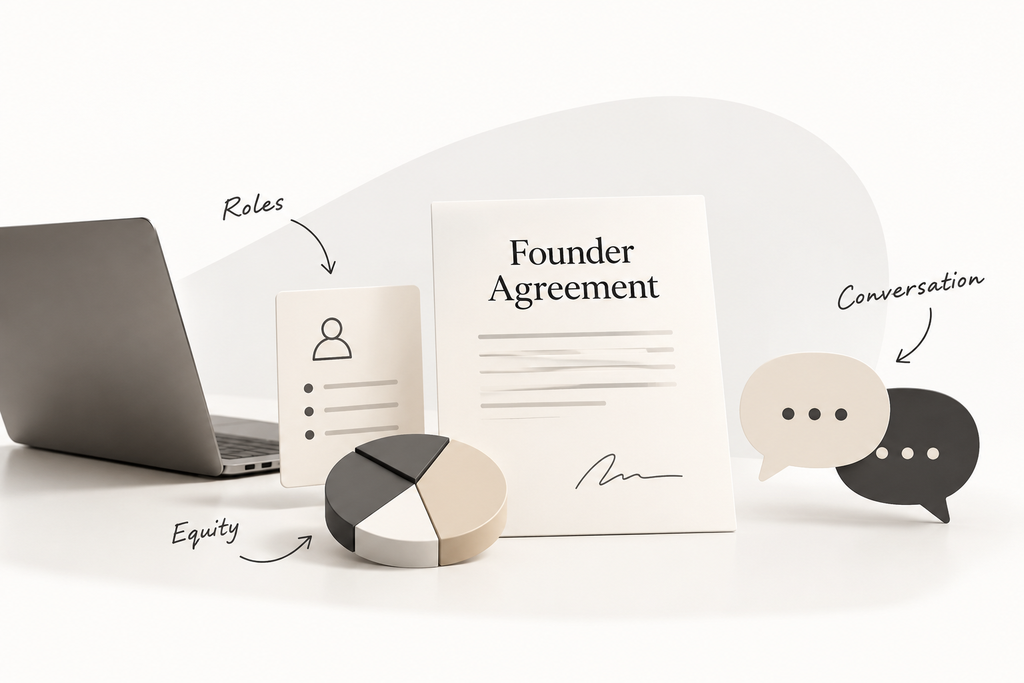
Most co-founder fights are not about the idea. They are about who owns what, who decides what, and what happens if someone leaves. Have these conversations early, while everyone still gets along.
Agree roles before titles
Write down, in plain language, what each person owns. For example: “Priya owns customers, sales and pricing. Tom owns product, build and tooling. Big decisions on spend over £500 or hiring are joint.” Titles like CEO and CTO can come later.
Think about equity as a long-term deal
There is no single correct split. Equal splits are common and can work well, but they should be a choice, not an avoidance of the conversation. Consider:
- Contribution over time, not just the idea. An idea with no evidence is worth less than most founders think.
- Commitment. Full-time versus part-time should be reflected somewhere.
- What each person brings: skills, customer access, capital, existing work.
- Vesting. Many startups use vesting, where founders earn their shares over a period (often several years, with a “cliff” before any shares vest). It protects everyone if one person leaves early.
Put it in writing
Once you decide to work together properly, document it. That usually means a founder agreement or shareholders’ agreement covering roles, equity, vesting, decision-making, intellectual property, and what happens if someone leaves. Templates exist, but for anything binding, get advice from a qualified solicitor.
If any founder needs a UK visa, check how the business structure and their role fit the relevant visa route before you register a company or allocate shares. Rules are set out on GOV.UK and can change.
This section is general information, not legal, tax or immigration advice.
Red flags to take seriously
No partner is perfect, but some signals are worth pausing on:
- They want equity before doing any work. Commitment should come before ownership.
- They avoid customers. If they won’t join a single customer conversation, they are not a co-founder for an early-stage startup.
- Vague answers on time. “I’ll fit it in” usually means it won’t happen.
- They only want to build. Building before evidence feels productive and often wastes months.
- Different end goals they won’t discuss. One wants a quick exit, the other a ten-year company.
- They miss small deadlines. The way someone handles a small commitment is how they’ll handle a big one.
- You feel you have to manage them. A co-founder should reduce your load, not add to it.
One red flag is a conversation. Three is usually a decision.
Co-founder checklist
Use this before you make anything official.
- I have spoken to at least 10 potential customers about the problem
- I know which skills the evidence says the business needs most
- I have decided whether this role needs a co-founder, a hire, a freelancer or an advisor
- We have discussed hours per week and plans after graduation
- We have discussed ambition, risk and money openly
- We have completed a 30-day trial with a shared goal
- We have each answered the three trial questions separately
- We have written down who owns which decisions
- We have discussed equity and vesting
- We plan to put a founder agreement in writing with proper advice
- Anyone who needs a visa has checked how this structure fits their route
Frequently asked questions
Do I need a co-founder to start a startup in the UK?
No. Many businesses start with one founder. A co-founder helps when a core job in the business needs a long-term owner you can’t cover yourself. Validate the idea first, then decide.
How do I find a technical co-founder if I’m not technical?
Bring evidence, not just an idea. Customer conversations, a waitlist or a paid pilot show a developer that the problem is real. Look in computer science departments, hackathons, matching platforms and tech meetups, and offer a short trial project before discussing equity.
Should co-founders split equity equally?
Equal splits are common but not required. Base the decision on commitment, contribution over time and what each person brings, and use vesting so equity is earned. Get professional advice before anything is signed.
Can I find a co-founder while I’m still studying?
Yes. University is one of the easiest places to meet potential co-founders through societies, enterprise teams, hackathons and other departments. Be open about how much time you each have during and after your course.
What if my co-founder needs a visa to stay in the UK?
Check how their role and the business structure fit the relevant visa route on GOV.UK before you register a company or allocate shares. Requirements differ by route and can change, so get qualified immigration advice for your situation.
How long should we test working together?
A focused trial of around four weeks, with a shared goal such as running customer conversations and building a small test, usually shows how you work together far better than months of casual chatting.
Build the right team, in the right order
The right co-founder can double your speed. The wrong one, chosen too early, can cost you a year. Start with evidence, test the partnership with real work, and put the important things in writing.
If you’re a student or graduate founder deciding whether you need a co-founder, what kind, or how to structure it, First500days can help you think it through with an operator’s view.
Book a free 30-minute strategy call and we’ll look at your idea, your evidence so far and the team you need for the next stage.
First500days is a Startup Development Partner for first-time founders. This article is general information and not legal, tax or immigration advice.