| SEO field | Value |
| SEO title | Customer Interviews for Startups: Who to Talk To, What to Ask, How to Read the Answers |
| Meta description | Ten customer conversations will teach you more than any pitch deck. Who to interview, how to find them with no network, an 8-question script, and how to score what you hear. |
| Primary keyword | customer interviews for startups |
| Secondary keywords | customer discovery questions, how to validate a startup idea, startup interview script, find first customers |
| Suggested URL slug | /blog/customer-interviews-for-startups |
First-time founders often spend weeks on a pitch deck before they’ve spoken to a single customer. The deck has a market-size slide, a competitor grid and a five-year forecast. What it doesn’t have is anything a real customer said.
A pitch deck is your view of the business. Customer conversations are the market’s view. Ten good ones will tell you whether the problem is real, who has it worst, what they already pay to fix it, and the words they use to describe it. That last part becomes your marketing copy, your landing page and, later, a much better pitch deck.
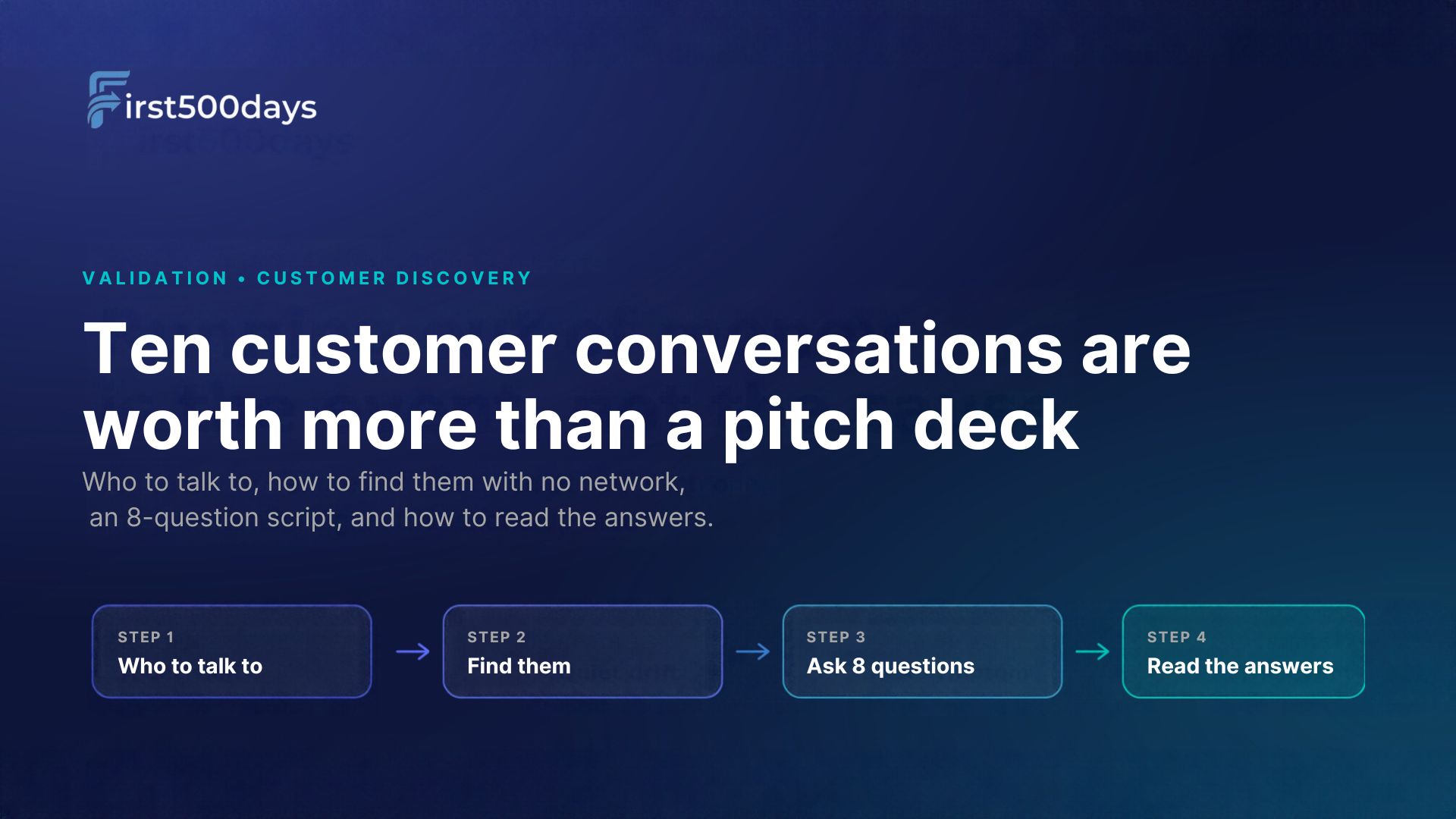
This guide covers the whole process: who to talk to, how to find them when you don’t have a network, an 8-question script you can use tomorrow, three questions to never ask, and how to turn ten conversations into a clear decision.
This is week two of our 30-day validation plan [Internal Link Opportunity: “Validate before you build” blog post]. If you haven’t written your problem statement yet, start there.
Who to talk to
Who you talk to matters more than anything else in this guide. Ten conversations with the right people will tell you something. A hundred with the wrong people will just mislead you.

Talk to people who have the problem now
Don’t interview people who might have the problem one day, or who think it sounds like a good idea. Look for people who have run into it recently, ideally in the last month. Their memories are specific, and specific memories are what you need.
Make the group narrow enough to list
Describe the person you’re looking for in one sentence, with a role, a situation and a place:
- Too broad: “Students”
- Better: “International Master’s students in the UK”
- Specific enough: “International Master’s graduates in the UK from the last two years who have started writing a business plan”
If you could find thirty of these people this week, the description is narrow enough.
Prioritise people already trying to solve it
The strongest interviewees are people who’ve already tried to fix the problem. They’ve searched for a tool, built a spreadsheet, paid a consultant or asked for help in a forum. They’re proof that the problem is worth acting on, and they can tell you exactly why the current options fall short.
Keep friends and family to a minimum
People who know you will try to be supportive, and that makes their answers less reliable. Use your network for introductions, not as your interview list. If more than two or three of your ten conversations are with people you already know, keep going until you have more strangers.
How to find them when you have no network
Many first-time founders, especially international students and recent graduates, worry that they don’t know anyone. You don’t need to. You need to know where your customers already gather, and a short message that’s easy to say yes to.
Where to look
| Channel | Best for | How to use it |
| Anyone with a job title | Search by role and location, then send a short note (no pitch) | |
| University alumni networks and societies | Students and graduates | Alumni directories, society group chats, careers events |
| WhatsApp, Slack and Discord communities | Professional groups and niches | Join, contribute first, then ask for help |
| Reddit and niche forums | Consumers and hobbyists | Look for people describing your problem, then message them directly |
| Events, meetups and co-working spaces | Local businesses and founders | Have short conversations in person, then book a proper call |
| Introductions from interviewees | Every type of customer | End every call by asking who else you should speak to |
The last row matters most. After your first two or three conversations, introductions from the people you’ve interviewed should become your main source. They’re warmer than cold messages, and those people are more likely to fit your profile.
The outreach message
Keep it short, honest and specific. Make clear you’re asking for their experience, not selling anything:
Hi [Name], I’m researching how [type of person] deals with [problem]. I’m not selling anything. I’d just like to learn from your experience. Would you be open to a 15-minute call this week? Happy to work around your schedule.
A few things help:
- Personalise the first line. Mention their role, a post they wrote, or a group you share.
- Ask for 15 minutes, not 30. A shorter ask gets more yeses. Many calls will run longer anyway.
- Follow up once. A polite nudge a few days later often gets a reply. After that, move on.
- Send more than you need. Many people won’t reply. Start with a list of about 30 names to get 10 conversations.
The 8-question interview script
This script asks about the past, not the future. Past behaviour is the best evidence you can get in a conversation, because people remember what they did far more accurately than they can predict what they’d do.

Use it as a guide, not something to read word for word. Follow up on anything interesting. The best insights usually come from the second or third “why?”.
Opening (1 minute): thank them, confirm you have 15 minutes, and repeat that you’re not selling anything. Ask if you can take notes.
- “Can you tell me a bit about your role, or your situation, as it relates to [area]?” Gives you context, and confirms they fit your customer profile.
- “When was the last time you ran into [problem]?” Anchors the conversation in a real, recent event rather than an opinion.
- “Walk me through what happened. What were you trying to do?” Gets the story in their own words. Listen for the moment it became frustrating.
- “What did you do about it?” Shows how they behave in reality. “Nothing” is an important answer too.
- “What have you tried to fix it in the past? What was wrong with those options?” Shows you the alternatives you’re competing with, and the gaps they leave.
- “Have you spent any money or time on this? Roughly how much?” The strongest signal in the script. People pay for problems that matter.
- “If you could change one thing about how you deal with this today, what would it be?” Gives you their priority, in their words, without you suggesting a solution.
- “Is there anyone else you think I should talk to about this?” Keeps your list growing, and the introductions tend to be good ones.
Closing (1 minute): thank them, and ask if you can follow up when you have something to show. If they ask what you’re building, tell them briefly at the very end, after you’ve heard everything they had to say.
Straight after the call
Spend five minutes writing up your notes before the next conversation. Write down:
- The exact phrases they used to describe the problem
- What they’ve tried and what they’ve spent
- Anything that surprised you
- Your score for the call (see “How to read the answers” below)
If you leave it until the end of the day, you’ll remember your impression of the call, not what they actually said.
Three questions you should never ask
These three feel natural to ask, which is why founders use them. Each one produces a confident answer that’s almost useless.

1. “Would you buy this?”
Why it fails: saying yes costs nothing, and saying no feels rude. Most people will say yes, or “probably”, to be kind. It tells you nothing about whether they’ll actually pay when the time comes.
Ask instead: “Have you paid for anything to solve this before?” And when you’re ready, make a real offer with a real price and ask for a commitment, such as a deposit, a pre-order or a paid pilot.
2. “Do you think this is a good idea?”
Why it fails: you’re asking for an opinion, and you’ll get a polite one. Even if they’re honest, their opinion of your idea isn’t the point. Their experience of the problem is.
Ask instead: “Tell me about the last time this happened.” Then listen for how much it cost them, how often it happens, and what they did about it.
3. “How much would you pay for this?”
Why it fails: people are bad at pricing hypothetical products. They tend to give a low number to seem sensible, or a high one to seem supportive. Neither is reliable.
Ask instead: “What do you spend on this today, in money or time?” What they already spend is the most honest guide to what a solution is worth to them.
The rule behind all three: ask about what people have done, not what they would do. Facts about the past are evidence. Predictions about the future are guesses.
How to read the answers
After ten conversations you’ll have pages of notes and a strong feeling about how it went. Don’t rely on the feeling. Score each conversation against the same five signals so you can compare them fairly.
Score each call
Give each signal 0, 1 or 2 points:
| Signal | 0 points | 1 point | 2 points |
| Recency | Can’t remember the last time | Within the last few months | Within the last month |
| Frequency | Once or rarely | A few times a year | Weekly or monthly |
| Pain | Mild annoyance | Real frustration | Clear cost in time, money or opportunity |
| Current effort | Does nothing about it | Uses a free workaround | Pays for a tool, a person or a service |
| Pull | Polite but uninterested | Asks to be kept informed | Asks to try or buy it, or makes an introduction |
Each call scores between 0 and 10.
Read the pattern, not the average
Once all ten are scored, look at the shape of the results:
- Strong signal: several calls score 7 or more, and the high scorers share a clear profile, such as the same role, situation or trigger. That shared profile is your first customer segment.
- Mixed signal: scores are spread out, with a few high and many low. The problem may be real for a narrower group than you thought. Look at what the high scorers have in common and interview more people like them.
- Weak signal: most calls score 4 or less. People recognise the problem but don’t act on it. Either the problem isn’t painful enough, or you’re talking to the wrong people.
These thresholds are a practical guide, not a statistical test. Ten conversations won’t prove anything about a market. What they will do is show strong patterns clearly and rule out weak ideas early.
Watch for false positives
Some things sound like evidence but aren’t:
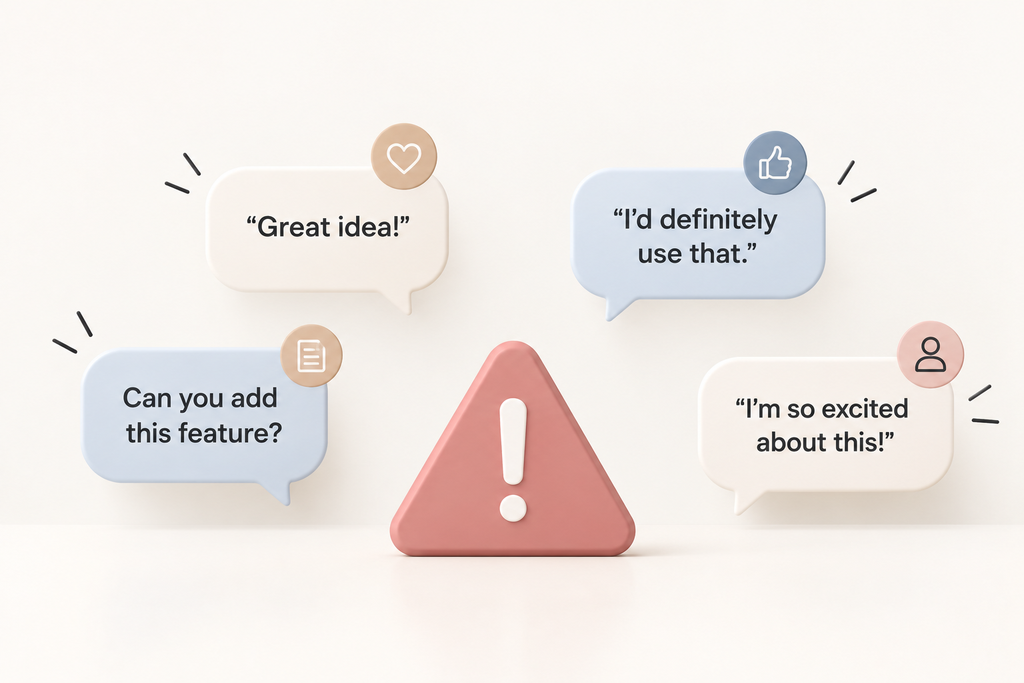
- Compliments, such as “Great idea!” or “I love this.” They’re nice to hear but tell you nothing.
- Hypothetical enthusiasm, such as “I’d definitely use that.” It costs them nothing to say.
- Feature requests from people who don’t have the problem. They’re designing a product they won’t buy.
- Your own excitement after a good call. Score it the next morning, from your notes.
The strongest signal of all is someone asking you for something: early access, a price, a time to start. When that happens without you prompting it, write it down word for word.
Your 10-conversation checklist
- Write your customer profile in one sentence (role, situation, place)
- Build a list of about 30 people who fit it
- Send short, personal outreach messages, and follow up once
- Run each call with the 8-question script
- Ask every interviewee for an introduction
- Write up notes within five minutes of each call
- Score each call from 0 to 10 on the five signals
- Look for the shared profile among your highest scorers
- Decide: test an offer, narrow the customer, or rethink the problem
How we approach this at First500days
In our work with early-stage founders, the ventures that struggle most rarely have a bad idea. More often they built before anyone had pinned down who exactly the product was for and what it needed to do first. Customer conversations are the cheapest way to settle that. They take a couple of weeks and almost no money, and they shape everything that follows: the product scope, the pricing, the brand message, and eventually the pitch deck.
That’s why we put them before the deck, not after.
Frequently asked questions
How many customer interviews do I need?
Ten is a practical starting point for spotting strong patterns. If the results are mixed, interview more people from the segment that scored highest. The aim isn’t a number. It’s a pattern clear enough to act on.
Should I interview friends and family?
Only a few, and treat their answers with caution. People who know you tend to be supportive, which makes their feedback less reliable. Use them mainly for introductions.
Should I show my product or idea during the interview?
Not until the end, if at all. Once you describe your solution, the conversation shifts from their problem to your idea, and people start being polite. Learn about the problem first.
How long should a customer interview be?
Ask for 15 minutes and plan for 20 to 30. Short requests get more yeses, and good conversations often run longer naturally.
What do I do after ten conversations?
If the signal is strong, test an offer with a landing page or a pre-sale. If it’s mixed, narrow your customer and interview again. If it’s weak, rethink the problem or the customer before building anything. Our 30-day validation plan [Internal Link Opportunity: “Validate before you build” blog post] covers each step.
Can I do customer interviews if I’m an international student with no network in the UK?
Yes. Alumni networks, university societies, LinkedIn and online communities are all good starting points, and introductions from your first interviewees will quickly widen your reach. You don’t need a network to start, because you build one by doing the interviews.
Turn ten conversations into a plan
If you’re at this stage, pressure-test the plan before you spend the next six months building it. Book a 30-minute strategy call with the First500days team. We’ll review your customer profile, your interview notes and your next step.