Your final year is already full: dissertation, exams, job applications, maybe part-time work. Then there’s the idea you can’t stop thinking about.
Most students in this position do one of two things. Some put the idea off until “after graduation”, and it quietly disappears. Others throw themselves into it, fall behind on their degree, and burn out by the second term.
There’s a better middle path: a small, protected block of time each week, spent on the right things in the right order.
This guide gives you a realistic plan built around 10 hours a week. That’s enough to make real progress without risking your degree. It covers:
- How to split those 10 hours between customers, building and learning
- What a typical week and term look like
- How to use the university resources most students never touch
- What to leave until after you graduate, and why
If you’re an international student, read the visa note in section 4 before you start anything that involves selling or trading.
1. The 10-hour week: where your time should go
Ten hours is about an hour and a half a day, or two evenings plus a weekend morning. It isn’t much, which is exactly why where it goes matters.
Most student founders spend almost all of it building: designing logos, learning to code or making an app. The problem is that building is the part least likely to tell you whether the idea is any good.
Here’s the split we recommend in the early stages:
| Activity | Hours a week | What it includes | Why it gets this much |
| Customers | 4 hours | Finding people with the problem, short calls, writing up notes, testing an offer | This is where you learn whether the idea is worth pursuing |
| Building | 3 hours | A landing page, a simple prototype, a manual version of the service | Only build what your customer conversations say is needed |
| Learning | 2 hours | Workshops, mentor sessions, reading about your market and competitors | It speeds up everything else, and your university gives you most of it free |
| Review and plan | 1 hour | Look back at the week, update your notes, decide next week’s one priority | Without this, the other nine hours drift |
The order matters. Customers come first because they decide what’s worth building. Building comes second, and should stay small. Learning supports both.
As you gather evidence, the balance can shift. Once you have people asking to use what you’re making, more of your time can move to building. But that shift should be earned by evidence, not assumed from the start.
Protect the time
Ten hours only works if it’s scheduled. Put specific blocks in your calendar, for example two weekday evenings and one weekend morning, and treat them like a lecture you can’t skip. During exam periods, cut back to two or three hours of customer work and pause the rest. Your degree comes first.
2. What a typical week looks like
Here’s one way to fit 10 hours around lectures, study and a social life:
| When | Time | Focus | Example tasks |
| Tuesday evening | 2 hours | Customers | Send 5–10 outreach messages; hold one or two 15-minute calls |
| Thursday evening | 2 hours | Customers + review | One more call; write up notes from the week’s conversations |
| Saturday morning | 3 hours | Building | Update your landing page, or improve the manual version of your service |
| Any weekday | 2 hours | Learning | A society event, an enterprise centre workshop or a mentor meeting |
| Sunday evening | 1 hour | Review and plan | What did I learn? What’s next week’s one priority? |
Adjust the days to suit your timetable. What matters is that customer work happens every week, not just when you feel ready.
A plan for one term
A 12-week term is enough to take an idea from “I think this could work” to real evidence:
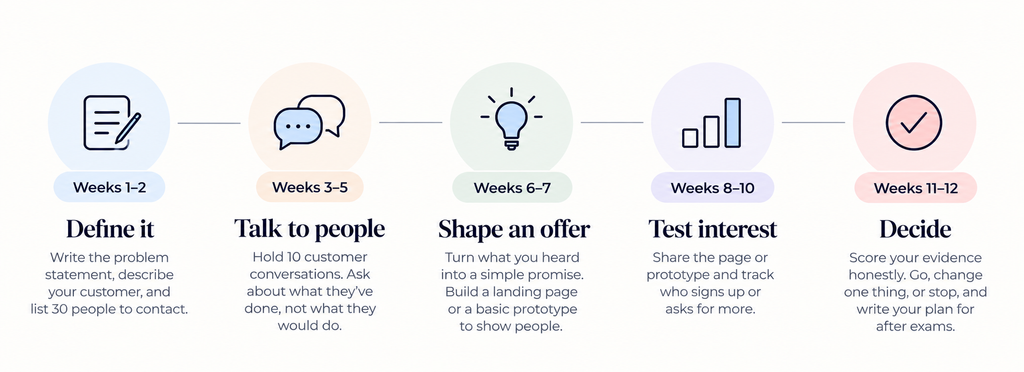
- Weeks 1–2: define it. Write a one-sentence problem statement, describe your customer specifically, and list 30 people to contact.
- Weeks 3–5: talk to people. Hold 10 customer conversations. Ask about what they’ve done, not what they would do.
- Weeks 6–7: shape an offer. Turn what you heard into a simple promise. Build a landing page or a basic prototype to show people.
- Weeks 8–10: test interest. Share the page or prototype with your interviewees and relevant groups, and track who signs up or asks for more. (International students: see the visa note before you take any money.)
- Weeks 11–12: decide. Score your evidence honestly. Go, change one thing, or stop, and write down your plan for after exams.
By the end of term you won’t have a finished company. You’ll have something more useful: evidence about whether the idea deserves more of your time.
3. Use the university resources most students ignore
While you’re a student, you have access to support that founders outside university often pay for. Most students never use it. What’s available varies by university, so check your own.
Entrepreneurship and enterprise teams
Many UK universities have an enterprise or entrepreneurship team, sometimes called an enterprise centre, venture team or innovation hub. They often offer:
- One-to-one advice on your idea and next steps
- Workshops on validation, pitching and business basics
- Pre-incubator or incubator programmes, sometimes with workspace
- Competitions with small grants or prizes
How to use them: book a meeting early in term, bring your one-sentence problem statement, and ask what support exists for students at your stage.
Societies
Entrepreneurship, business and tech societies are useful for two things:
- Finding co-founders and collaborators, especially people with skills you don’t have
- Finding customers, if your idea is aimed at students or young professionals
How to use them: go to events with a specific question to ask, not just to network.
Mentors and academics
Lecturers, researchers, careers advisers and alumni mentors are often more willing to help than students expect, especially if you ask a specific question.
How to use them: instead of “Can you mentor me?”, ask “I’m testing whether [problem] is real for [customer]. Could I get 20 minutes of your view on it?” A specific ask gets a much better response.
Your alumni network
Alumni directories and LinkedIn groups give you access to people working in almost every industry. They’re often the easiest route to customer conversations for business-focused ideas.
Your own research
If your dissertation or final-year project explores a real problem, use it. You’ll understand that problem in more depth than most founders understand theirs. Check your university’s rules on ownership of anything you create during your studies before you build on it commercially.
4. What to leave until after graduation
Some things feel urgent in your final year but are better left until later. Doing them too early costs time and money, and sometimes creates problems you don’t need yet.
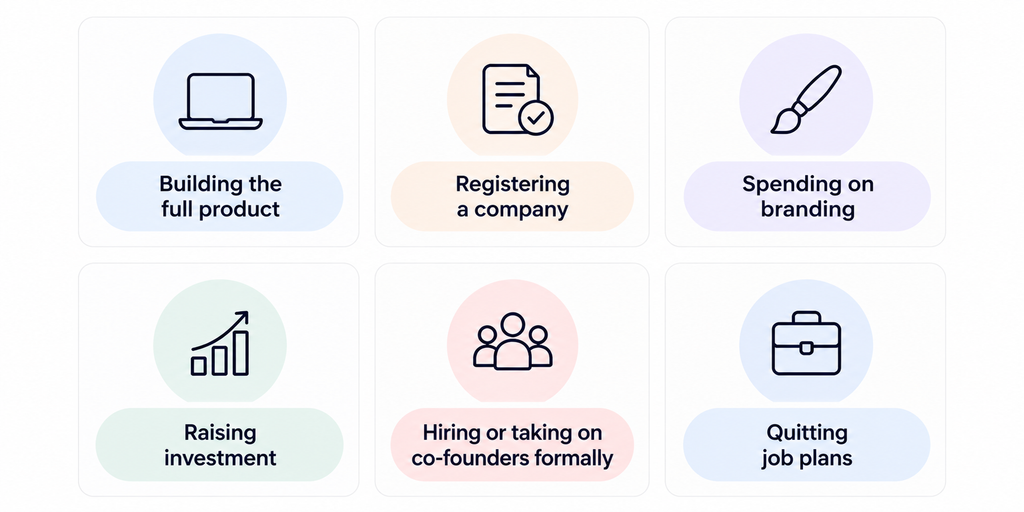
| Leave until later | Why it can wait |
| Building the full product | Without evidence, you’ll probably build the wrong thing. A landing page or manual version is enough for now. |
| Registering a company | It brings filings, accounts and deadlines from day one. Register when a real commitment needs it. |
| Spending on branding | A logo and website won’t tell you if the idea works. Customer conversations will. |
| Raising investment | You’ll get better terms, and better investors, once you have evidence. |
| Hiring or taking on co-founders formally | Work with people informally first. Formal arrangements can wait until the idea is proven. |
| Quitting job plans | Keep your options open until the evidence is strong. |
What you can do now is the most valuable work of all: understanding the problem, talking to customers and testing interest. None of it needs a company, a budget or a finished product.
A note for international students: check your visa before you trade
If you’re in the UK on a Student visa, GOV.UK lists being self-employed among the things you cannot do. In practice, that means you should be careful about anything that looks like running a business, such as selling, invoicing or taking payments, while you’re on a Student visa.
The research and validation work in this guide (defining the problem, talking to potential customers, testing interest) is about learning, not trading. But the line can be unclear, so:
- Check the current rules on GOV.UK before you sell anything or take money
- Speak to your university’s international student advice team, who can explain what applies to you
- Plan your visa route early if you want to keep building in the UK after you graduate
After graduation, the Graduate visa allows self-employment, and the Innovator Founder visa is the main long-term route for founders. Our guide to starting a business in the UK as an international graduate [Internal Link Opportunity: international graduate guide] explains both.
This is general information, checked against GOV.UK in October 2026, not legal or immigration advice. Rules change, so always confirm your own situation with a qualified adviser.
5 common mistakes student founders make
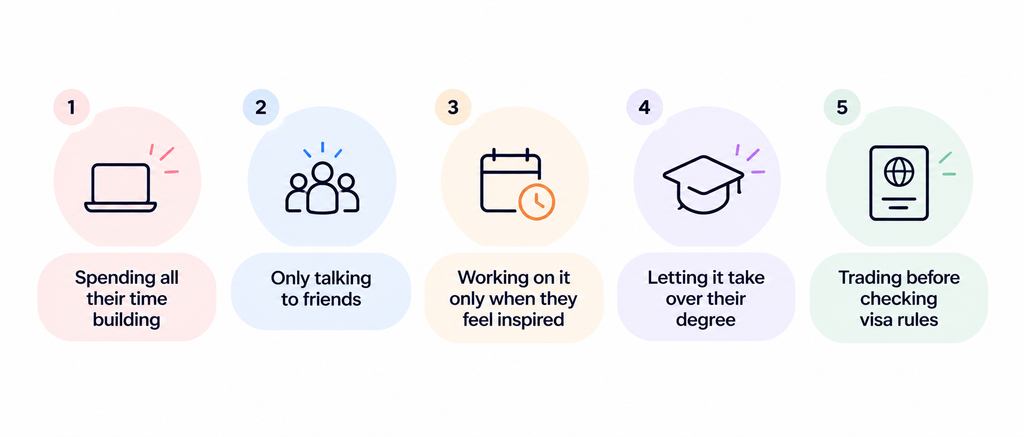
- Spending all their time building. It feels productive but rarely tells you whether the idea is worth pursuing.
- Only talking to friends. Classmates will be supportive, which makes their feedback unreliable. Use them for introductions instead.
- Working on it only when they feel inspired. Without fixed weekly time, the idea drifts until it’s forgotten.
- Letting it take over their degree. Burning out before exams helps neither the degree nor the business.
- Trading before checking visa rules. International students should check what their visa allows before selling anything.
Your weekly checklist
- 10 hours blocked in my calendar this week
- At least 1–2 customer conversations held
- Notes written up within a day of each call
- One small building task done, based on what I heard
- One learning session (a workshop, mentor or society event)
- Weekly review: what I learned, and next week’s one priority
Frequently asked questions
Can I really build a startup in 10 hours a week?
You can make real progress, especially in the early stages, when the most important work is understanding the problem and talking to customers. You won’t build a full company in 10 hours a week, but you can find out whether the idea deserves more of your time.
Should I focus on my startup or my degree?
Your degree. A fixed, limited weekly block lets you do both. Cut back during exams, and pick the pace back up afterwards.
What university support is available for student founders?
It varies, but many UK universities offer enterprise or entrepreneurship teams, workshops, incubator programmes, competitions, societies and mentoring. Check your university’s website or ask the careers service.
Can international students start a business while studying in the UK?
On a Student visa, GOV.UK says you can’t be self-employed, so be careful about selling or trading. Research and validation are a different matter. After graduation, the Graduate visa allows self-employment. Always check current GOV.UK guidance and speak to your university’s international advice team.
Should I register a company while I’m still a student?
Usually there’s no need. Register when a real commitment needs a legal entity, such as a contract or payments, and take advice first if your visa status affects your options.
Plan your first 500 days, starting now
Your final year is one of the best times to start testing an idea: you have time, support and a network around you that’s hard to find later. Use it well, and you’ll graduate with evidence instead of just an idea.
If you’re at this stage, map your next 12 months before you spend the next six building. Book a free 30-minute strategy call with the First500days team. We’ll help you plan what to test now, what to leave until after graduation, and how to get there.
Book a strategy call → [Internal Link Opportunity: strategy-call booking page] · Download the Idea Validation Kit → [Internal Link Opportunity: kit download page]
Sources: Student visa: what you can and cannot do – GOV.UK · Graduate visa – GOV.UK, checked October 2026.