Both camps argue as though one answer were universally braver. It is a structural question, not a moral one — and four features of your business model decide it, mostly before your preferences get a vote.
Bootstrap when gross margin is high, the sales cycle is short, little capital is required before revenue, and no land grab is under way. Raise when any of those is reversed — thin margin, long cycle, heavy up-front build, or a closing window. Most businesses are not evenly split across the four; when they are, the honest answer is usually to wait and find out more.
What makes this decision hard is that it is rarely presented as a decision. It is presented as an identity — the disciplined bootstrapper against the ambitious venture founder — and identities are much harder to reason about than trade-offs.
What raising actually costs
Not the interest, because there is none. The cost is ownership, and it compounds in a way founders systematically underestimate at the first round.
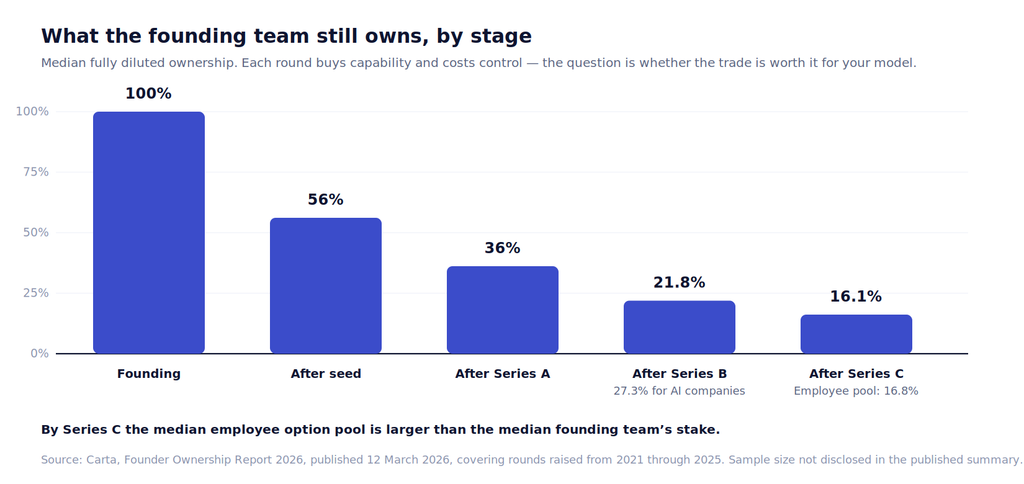
Carta’s Founder Ownership Report 2026 found the median founding team retains about 56% after seed, 36% after Series A, and 21.8% after Series B — 27.3% for AI companies. By Series C, the median employee option pool (16.8%) is larger than the median founding team’s remaining stake (16.1%).[1]
None of that is an argument against raising. It is an argument for knowing what you are buying with each round, and for being able to name the specific capability the money purchases — because you are paying for it in a currency that does not come back.
The four factors
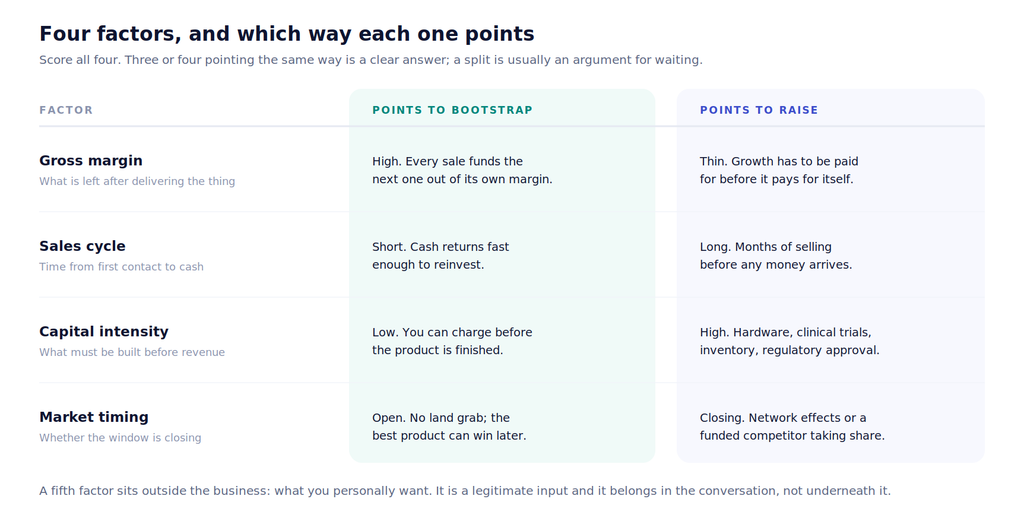
Gross margin determines whether growth can pay for itself. A business keeping 80% of every sale can fund the next customer out of the last one. A business keeping 25% cannot, and will need capital to grow at any speed — which is why services businesses with thin margins and software businesses with fat ones end up on different paths despite similar revenue.
Sales cycle determines how quickly that margin comes back. Cash returning in thirty days behaves completely differently from cash returning in nine months, even at identical annual revenue. Long cycles consume working capital in a way that looks like a growth problem and is actually a timing problem.
Capital intensity is the most decisive of the four and the least negotiable. If you must build a factory, run a clinical trial, hold inventory or obtain regulatory approval before anyone can pay you, the bootstrapping question largely answers itself. Software has an unusual property here that founders in other sectors do not enjoy: you can often charge before the product is finished.
Market timing is the one most often invented. Genuine land grabs exist — where network effects mean the largest player wins permanently, or where a funded competitor is taking the accounts you need. But “the window is closing” is also the most common rationalisation for raising money without a specific use for it. The test is whether you can name the mechanism by which being second is fatal.
If you cannot say what the money buys that you cannot otherwise get, you are not raising for a reason. You are raising because it is what companies like yours do.
The arithmetic nobody runs
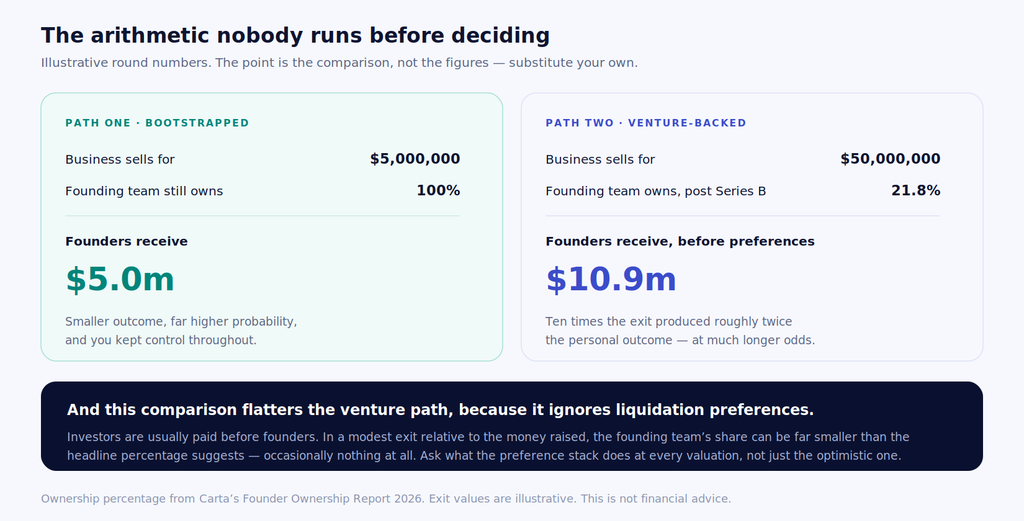
The comparison is uncomfortable and worth sitting with. A ten-times-larger exit produced roughly twice the personal outcome, at considerably longer odds. That does not make the venture path wrong — a $50m outcome may be the only version of this business worth building, and some problems cannot be solved at $5m scale. But it does mean the venture path has to be justified by something other than the size of the headline number.
And the real arithmetic is worse than shown, because of liquidation preferences. Investors are typically paid before founders. In an exit that is modest relative to the money raised, the founding team’s proceeds can be far below what the ownership percentage implies, and occasionally nothing. Ask your adviser what the preference stack pays out at several valuations, not just the optimistic one. Founders discover this at exit far more often than at signing.
What each path actually optimises for
| Bootstrapped | Venture-backed | |
|---|---|---|
| Speed | Constrained by cash generated | Constrained by hiring and execution |
| Control | Yours, including the decision to stop | Shared, with obligations to a growth trajectory |
| Acceptable outcomes | A profitable business at any size is a success | A modest outcome may not clear the preferences |
| Failure mode | Growing too slowly to matter | Growing too fast to be sustainable |
| Exit options | Sell, hold, pay yourself dividends, or neither | Sell or keep raising; holding is rarely available |
| Who you answer to | Customers | Customers and a board |
The row founders weigh least and regret most is the third. Raising redefines what counts as success. A company that would have been an excellent outcome at $8m becomes a disappointment once $6m has been invested against a much larger expectation — and that reframing is permanent.
The middle paths
The debate is usually framed as binary and rarely is.
- Bootstrap first, raise later. Reach revenue on your own, then raise at a materially better valuation with real leverage. Slower, and the strongest position available to most software businesses.
- Raise a small amount, once. A single modest round to clear a specific obstacle, with no assumption of a next one. Unfashionable, and appropriate more often than it is used.
- Revenue-based finance or debt. Capital repaid from revenue rather than exchanged for ownership. Well suited to businesses with predictable recurring revenue, and worth understanding properly before dismissing.
- Customer-funded. Prepayments, annual contracts paid up front, or a paid pilot that funds the build. The cheapest capital available, and it comes with validation attached.
- Grants and non-dilutive schemes. Slow, administratively heavy, and free. Particularly relevant in deep tech, climate and health, and in several of the markets where founder-visa routes operate.
Consulting revenue as a bridge
Funding product development with services income is a genuine middle path, and a genuinely risky one. It works when the consulting work is in the same domain as the product and generates customer insight. It fails when the consulting becomes the business by accident — which happens gradually, and is usually only noticed a year later. Set a revenue mix you will not cross, in writing, before you start.
How to decide
- Score the four factors honestly. Honestly is the operative word — founders who want to raise discover closing windows everywhere.
- Name what the money buys. One sentence, specific: eighteen months to move from one working channel to three. If you cannot write it, that is the answer for now.
- Model both paths for five years. Include dilution, and include the preference stack. Most founders have never seen these side by side.
- Ask what you want. A legitimate input. Some people want the biggest possible outcome; others want a business they control and can live inside for a decade. Both are respectable and they point different ways.
- Decide, and write down what would change it. The decision is not permanent — but revisiting it every time something is hard is its own failure mode.
Five bad reasons to raise
- Everyone else is. Your peer group’s funding announcements tell you about their business models, not yours.
- It validates the idea. It validates that one investor believed a pitch. Customers validate the idea, and they pay you instead of the reverse.
- To pay ourselves a salary. A legitimate need and the wrong instrument. Investors fund growth, not stability, and the runway question will surface immediately.
- To buy time to find product–market fit. Capital buys time to solve a known problem. Time alone does not find fit, and a larger team searching is slower than a small one.
- Because a term sheet appeared. Being offered money is not a reason to take it, and taking it because it was offered is how founders end up on a trajectory they never chose.