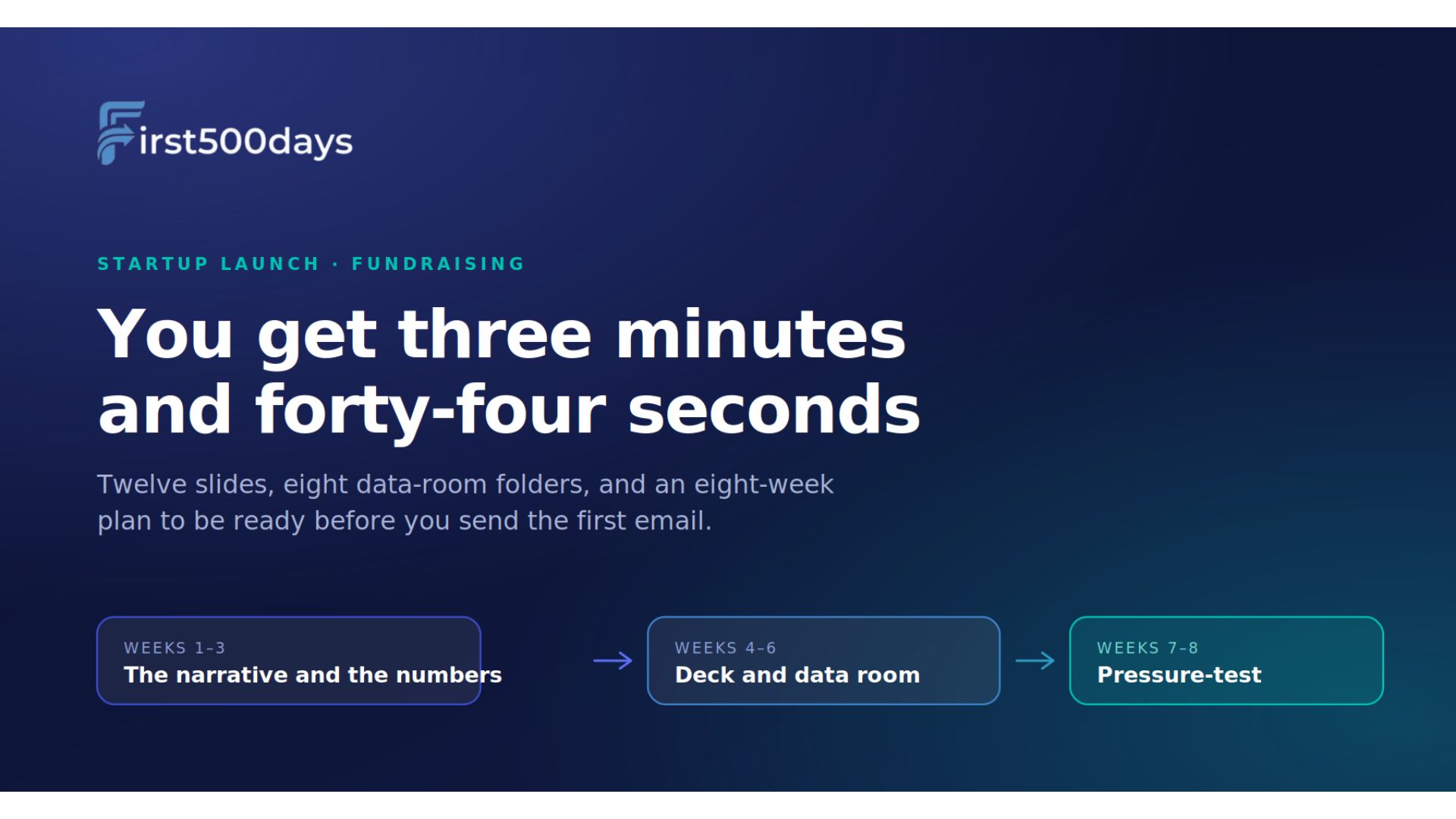
Fundraising fails on preparation more often than on merit. The deck gets under four minutes of attention, the data room gets weeks of scrutiny, and the narrative is what has to survive both. Eight weeks is enough to build all three — before you send the first email.
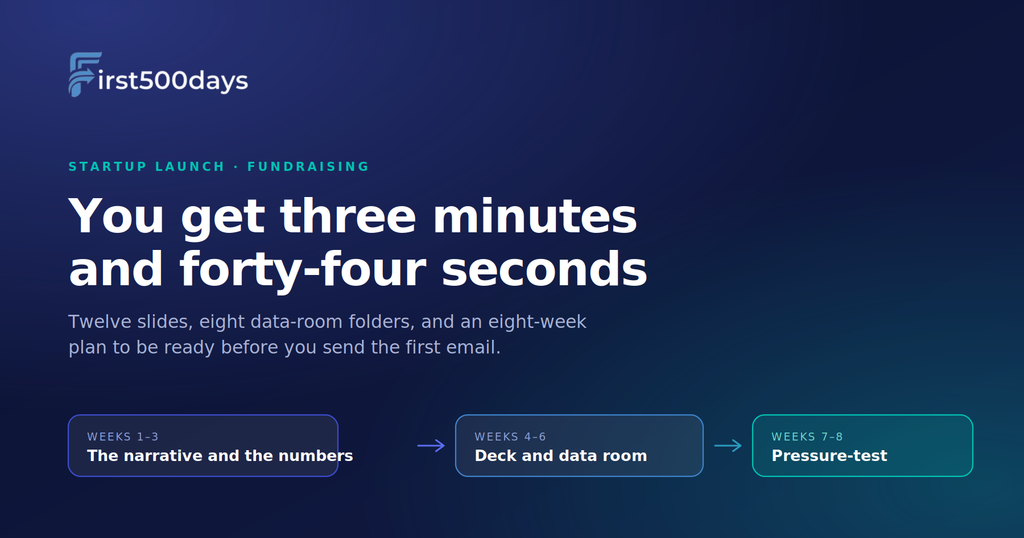
Being investor-ready means three things exist and agree with each other: a twelve-slide deck where every slide proves something, a data room organised into eight folders and assembled before diligence begins, and a narrative connecting what you have already proved to what the money will prove next. Budget eight weeks — three on the narrative and numbers, three on the deck and data room, two on pressure-testing.
Almost none of that work is design. Founders reliably spend their preparation time on slide aesthetics and almost none on the financial model’s assumptions, which is precisely the reverse of where the scrutiny falls.
How little time the deck actually gets
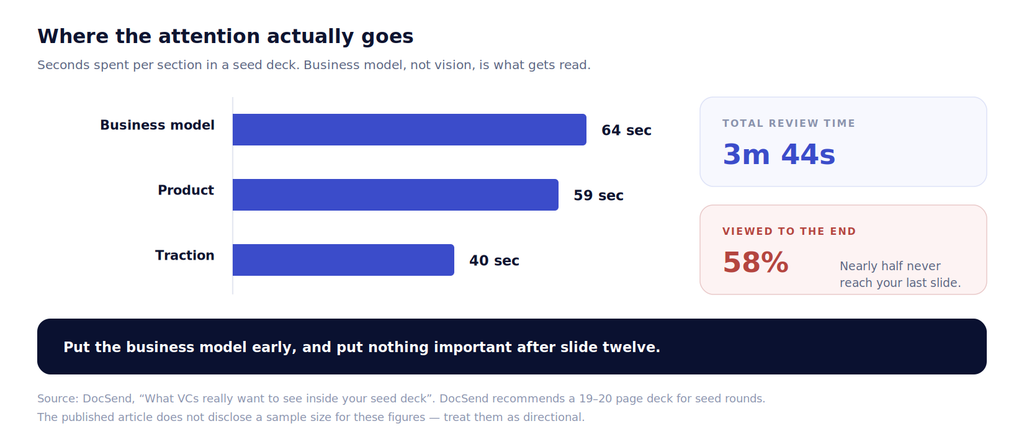
DocSend’s analysis of seed decks found an average review time of three minutes and forty-four seconds, with only 58% of decks viewed to completion. Business model drew the most attention at 64 seconds, followed by product at 59 and traction at 40.[1] Their published article does not disclose a sample size for these figures, so treat them as directional rather than precise — but the direction is unambiguous and matches what founders report.
Two things follow. First, the vision slide most founders labour over is not where the time goes; the business model is. Second, anything genuinely important placed after slide twelve has a meaningful chance of never being seen.
The deck’s job is not to close the investment. It is to earn the meeting, and to survive being forwarded to a partner who was not on the call.
The twelve slides
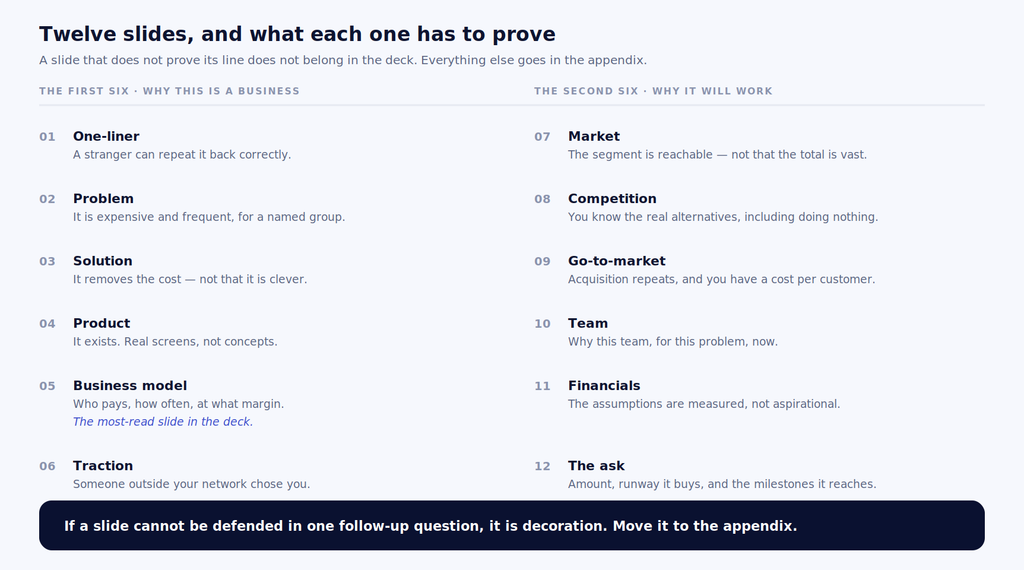
Three of these are where decks most often fail.
Traction (6). The question is not how much revenue but where it came from. Revenue generated entirely by the founder’s network reads very differently from revenue generated by a repeatable channel, and investors will ask. Show the split before they do.
Market (7). The instinct is to present the largest defensible total addressable market. The better move is to present the reachable segment, with an honest route to it. A vast market you cannot reach is a weaker position than a modest one you can, and experienced investors read an inflated TAM as a lack of specificity rather than as ambition.
Financials (11). A forecast with visible assumptions is more credible than a confident one. Mark which numbers are measured and which are assumed, and state what would have to be true for the assumed ones to hold. Founders fear this looks weak; it reads as competence.
The narrative
The narrative is the connective tissue, and it is the part that cannot be outsourced. In its simplest form it is four sentences: what changed in the world to make this possible now, what we have proved so far, what we have not yet proved, and what this money buys us the ability to prove.
That fourth sentence is where most pitches are vague and where investors are most attentive. “Eighteen months of runway” is not a milestone. “Eighteen months to get from one working acquisition channel to three, and from £40k to £150k of monthly recurring revenue” is a claim someone can evaluate — and, importantly, one you can be held to.
The third sentence matters more than founders expect. Naming what you have not proved, before you are asked, does two things: it demonstrates that you understand your own risk profile, and it lets you frame the risk rather than having it framed for you in a partner meeting you are not in.
The data room
The deck gets minutes. The data room gets weeks, and it is where rounds actually stall.
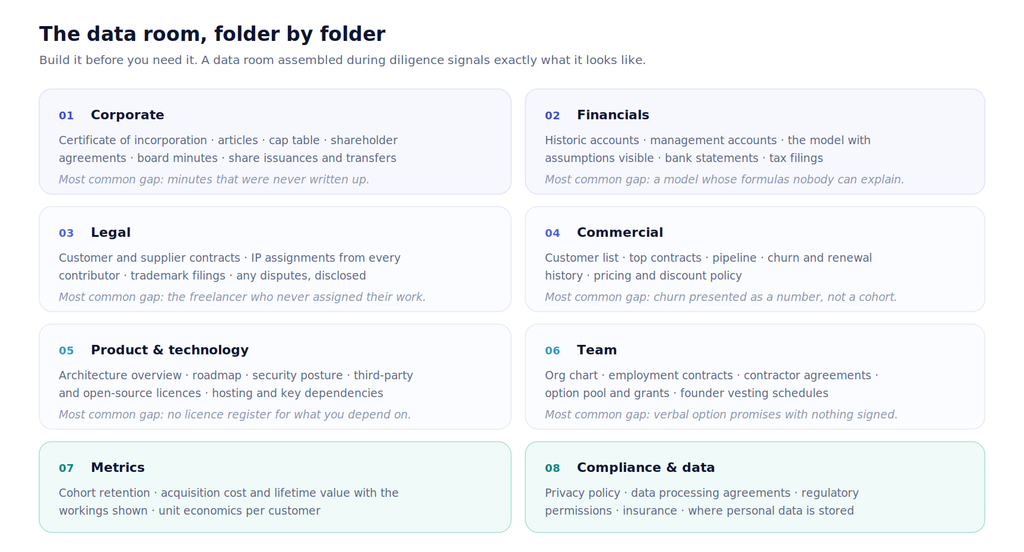
Build it before you start raising. A data room assembled during diligence is visible as one — documents arrive late, in inconsistent formats, and each request generates a new one. Every day of delay is a day for enthusiasm to cool and for the investor to see other opportunities.
Two folders account for most of the trouble. Legal, because IP assignments from early contributors are missing more often than not — the freelancer who built the first landing page, the designer who did the logo, the co-founder who wrote code before the company existed. And Team, because option promises made verbally have a way of surfacing exactly when a cap table is being scrutinised.
Fix the gaps before you open the room, not during
A missing IP assignment discovered during diligence is negotiated from a position of weakness — the contractor now knows exactly how much you need their signature. The same conversation six months earlier costs a friendly email and a small fee. Audit the room before you need it.
The eight-week plan
| Weeks | What you do | What exists at the end |
|---|---|---|
| 1–2 | Assemble the real numbers: cohorts, unit economics, acquisition by channel, churn. Rebuild the model from measured inputs. | A model whose every assumption you can defend |
| 3 | Write the narrative as prose before it becomes slides. Four sentences, then a page, then a story. | A one-page narrative that survives being read aloud |
| 4–5 | Build the twelve slides from the narrative. Appendix everything that does not prove its line. | A deck under twenty pages with a defensible appendix |
| 6 | Assemble the data room and audit it for the gaps in the graphic above. | Eight folders, populated, with gaps closed or disclosed |
| 7 | Pressure-test with people who will be blunt: an operator, a finance person, and someone who has raised recently. | A revised deck and a list of questions you cannot yet answer |
| 8 | Answer those questions. Build the target investor list and the sequencing plan. | Readiness, and a list — in that order |
The order matters. Founders who start with the deck end up writing a narrative that fits the slides they have already made, which is backwards and shows.
Questions you will be asked
Prepare answers to these before the first meeting, not after the third.
- Where did your customers come from? Testing whether acquisition is repeatable or personal.
- Why has nobody done this already? Testing whether you understand your market’s history, not whether you are original.
- What happens if you do not raise? Testing whether the business has a path without them — which materially improves your position.
- What is the biggest risk? Testing self-awareness. A founder who names a real risk is more fundable than one who claims there are none.
- Who churned, and why? Testing whether you look at your own bad news.
- What would you do with half the money? Testing whether the plan is a plan or a wish list.
Six preparation mistakes
- Starting the process before the evidence exists. A deck cannot compensate for six months of missing traction, and a failed process makes the next one harder because investors remember.
- Optimising design over substance. Under four minutes of attention, and none of it on your gradient choices.
- Hockey-stick forecasts. A model requiring conversion rates you have never achieved invites scrutiny of everything else in the deck.
- Hiding the bad news. Churn, a failed channel, a departed co-founder — all of it surfaces in diligence, and surfacing it yourself is worth more than the discomfort.
- Approaching the best investors first. Sequence the list so early conversations are practice. The pitch improves measurably after five meetings.
- Treating the round as the milestone. Capital is a tool for a specific job. If you cannot name the job, that is what the meeting will reveal.