There is no standard first five. There is a constraint, and the right hire is whoever removes it. Hiring against an imagined org chart instead is the single most reliably fatal mistake in early scaling — and there is data on exactly how fatal.
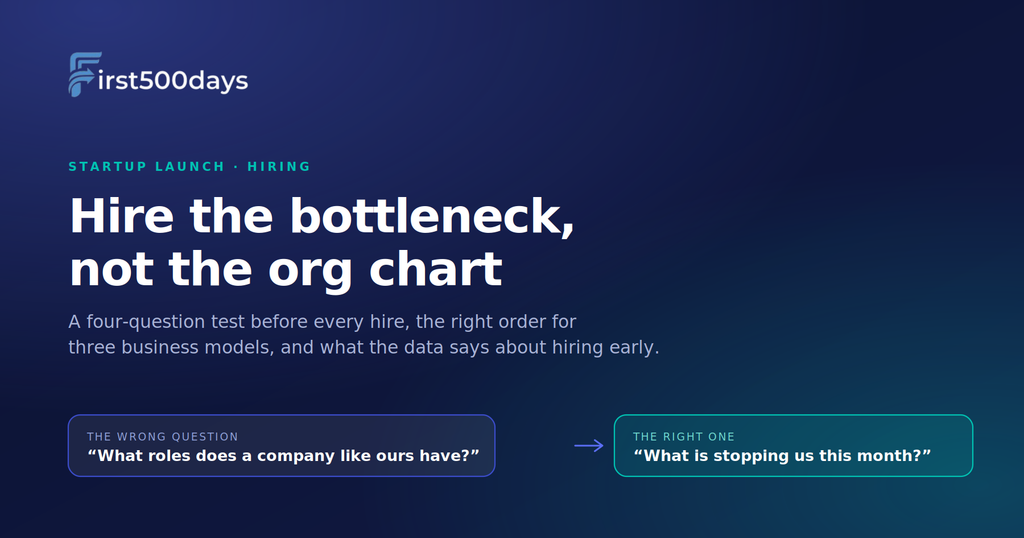
Hire when four things are true: the role is genuinely the constraint on the company right now, it has been the constraint for about three months, it cannot be solved by buying software or contracting the work, and you can describe in one sentence what the person will have achieved in ninety days. The order of your first five follows your business model — what a SaaS company makes scarce is not what a services business or a marketplace makes scarce.
The cost of getting this wrong is not a bad hire. It is a good person in a role the company did not yet need, which is harder to diagnose and slower to correct.
What the data says about hiring early
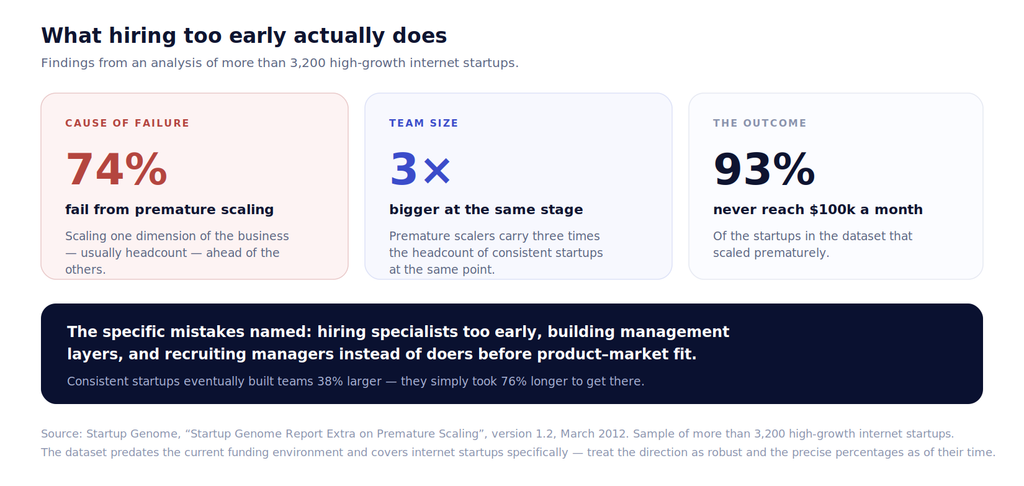
The Startup Genome study found that around 70% of the startups in its dataset scaled prematurely, that 74% of high-growth startup failures were attributable to premature scaling, and that premature scalers carried roughly three times the headcount of consistent startups at the same stage.[1] The specific mistakes it names are worth reading slowly: hiring specialists too early, building management layers, and recruiting managers rather than individual contributors before product–market fit.
The most useful finding is the least quoted one. Companies that scaled responsibly eventually built teams 38% larger — they simply took 76% longer to get there. Restraint early is not a smaller company. It is the same company, later, still alive.
The dataset is now over a decade old and covers internet startups specifically, so treat the direction as robust and the precise percentages as of their time. The mechanism has not changed.
Headcount is a consequence of a working motion, not a cause of one.
The test to run before every hire
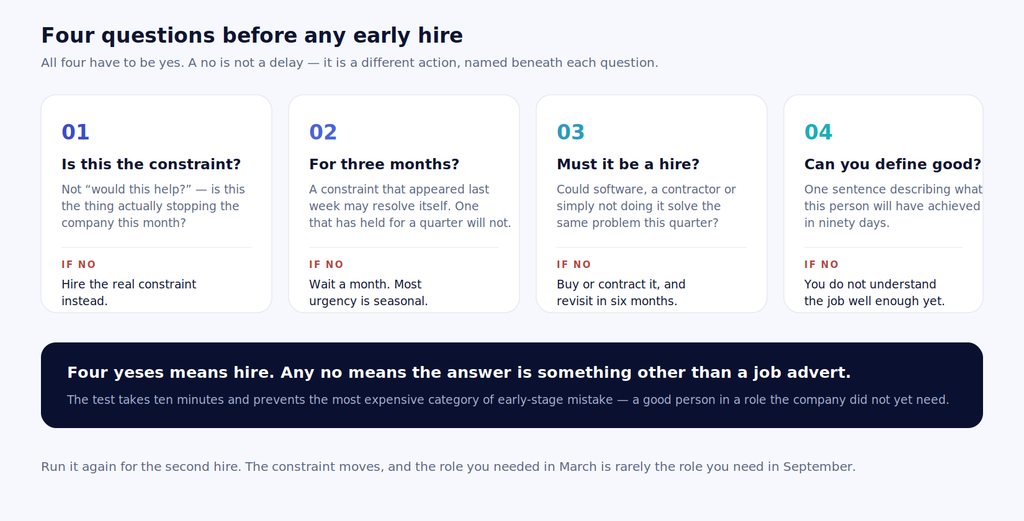
Question three is the one founders skip. A surprising share of early hiring exists to solve problems that software solves better, or that a contractor can cover for two days a month at a fraction of the cost. Bookkeeping, design, recruitment, legal, first-line support tooling — all of these are frequently hired when they should have been bought.
Question four is a quiet diagnostic of something else. If you cannot write one sentence describing what success looks like in ninety days, you do not yet understand the job well enough to interview for it, let alone to manage it. Founders often discover at this point that they want help rather than a specific role, which is a different and cheaper problem to solve.
The order, by business model
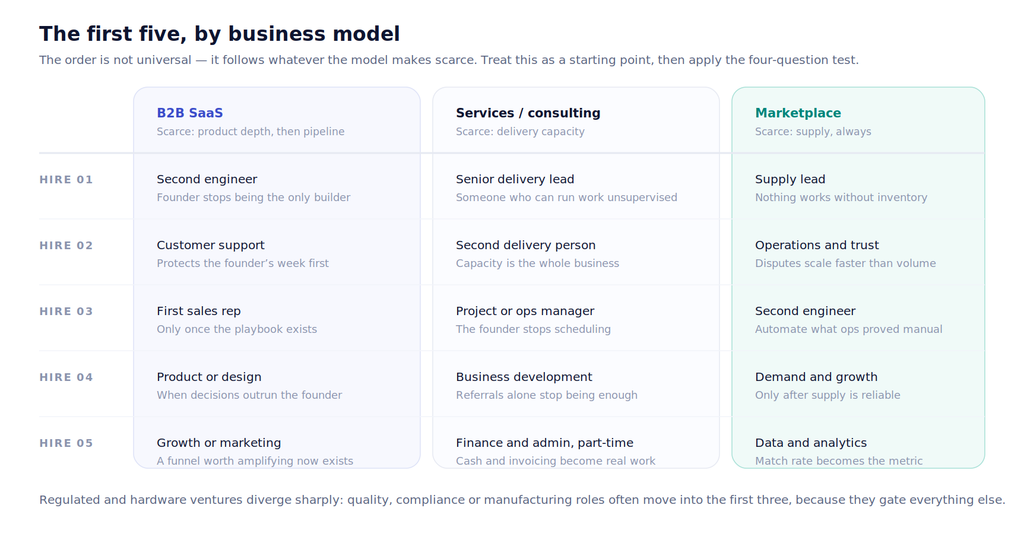
The logic behind each column is worth stating plainly.
SaaS is constrained by product depth first and pipeline second. The second engineer removes the founder as the single point of build; support arrives next because it protects the founder’s week more than any other hire; sales comes third and only once a playbook exists.
Services businesses are constrained by delivery capacity from day one, because revenue is directly bounded by hours. The first two hires deliver; the third takes scheduling and account management off the founder. Business development comes fourth — earlier than in SaaS, because referrals stop being sufficient sooner than founders expect.
Marketplaces are constrained by supply, always, and usually for longer than the founders plan for. Demand-side hiring before supply is reliable produces a bad experience at scale, which is worse than a small one.
Regulated and hardware ventures break the pattern entirely: quality, compliance or manufacturing roles often belong in the first three, because they gate everything downstream and cannot be deferred.
Employee, contractor, or neither
The permanent-hire instinct is expensive and frequently unnecessary at this stage.
| Arrangement | Right when | The real cost |
|---|---|---|
| Permanent employee | The work is continuous, core, and needs company context to do well | Fixed cost with a lagged return; slow and expensive to unwind |
| Contractor | The work is bounded, specialist, or you are still learning what the role is | Availability is not guaranteed; IP must be assigned in writing |
| Fractional senior | You need judgement a few days a month, not capacity | High day rate; only works if the scope is genuinely advisory |
| Buy software instead | The problem is repetitive and well-defined | Configuration and maintenance time nobody budgets for |
Two cautions on contractors specifically. First, in many jurisdictions a contractor retains rights in what they create unless there is a written assignment — a paid invoice is not a transfer of ownership. Second, employment status is determined by how the relationship actually works rather than by what the contract calls it, and getting that wrong carries real liability. Both are worth ten minutes of proper advice, especially when the person is in a different country from the company.
Hiring across borders
Increasingly the best candidate is not in the same country as the entity. Three practical routes, in rising order of cost and commitment:
- Contractor, invoicing directly. Fastest and cheapest, appropriate for genuinely independent work. Carries misclassification risk if the person works like an employee.
- Employer of record. A third party employs them locally on your behalf. Compliant, quick, and priced accordingly — usually worth it for one or two people in a market you are testing.
- Your own local entity. Makes sense once you have several people in one country, or where an entity is required for other reasons such as selling locally.
The mistake to avoid is treating the cheapest option as the default without checking how the relationship will actually operate. A full-time person, working your hours, using your systems, managed by you, is generally an employee in substance whatever the paperwork says.
The first hire is a culture decision, whether or not you intend it
At five people, one person is 20% of the company. What they tolerate becomes normal, and how they treat customers becomes how the company treats customers. This argues for hiring slowly on the first two and for being unusually willing to correct a mismatch early — not because the person is bad, but because the multiplier is large.
What to pay
Early-stage compensation is a trade between cash and equity, and the honest version of that conversation is short: below-market salary should come with meaningful equity and an explicit acknowledgement that the equity may be worth nothing.
Two practical guides. Benchmark salary against the market the person lives in, not the market your company is registered in — the alternative feels like arbitrage to the candidate and predicts a short tenure. And apply the same vesting to early employees as to founders, for the same reason: it makes an imperfect decision survivable.
Avoid the pattern of paying below market with vague equity and a promise to fix it after the raise. It selects for people without other options, which is not the pool you want for the first five.
Six mistakes
- Hiring the org chart. Building the team of the company you hope to become rather than the one you have. This is the failure the Startup Genome data describes.
- Hiring a manager first. A head of anything with nobody to lead will build process for a motion that does not exist. Individual contributors first.
- Hiring specialists too early. Named explicitly in the research. Generalists who can do three jobs adequately beat specialists who can do one job excellently at five people.
- Hiring to escape a task the founder dislikes. Frequently the task is the one the founder should still be doing. Sales is the usual example.
- Waiting for the perfect candidate. The mirror-image error. If the constraint has held for three months and a good-enough candidate is available, the cost of waiting exceeds the cost of imperfection.
- Keeping a mismatch too long. At five people this is not kindness. Everyone knows, including the person, and the delay damages both sides.