Founder-led selling works right up until the founder becomes the constraint. The transition out of it is not a hiring decision — it is a documentation problem, and hiring before you have solved it is how companies lose a year and a salary.
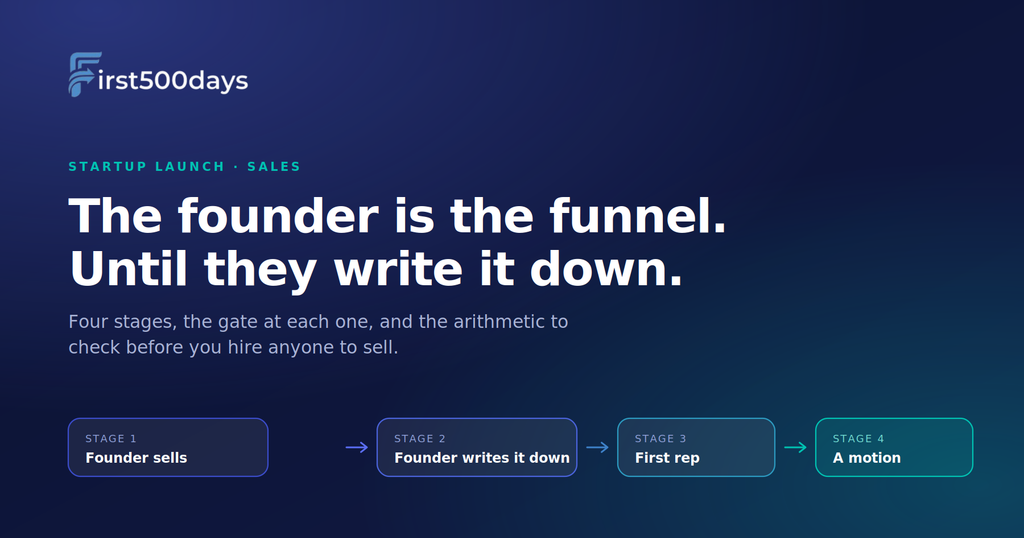
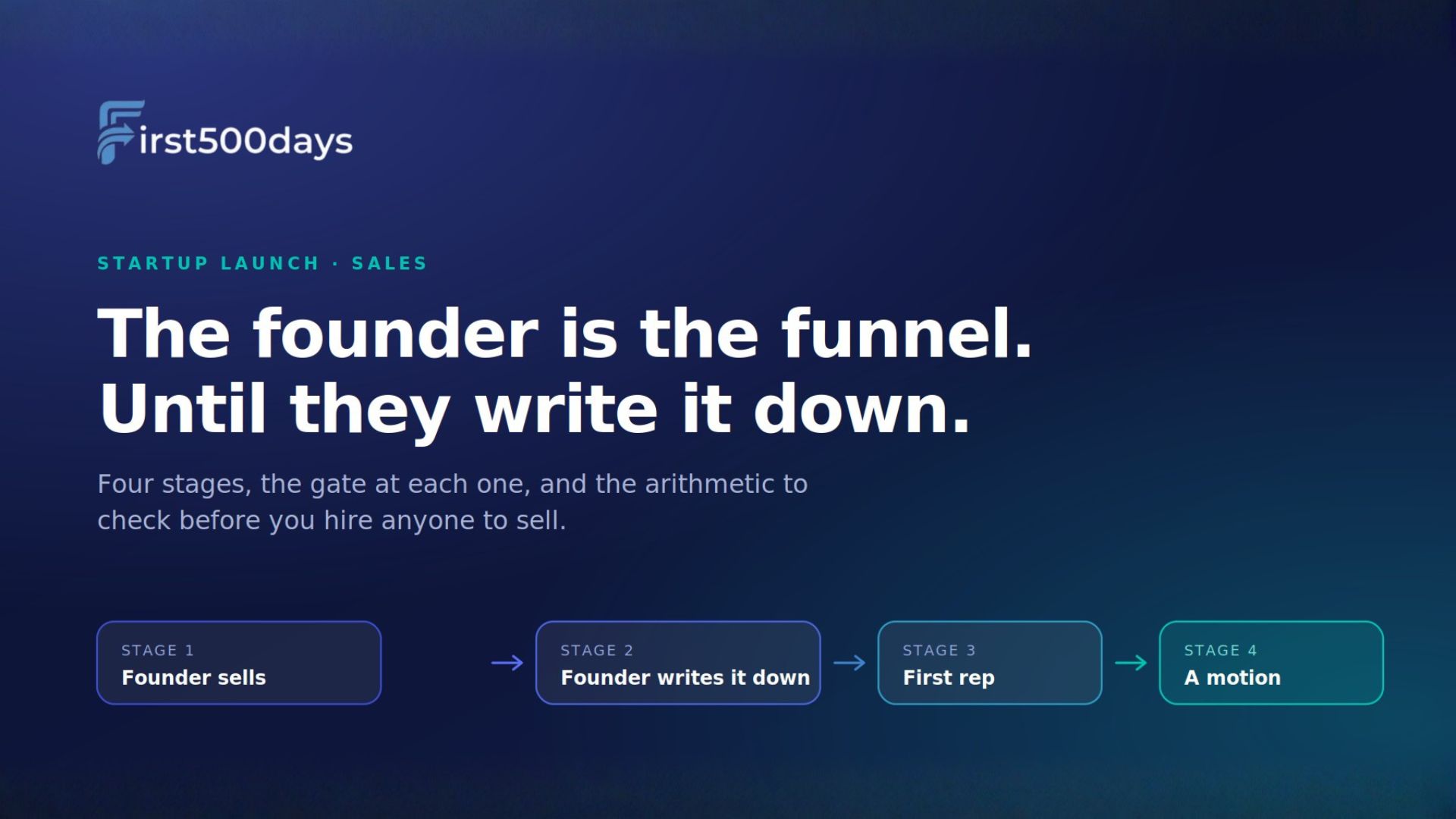
Moving from founder-led sales to a repeatable motion happens in four stages, each with a gate that has to be passed before the next begins: the founder sells everything until they can predict which conversations close; then writes down what they know until the win reasons repeat; then hires one rep and stays in the room until that rep closes three deals alone; and only then hires more. The unit economics have to clear two tests before any of that hiring is affordable.
The mistake this article exists to prevent is common and expensive: hiring a salesperson to fix a sales problem the founder has not yet understood. When it fails — and it usually does — nobody can tell whether the hire was wrong or the proposition was.
Why founder-led selling has to come first
The founder is not selling because they are the best salesperson in the company. They are selling because they are the only person who can change the product in response to what they hear, and because early sales conversations are simultaneously research.
That dual purpose is exactly what cannot be delegated. A rep can be told what to say; they cannot notice that three prospects in a row described the problem in a way nobody internally has considered, and then rewrite the positioning that afternoon. Until that loop has run enough times to produce a stable pattern, hiring simply outsources the discovery to someone with no authority to act on it.
Founder-led sales is not a stage you endure until you can afford real salespeople. It is the mechanism that produces the thing real salespeople will later sell.
The four stages, and the gate at each one
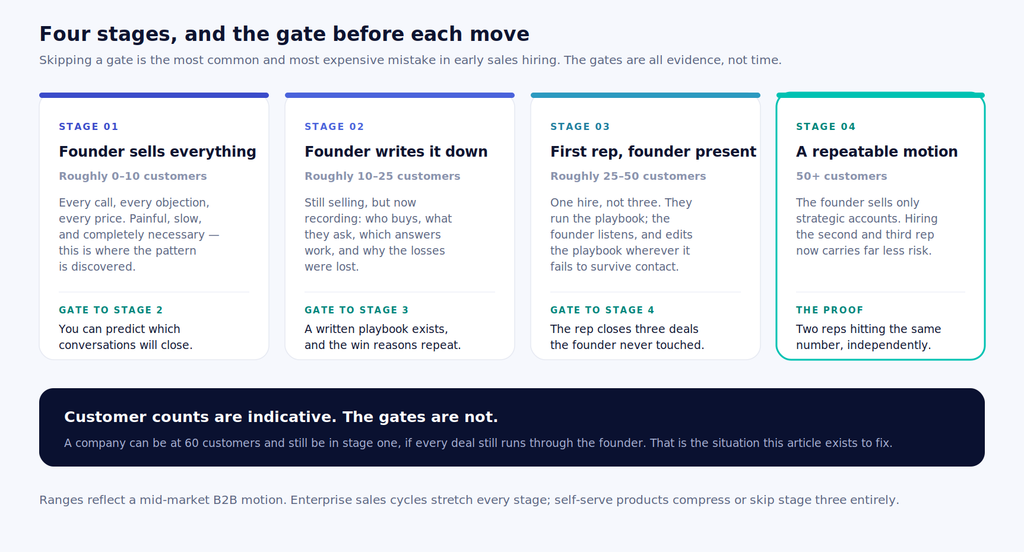
The gate between stages one and two is the one founders judge wrongly most often. “I can predict which conversations will close” means something specific: before the second call, you can name the two or three signals that determine the outcome, and you are right most of the time. If your forecast is really hope with a spreadsheet attached, the pattern has not arrived yet and more calls are the answer.
The gate into stage four — a rep closing three deals the founder never touched — is deliberately strict. One closed deal proves the rep is capable. Three proves the playbook is.
What actually has to be written down
“Document your sales process” is advice everyone agrees with and few act on, because it is not specific enough to start. Here is the specific version.
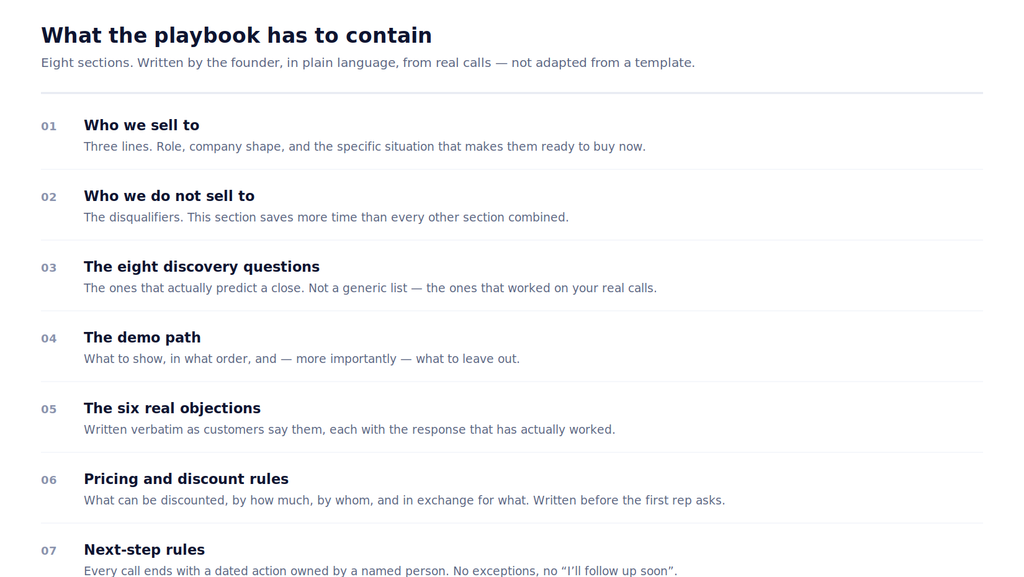
Two sections carry disproportionate weight.
Who we do not sell to. Founders resist writing disqualifiers because every prospect feels like a possible customer when there are few of them. But a rep without disqualifiers will chase everything, and the cost is not the lost deals — it is the four months spent on a pipeline that was never going to close, discovered too late to correct.
Why we lose. Recorded verbatim, not summarised. “Price” is almost never the real reason; it is the polite reason. What sits underneath — the value was not established, the wrong person was in the room, the timing was wrong, a competitor was already embedded — is where the improvements come from. Ask every lost prospect one question: what would have needed to be different? People who have just said no are unusually honest.
Record the calls
With consent, and subject to the rules in your jurisdiction. Reviewing recordings is the fastest way to notice that the objection you thought you handled well is the one you lose on — and the fastest way to onboard a first rep, who can hear thirty real conversations in their first week instead of shadowing three.
Before you hire: the arithmetic
A salesperson is a substantial fixed cost with a lagged return. Two standard tests tell you whether the business can absorb one, and it is common for them to disagree.
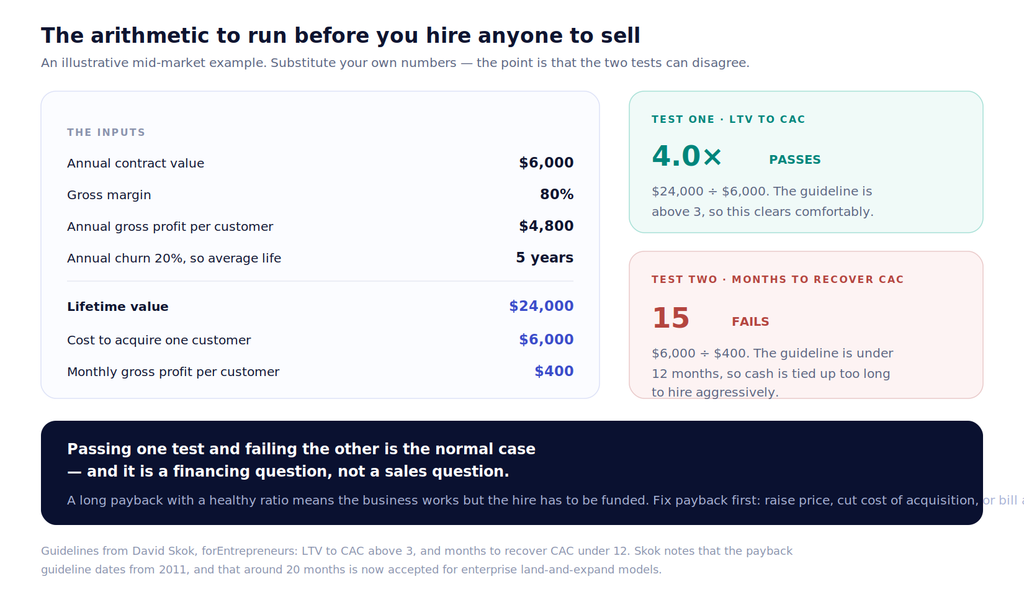
David Skok’s widely used guidelines are that lifetime value should exceed acquisition cost by more than three times, and that months to recover acquisition cost should be under twelve.[1] Skok himself notes that the payback guideline was written in 2011, when capital was scarce, and that around twenty months is now accepted for enterprise land-and-expand models — which is a useful reminder that these are guidelines rather than laws.
When the ratio is healthy and payback is slow, the business works but the hire has to be financed. The fixes are ordered: raise price, reduce acquisition cost, or move to annual billing paid up front. All three are faster than raising money to cover the gap.
Hiring the first one
The first sales hire is not the same job as the fifth, and hiring for the wrong version is the most common error.
| Look for | Why | Warning sign |
|---|---|---|
| Comfort with ambiguity | The playbook is incomplete and they will hit gaps weekly | “What’s the process for this?” asked as a blocker rather than a question |
| Curiosity about the customer | They are still doing discovery, not just closing | Talks about their numbers, never about the buyers |
| Willingness to write | They should be improving the playbook, not just using it | Treats documentation as admin |
| Experience at your stage | Selling an unknown brand is a different job from selling a known one | Great record at a company with inbound leads and a brand |
On compensation: a base-to-variable split of roughly 50/50 to 60/40 is common for early sales hires, with the variable tied to closed revenue rather than activity. Set the target from your own real conversion rates, not from ambition — a target the founder has never personally hit is not a target, it is a resignation letter with a delay.
Give them six months before judging. A ramp of three to four months is normal in B2B, and firing at month three tells you nothing except that ramping takes longer than three months.
What the founder keeps
Not everything transfers, and pretending otherwise damages both the company and the rep. The founder should stay on strategic accounts where their presence genuinely changes the outcome, on any deal that requires a product commitment, and on the first conversation with any new segment — because that is discovery again, and discovery does not delegate.
What the founder should stop doing is the middle of the funnel: the second demo, the follow-up, the scheduling, the routine negotiation. That is where their time leaks and where a competent rep is genuinely better.
Signals the transition is working — and that it is not
| Working | Not working |
|---|---|
| The rep loses deals for reasons already in the playbook | Every loss is explained as “they wanted a feature we don’t have” |
| The playbook is edited monthly | The playbook has not changed since it was written |
| Deals close without the founder joining a call | The rep asks the founder to “come in at the end” on every deal |
| Forecast accuracy improves quarter on quarter | Forecasts are consistently optimistic and nobody can say why |
| The founder’s calendar has changed shape | The founder is still in as many calls as before, plus managing |
That last row is the honest one. If the founder’s week looks identical after the hire, the motion has not transferred — it has been supplemented.
Five mistakes
- Hiring to escape selling. Founders who dislike selling hire early and delegate the one thing that cannot be delegated yet. The discomfort is not the signal; the pattern is.
- Hiring two reps at once. With one, a failure is diagnosable. With two, you cannot tell whether it was the people, the playbook or the market.
- Hiring a leader before an individual contributor. A sales leader with nothing to lead will build process for a motion that does not exist yet. That hire comes after two or three reps are working.
- Setting the target from the plan. Quotas derived from the fundraising model rather than from observed conversion rates produce misses that look like people problems.
- Keeping the best leads. Founders who route the promising prospects to themselves and the rest to the rep are running an experiment guaranteed to fail.