
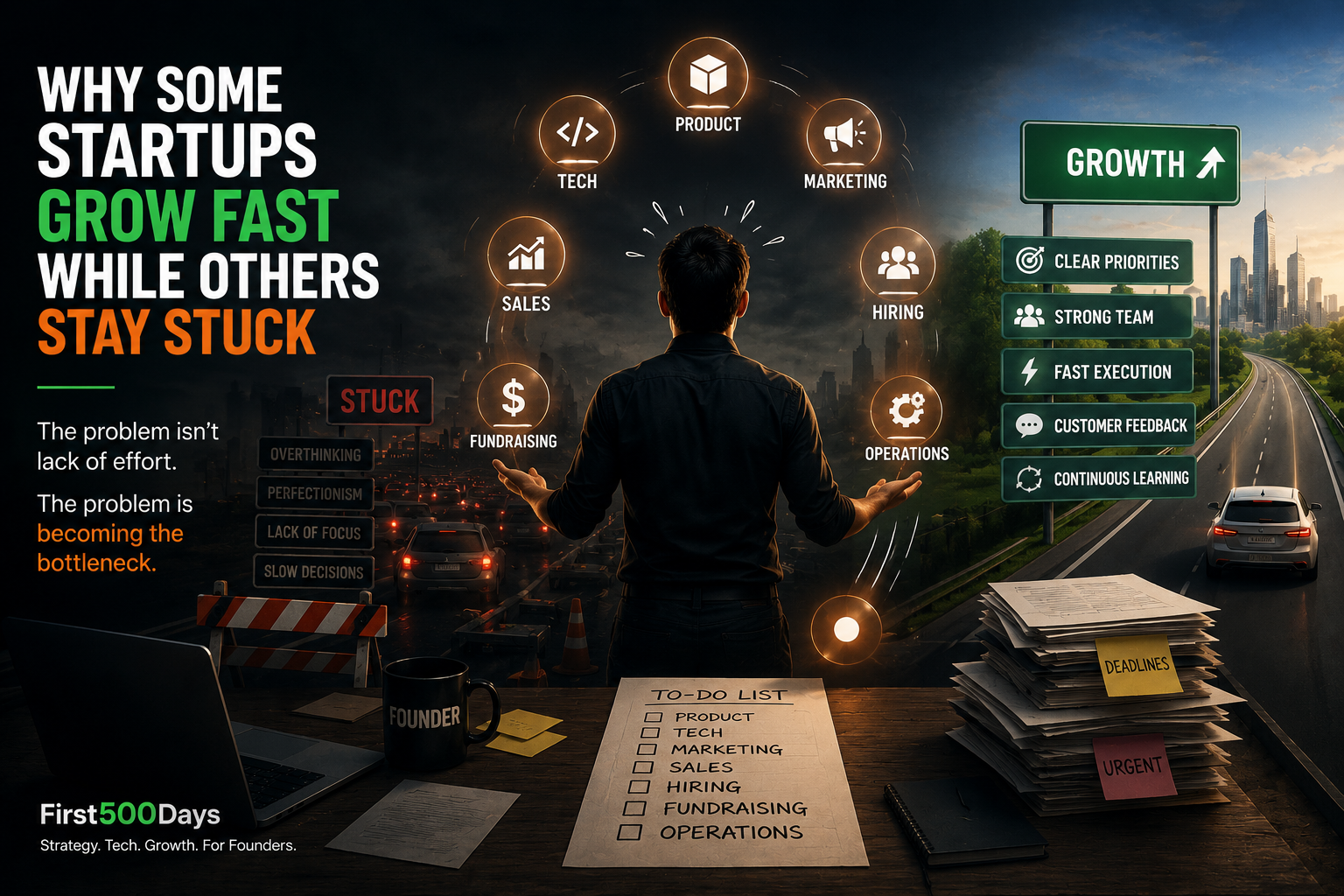
Every Startup Begins With Excitement
Every startup begins with optimism.
Founders start with a vision of what their business could become. They imagine the product, the customers, the launch, and eventually the growth that follows. In the early days, progress feels tangible because every decision creates movement. Building a prototype, speaking to customers, securing the first users, or even setting up the company feels like momentum.
However, as the startup evolves, a noticeable gap begins to emerge.
Some startups launch quickly, learn quickly, acquire customers, and continue building momentum. Others spend months moving in circles. They are still refining the product, still debating features, still revisiting strategy, and still preparing for a launch that never seems to arrive.
What makes this difference particularly interesting is that it is rarely explained by the quality of the idea itself. Many founders assume that startups grow slowly because the market is difficult, funding is limited, or competition is intense. While those factors certainly matter, they often fail to explain why two startups operating under similar conditions can experience dramatically different outcomes.
More often than not, the difference comes down to execution speed.
Why Founders Become Their Own Growth Constraint
One of the most common patterns in early-stage startups is that founders attempt to manage everything themselves.
In the beginning, this seems reasonable. Resources are limited, hiring is expensive, and there is a natural desire to stay close to every aspect of the business. Founders find themselves making product decisions, overseeing technology development, handling marketing, speaking with customers, recruiting talent, managing operations, and in some cases even preparing fundraising materials simultaneously.
The problem is not that founders are involved.
The problem is that eventually the business becomes dependent on a single individual for nearly every important decision.
As this dependency grows, decision-making slows down. Priorities become less clear. Execution becomes inconsistent because attention is constantly shifting between competing responsibilities. The founder works harder than ever, yet the business does not move proportionately faster.
This is often the point where startups begin to feel stuck.
Interestingly, many founders interpret this situation incorrectly. They assume the problem is lack of effort, when in reality the problem is lack of leverage. Working longer hours rarely solves a structural bottleneck.
Fast-Growing Startups Think About Time Differently
One of the defining characteristics of fast-growing startups is their relationship with time.
Most founders are careful about spending money. Relatively few are equally protective of time.
This creates a paradox. Founders frequently spend months trying to solve problems themselves in order to save money, without realizing that the delay may be costing the business far more than the expense they are trying to avoid.
A startup that spends six months figuring out technology architecture, go-to-market strategy, customer acquisition, or product validation independently may eventually arrive at the correct answer. The challenge is that competitors, customer expectations, and market conditions continue evolving during that period.
The market rarely waits.
Fast-growing startups understand that speed creates optionality. Faster learning leads to faster iteration. Faster iteration leads to better decisions. Better decisions compound over time.
This is why execution speed is often a stronger predictor of startup success than perfection.
The Hidden Cost of Perfection
Another reason startups stay stuck is that founders often mistake readiness for perfection.
The desire to launch the perfect product is understandable. No founder wants customers to experience something incomplete or flawed.
However, perfection can quietly become one of the biggest barriers to growth.
Many startups delay launches because they believe they need a better website, a stronger brand identity, additional features, improved onboarding, or a more polished user experience. While these improvements may add value, they often provide less value than real market feedback.
The startups that grow quickly tend to treat launch as the beginning of learning rather than the final stage of preparation.
They understand that many of the assumptions made inside meeting rooms can only be validated in the market. Customer behaviour, product adoption, pricing, and positioning become significantly clearer once real users start interacting with the product.
Growth is rarely driven by waiting.
It is usually driven by shipping, learning, and improving faster than competitors.
How First500Days Can Help
Building a startup is hard enough.
Figuring out product, tech, growth, and execution all at once makes it even harder.
At First500Days, we help founders move faster with the right strategy, technology, and growth systems—so they can focus on building the business, not solving every problem alone.
Whether you’re validating an idea, building a product, or planning your next stage of growth, we’re here to help.
Explore how we work: https://first500days.com/
Follow us on Instagram: https://www.instagram.com/first500days/
Join our Founder Community: https://chat.whatsapp.com/KAXDPBXZY1Q2WkL8PeriRY?mode=gi_t