
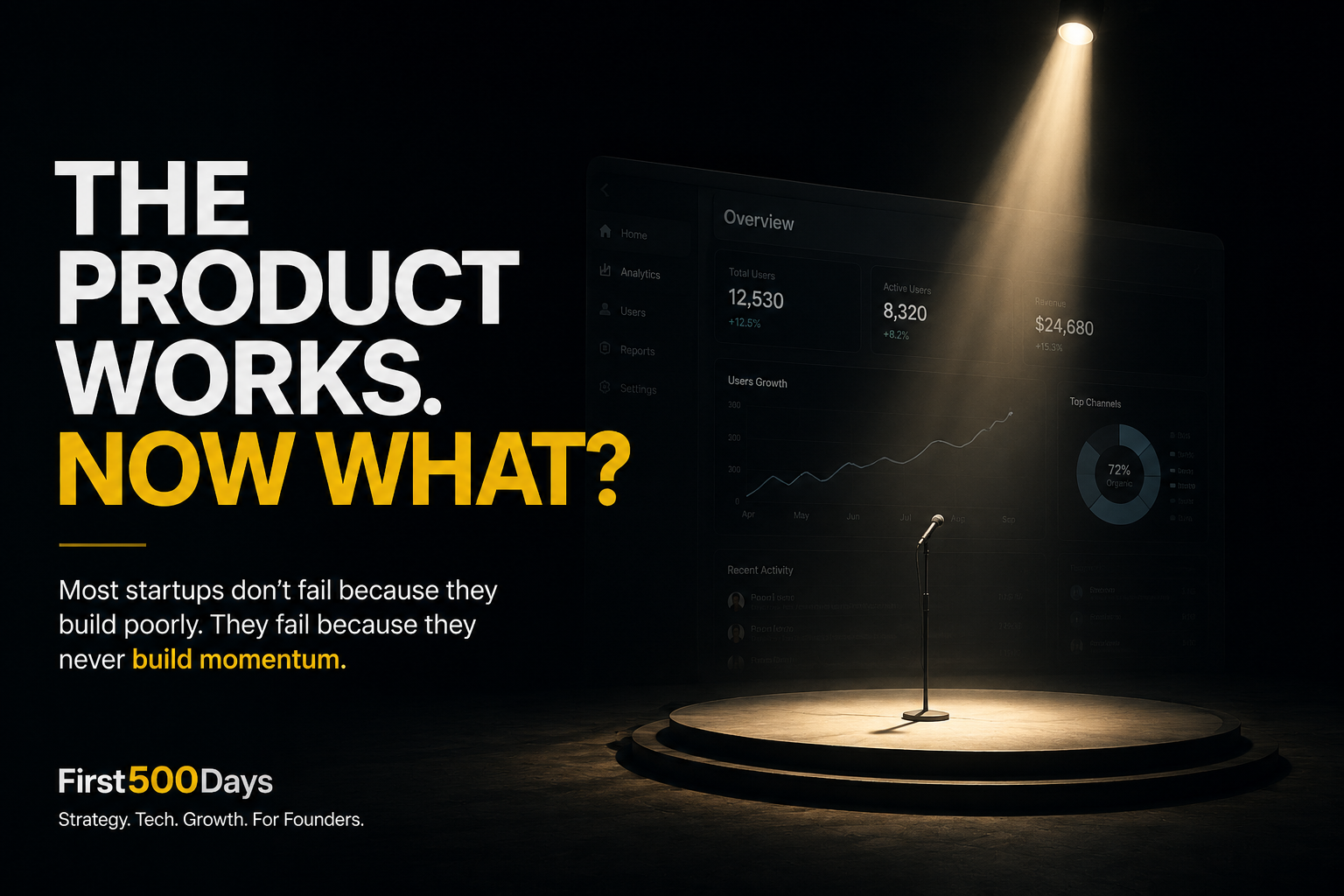
The startup ecosystem has no shortage of great products.
Every year, founders launch platforms with sophisticated technology, thoughtful user experiences, and solutions to genuine market problems. Yet a surprising number of these products struggle to achieve meaningful adoption. Some fade quietly within months of launch, while others continue operating for years without ever finding the growth their founders originally envisioned.
This raises an important question.
If product quality has improved dramatically over the last decade, why do so many products still fail?
The answer lies in a misconception that continues to shape how many founders think about growth.
Building a great product and building a successful business are not the same thing.
For many startup teams, product development receives the majority of attention. Features are refined, interfaces are polished, and engineering roadmaps become the centre of daily operations. The underlying assumption is simple: if the product is good enough, customers will naturally arrive.
In reality, markets rarely work that way.
Customers do not reward products simply because they are well-built. They reward products they discover, understand, trust, and eventually integrate into their lives or businesses. The gap between building something valuable and creating widespread adoption is where many startups struggle.
The Myth of “Build It and They Will Come”
The belief that good products naturally attract users has existed for decades. It is one of the most persistent assumptions in entrepreneurship.
Unfortunately, it is also one of the most expensive.
Today’s consumers operate in an environment defined by abundance. Every category, whether SaaS, e-commerce, fintech, healthtech, or AI, is crowded with alternatives. Customers are constantly exposed to new products, new brands, and new messages competing for their attention.
This means that even genuinely superior products face a difficult challenge.
They must first be noticed.
Research discussed at Storyboard18 and Snapchat’s Gen Z Trend Check highlighted just how competitive attention has become. Industry leaders noted that Gen Z consumers often decide within less than 2.5 seconds whether a piece of content deserves their attention. The implication extends far beyond social media. It reflects a broader shift in consumer behaviour where evaluation windows have become dramatically shorter and competition for attention has intensified.
For startups, this changes the equation entirely.
A product launch is no longer competing only against direct competitors. It is competing against every notification, every creator, every advertisement, and every alternative demanding a customer’s attention at the same moment.
Under these conditions, product quality alone becomes insufficient.
Visibility becomes equally important.
Why Distribution Has Become a Competitive Advantage
Many founders think of distribution as a marketing function.
Increasingly, it is becoming a business function.
Some of the most successful startups of the last decade did not necessarily win because they had the most advanced technology. They won because they built effective systems for acquiring users consistently.
Consider how companies like Notion, Canva, and HubSpot grew.
Their products were important, but their distribution strategies were equally critical. They invested heavily in content, communities, referrals, partnerships, education, and user advocacy. By the time many potential customers evaluated the product itself, trust had already been established through multiple touchpoints.
This reflects a broader reality in modern markets.
Customers rarely move through a neat, predictable funnel anymore.
They may discover a product through a creator, validate it through online reviews, encounter it again through content, discuss it within a community, and only then decide to try it.
The journey is increasingly fragmented.
As Snap India’s Managing Director Pulkit Trivedi noted, the traditional marketing funnel is becoming less linear and more cyclical, shaped by communities, creators, and identity rather than sequential stages of awareness and purchase.
For startups, this means growth cannot be treated as something that happens after launch.
Growth must be designed into the business from the beginning.
The Positioning Problem Most Founders Don’t See
Another reason great products fail is that founders often confuse clarity with familiarity.
After spending months or years building a product, founders understand every feature, workflow, and technical advantage. The product feels obvious to them.
Customers experience something very different.
When a potential user encounters a product for the first time, they are not evaluating the technology. They are trying to answer a much simpler question:
“Why should I care?”
This is where positioning becomes critical.
Strong positioning reduces the effort required to understand a product.
Weak positioning increases it.
In competitive markets, customers rarely spend significant time trying to decode a value proposition. If understanding requires too much effort, attention moves elsewhere.
This is particularly important in an era where consumers increasingly reward relevance over information.
As creators and marketers highlighted during the Gen Z Trend Check discussion, attention today is often driven less by volume and more by relatability, context, and authenticity. People engage with messages that feel immediately relevant to their situation and identity.
The same principle applies to products.
A technically superior product with weak positioning can lose to a simpler competitor that communicates value more clearly.
The Real Challenge Begins After Launch
Building a great product remains one of the most important challenges in a startup.
But in today’s market, product quality alone rarely determines success.
The startups that grow are usually the ones that understand how product, positioning, distribution, and execution work together. They don’t treat growth as a post-launch activity. They build systems that help customers discover, trust, and adopt what they’ve created.
Because after launch, the challenge is no longer building the product.
It’s building momentum.
For founders navigating that journey, the right guidance at the right stage can often save months of experimentation and costly mistakes.
At First500Days, we work with startups across product strategy, technology, and growth to help turn strong ideas into scalable businesses.
If you’re building something and thinking through your next stage of growth, explore how we work at https://first500days.com/ or join our founder community to learn from others navigating similar challenges.