Many international students finish a Master’s in the UK with an idea they’d like to build. Most never start. That’s rarely for lack of ambition. It’s because the path looks confusing: What does my visa allow? Do I need a company first? How do I stay in the UK long enough to build something?
This guide answers those questions in the order you’ll face them. It covers:
- What your visa allows, from Student visa to Graduate visa to Innovator Founder visa
- How to validate your idea before you spend money
- How to choose a business structure and register
- How to plan your route beyond the Graduate visa
Important: Immigration rules change, and everyone’s situation is different. The visa details below were checked against GOV.UK in October 2026. This guide is general information, not legal or immigration advice. Always confirm your own position with a qualified immigration adviser before making decisions.
Step 1: Check what your visa allows
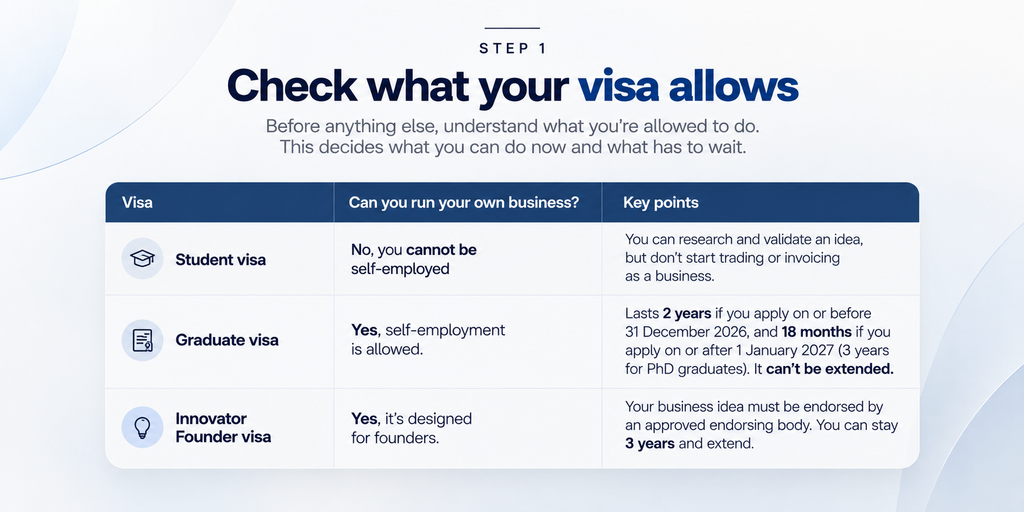
Before anything else, understand what you’re allowed to do. This decides what you can do now and what has to wait.
| Visa | Can you run your own business? | Key points |
|---|---|---|
| Student visa | No, you cannot be self-employed | You can research and validate an idea, but don’t start trading or invoicing as a business |
| Graduate visa | Yes, self-employment is allowed | Lasts 2 years if you apply on or before 31 December 2026, and 18 months if you apply on or after 1 January 2027 (3 years for PhD graduates). It can’t be extended |
| Innovator Founder visa | Yes, it’s designed for founders | Your business idea must be endorsed by an approved endorsing body. You can stay 3 years and extend |
On a Student visa: research, don’t trade
GOV.UK lists being self-employed among the things you cannot do on a Student visa. You can still do the most valuable early work, though: defining the problem, talking to potential customers and testing whether people care. Just don’t start trading. If you’re unsure where the line is, check with your university’s international student advice team.
On a Graduate visa: build, but watch the clock
The Graduate visa lets you be self-employed, which makes it a practical window to start a business. But it can’t be extended, and its length is getting shorter for new applicants: from 1 January 2027 it drops from 2 years to 18 months. If you want to stay in the UK to build long-term, you’ll need to switch to another visa before it ends.
The Innovator Founder visa: the founder route
The Innovator Founder visa is the main UK route for people who want to set up and run an innovative business. According to GOV.UK:
- Your business idea must be new, innovative, viable and scalable, and different from anything else on the market
- It must be endorsed by an approved endorsing body. The endorsement assessment costs £1,000, plus £500 for each meeting with the endorsing body after your visa is granted (at least two)
- You can’t join a business that’s already trading
- You can stay for 3 years, meet your endorsing body at around 12 and 24 months, and extend for another 3 years
- The application fee is £1,357 from outside the UK or £1,693 to switch from inside the UK, plus the immigration health surcharge
- You must meet the English language requirement
The most important takeaway: the endorsing body needs to be convinced your business is real and viable. That means evidence (customers, demand, a clear plan) matters far more than a polished story. Which brings us to Step 2.
Step 2: Validate your idea before you spend money
Many international graduates make the same mistake: they register a company, design a logo and start building an app before checking whether anyone wants it. On a time-limited visa, that’s especially costly. Months spent building the wrong thing are months you don’t get back.
Validation is the opposite approach. You test the riskiest parts of your idea cheaply and quickly, using real people. Much of it can start while you’re still studying, since it involves research and conversations rather than trading.
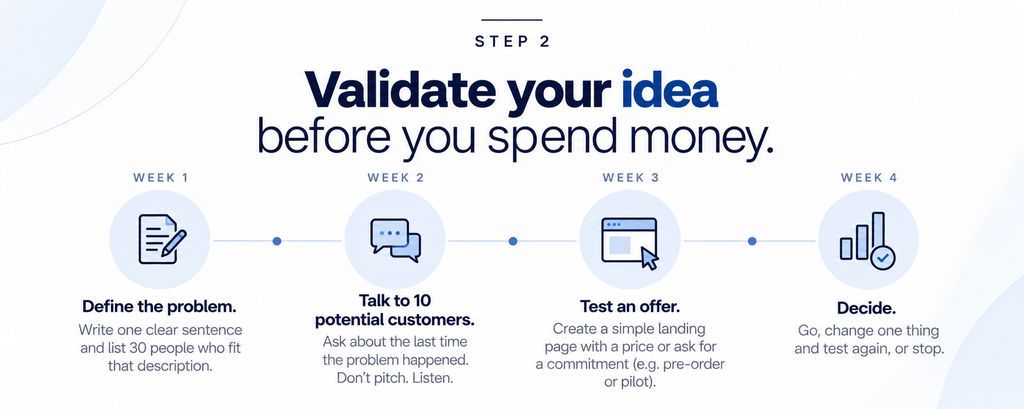
A simple 30-day validation sprint
- Week 1: Define the problem. Write one sentence: “[Specific person] struggles to [do something] because [reason], and today they [workaround].” Then list 30 people who fit that description.
- Week 2: Talk to 10 potential customers. Ask about the last time the problem happened and what they did about it. Don’t pitch. Listen for frustration, workarounds and money already being spent.
- Week 3: Test an offer. Put up a simple landing page with a price, or ask your most interested interviewees for a commitment, such as a pre-order or a signed pilot. (Check that what you do fits your visa. On a Student visa, keep this to research and interest, not sales.)
- Week 4: Decide. Go, change one thing and test again, or stop.
Your advantage as an international graduate
You probably have more to work with than you think:
- Your Master’s research. If your dissertation explored a real problem, you already understand it better than most founders understand theirs.
- Your university network. Alumni directories, societies, entrepreneurship clubs and enterprise centres are full of people willing to talk to you.
- Two markets. You understand both the UK and your home country, which can reveal problems, gaps and customers that others miss.
Why this matters for the Innovator Founder visa
An endorsing body has to judge whether your business is innovative, viable and scalable. Evidence from real customers (interview findings, sign-ups, letters of intent, pilots) makes that case far more convincingly than projections alone. Validation isn’t just good business practice. It strengthens your application too.
[Internal Link Opportunity: “Validate before you build: a 30-day plan” blog post] · [Internal Link Opportunity: “Ten customer conversations” blog post]
Step 3: Choose a structure and register
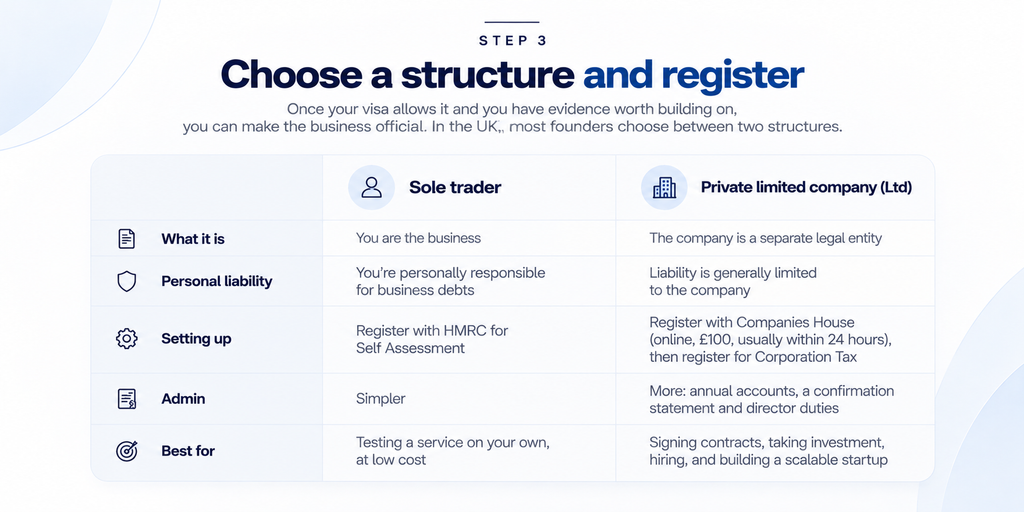
Once your visa allows it and you have evidence worth building on, you can make the business official. In the UK, most founders choose between two structures.
| Sole trader | Private limited company (Ltd) | |
|---|---|---|
| What it is | You are the business | The company is a separate legal entity |
| Personal liability | You’re personally responsible for business debts | Liability is generally limited to the company |
| Setting up | Register with HMRC for Self Assessment | Register with Companies House (online, £100, usually within 24 hours), then register for Corporation Tax |
| Admin | Simpler | More: annual accounts, a confirmation statement and director duties |
| Best for | Testing a service on your own, at low cost | Signing contracts, taking investment, hiring, and building a scalable startup |
When to register
Register when a real commitment needs a legal entity: a customer contract, payments you need to invoice, or a step in your visa plan. Don’t do it just because it feels like the next step. A company brings obligations from day one, such as filings, accounts and deadlines, even if the business isn’t trading yet.
A note on timing and the Innovator Founder visa
GOV.UK states that you can’t join a business that’s already trading on the Innovator Founder visa. If you plan to apply for it, think carefully about when and how you register and start trading. Get immigration advice before you incorporate, so your structure supports your visa plan rather than complicating it.
Other early essentials
- A business bank account. Keep business and personal money separate from the start.
- Basic bookkeeping. Even a simple spreadsheet from day one will save you pain at tax time.
- Terms and privacy policy. You’ll need these if you collect customer data or take payments online.
Tax and legal requirements depend on your situation. Speak to an accountant before you register, especially if your visa status affects your options.
Step 4: Plan your route beyond the Graduate visa
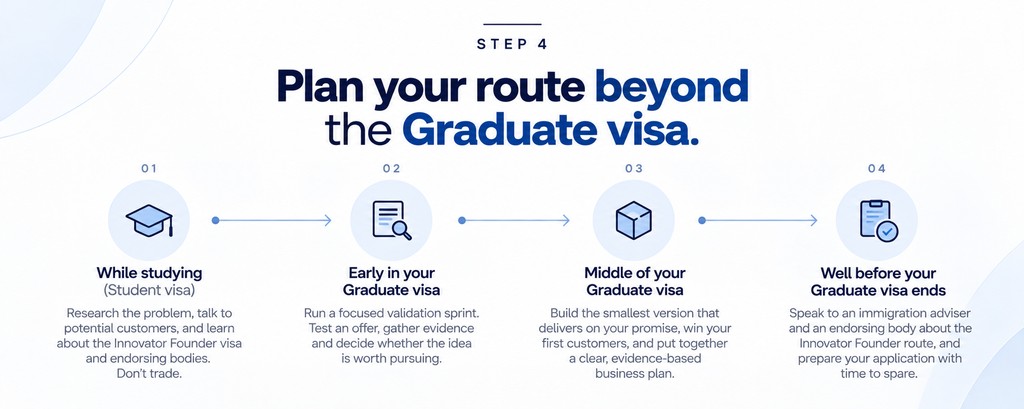
The Graduate visa can’t be extended. So if you want to keep building in the UK, the time to plan your next step is at the start of your Graduate visa, not near the end.
Here’s a practical way to think about the sequence:
- While studying (Student visa): research the problem, talk to potential customers, and learn about the Innovator Founder visa and endorsing bodies. Don’t trade.
- Early in your Graduate visa: run a focused validation sprint. Test an offer, gather evidence and decide whether the idea is worth pursuing.
- Middle of your Graduate visa: build the smallest version that delivers on your promise, win your first customers, and put together a clear, evidence-based business plan.
- Well before your Graduate visa ends: speak to an immigration adviser and an endorsing body about the Innovator Founder route, and prepare your application with time to spare.
Why starting early matters more from 2027
If you apply for a Graduate visa on or after 1 January 2027, it will last 18 months rather than 2 years. That’s six months less to validate, build and prepare an application. For students graduating in 2026 and 2027, the order you do things in matters even more: validate early, build only what the evidence supports, and plan your visa route from the start.
What a strong founder application usually rests on
An endorsing body is assessing whether your business is innovative, viable and scalable. In practice, the strongest cases tend to show:
- A clearly defined problem and customer
- Evidence of demand, such as interviews, sign-ups, pilots or early revenue
- A realistic plan for building, launching and growing
- Why you are the right person to build it
None of these come from a slide deck alone. They come from doing the work in the right order.
5 common mistakes international graduates make
- Starting to trade on a Student visa. Research and conversations are fine, but self-employment isn’t allowed.
- Registering a company before validating the idea. It creates admin and costs before you know if anyone wants what you’re building.
- Building the full product first. On a time-limited visa, months spent on the wrong product are hard to recover.
- Leaving visa planning too late. The Graduate visa can’t be extended, so plan your next route early.
- Polishing the pitch instead of gathering evidence. Endorsing bodies, investors and customers all respond to evidence, not just a good story.
Your checklist
- Confirm what your current visa allows
- Write a one-sentence problem statement
- Talk to 10 potential customers
- Test an offer in a way your visa allows
- Choose a business structure, with advice from an accountant
- Map out your visa timeline from today to the end of your Graduate visa
- Speak to a qualified immigration adviser about the Innovator Founder route
Frequently asked questions
Can international students start a business in the UK?
On a Student visa, you can’t be self-employed. But you can research, plan and validate your idea. On a Graduate visa, self-employment is allowed. For a longer-term route, the Innovator Founder visa is designed for people setting up an innovative business.
Can I be self-employed on a Graduate visa?
Yes. GOV.UK lists self-employment among the things you can do on a Graduate visa. The visa can’t be extended, though, so you’ll need a different visa to stay longer.
How long is the Graduate visa?
According to GOV.UK, it lasts 2 years if you apply on or before 31 December 2026, and 18 months if you apply on or after 1 January 2027. It lasts 3 years for PhD and other doctoral graduates.
How much does it cost to register a company in the UK?
Registering a private limited company online with Companies House costs £100, and the company is usually registered within 24 hours (as of October 2026).
What do I need for the Innovator Founder visa?
Your business idea must be new, innovative, viable and scalable, and endorsed by an approved endorsing body. You also need to meet the English language requirement and pay the application fee and immigration health surcharge. Check the full requirements on GOV.UK and get professional advice before applying.
Should I register a company before applying for the Innovator Founder visa?
It depends on your situation. GOV.UK states you can’t join a business that’s already trading, so the timing of registration and trading matters. Speak to an immigration adviser before you incorporate.
Plan your first 500 days
Starting a business as an international graduate is about sequence, not speed: what your visa allows, what evidence you have, and what to do next.
If you’re at this stage, map your next 12 months before you commit to a structure or a visa route. Book a free 30-minute strategy call with the First500days team. We’ll help you plan the order: validation, launch and your route to staying in the UK.
Book a strategy call → [Internal Link Opportunity: strategy-call booking page] · Learn about the Innovator Founder visa →