We were already doing the work. Customers were calling, our professionals were going out, jobs were getting done — all of it run on phone calls and memory.
What we did not have was a system. First500days built it: the apps customers book on, the app our Xperts use in the field, and the admin panel we run the whole operation from.
The business did not change. What changed is that it now runs on software instead of on people remembering.
UrbanXperts connects customers with independent, verified professionals for the work homes and offices actually need doing: AC and appliance repair, painting and renovation, cleaning, plumbing, electrical work and pest control.
When First500days was engaged, all of that was already happening — offline. The demand existed, the professionals existed, and jobs were being completed. What did not exist was any software underneath it. Every booking, assignment, status update and payment ran through phone calls and manual coordination, which is a model that works right up until the moment you want it to grow.
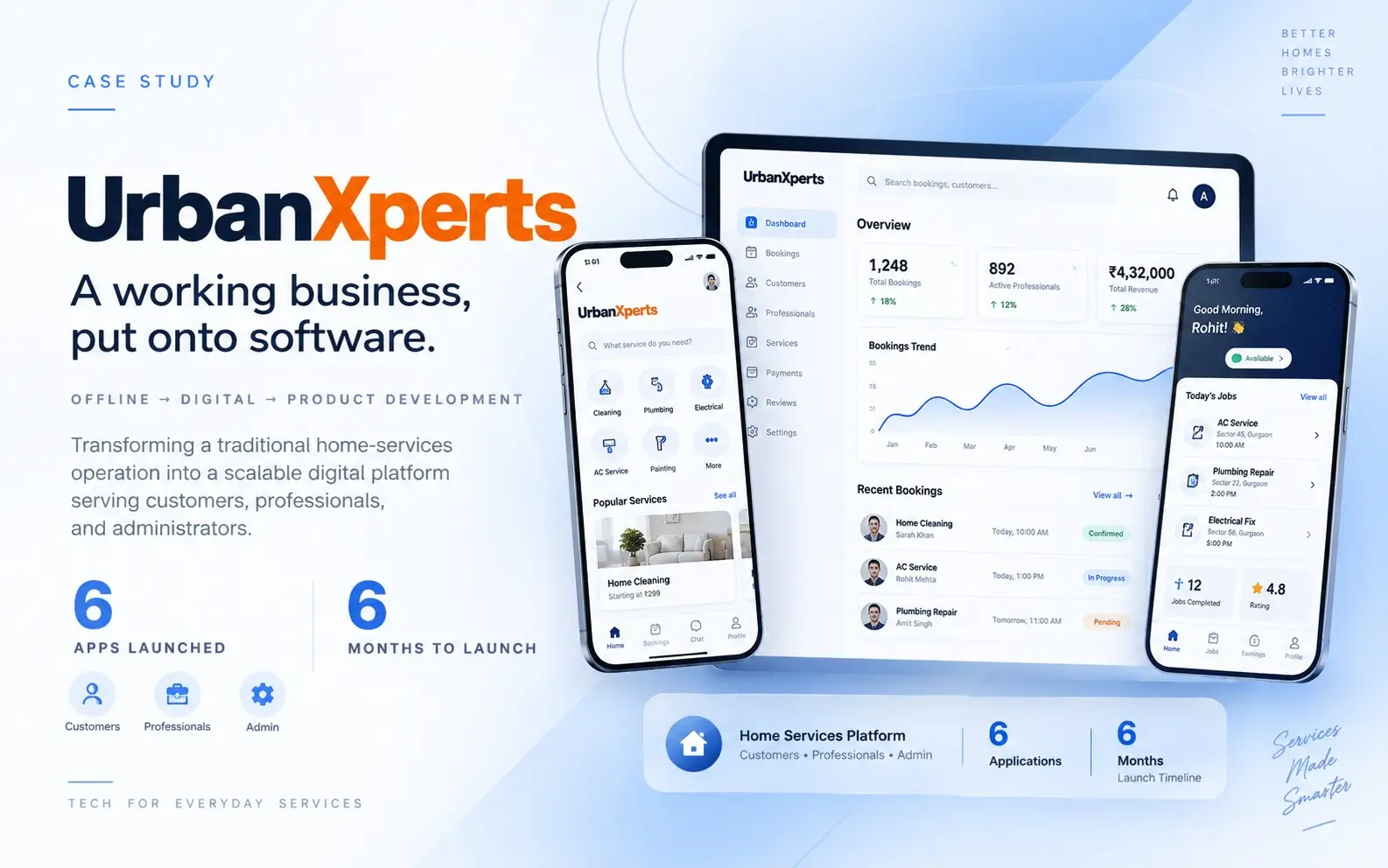
The engagement was single-purpose: digitise the business. First500days built six applications across all three sides of the operation — a customer app on web, Android and iOS, an Xperts app on Android and iOS for the professionals in the field, and a web admin panel for the company.
Six months later UrbanXperts runs on that platform, live on both app stores.
Home services is a coordination problem wearing the costume of a trade. A customer wants a specific job done at a specific time; a professional needs to know where to go and what the work is; and someone in the middle has to match them, confirm the visit, hold the price and settle the money afterwards.
Done offline, that coordination sits in one place: a person with a phone and a good memory. It works — UrbanXperts is proof that it works — but every job passes through the same human bottleneck, and nothing about a job is visible unless somebody asks.
Digitising it means giving each of the three sides its own surface. Customers get a place to browse, price and book. Professionals get the job in their hand with the details attached. The company gets a control layer that can see every job at once instead of one at a time.
This is the inverse of the usual startup problem. UrbanXperts was not looking for customers or a business model — it had both. It was looking for the layer that would let it stop running on memory.
An offline services business does not fail for lack of software. It simply stops getting bigger — because the number of jobs it can run is capped by the number a person can hold in their head at once.
A narrow brief, and a demanding one — because the software had to fit an operation that already worked rather than ask the operation to fit the software.
A running business with no working app. Every booking, every assignment to a professional, every status update and every settlement was coordinated by hand — which put a hard ceiling on how many jobs could be in flight at once.
We brought the business onto technology and automated it: six applications covering all three sides — customers on web, Android and iOS; Xperts on Android and iOS; and the company on a web admin panel — so the coordination that used to live in someone's head now lives in a system.
The front door: search a service, set a location, see pricing and book.
Booking, cart, bookings history and account, on the phone in the customer's hand.
Full parity on iPhone, live on the App Store.
Where the professional receives the job, with the work, the address and the schedule attached.
The same field experience for professionals on iPhone.
Where the company runs the catalogue, assigns jobs, tracks visits and manages both sides.
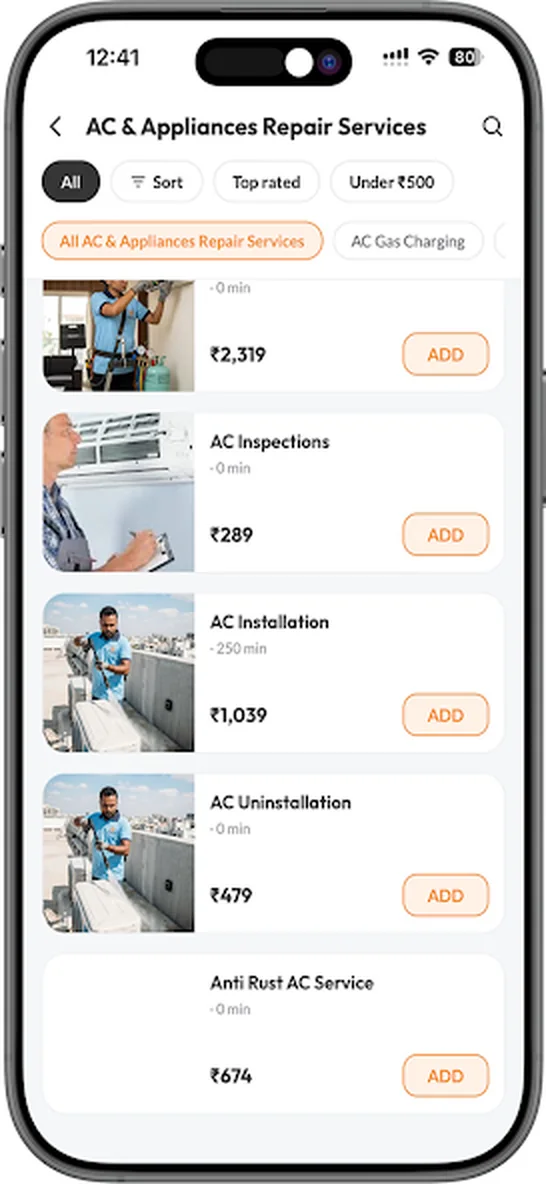
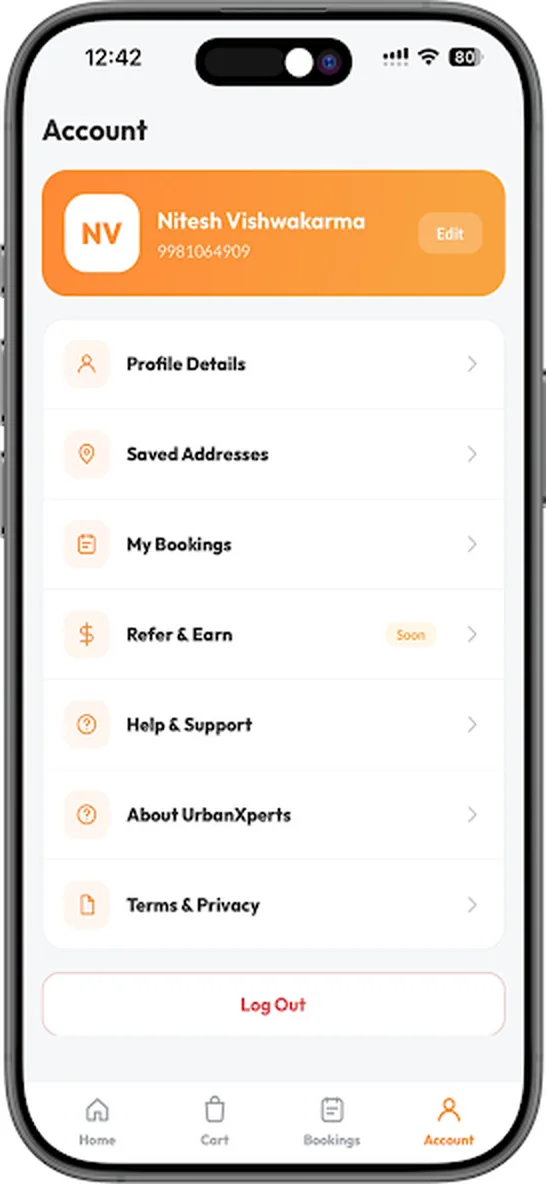
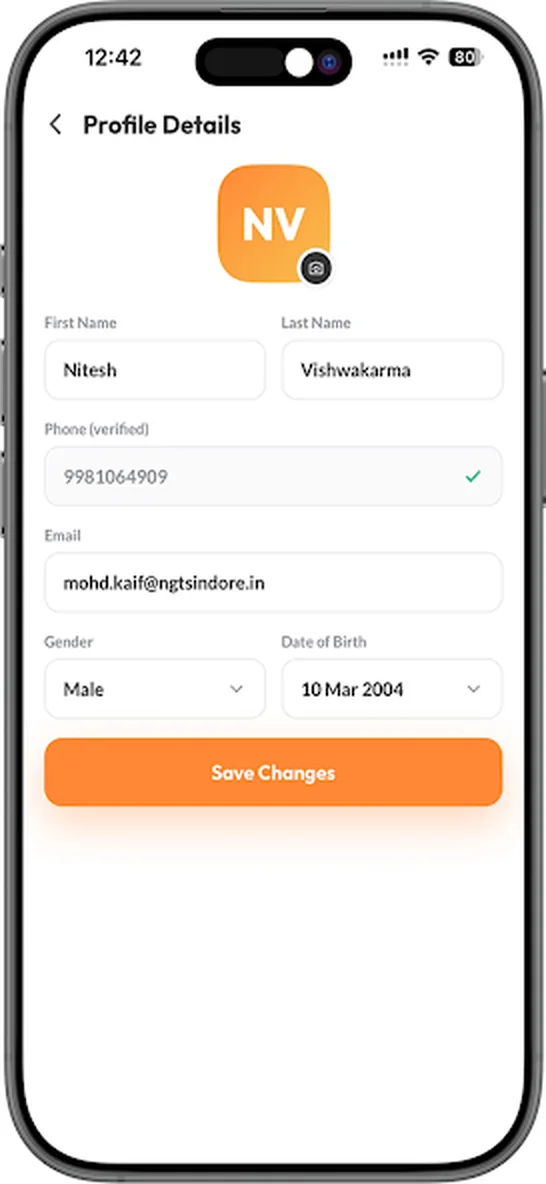
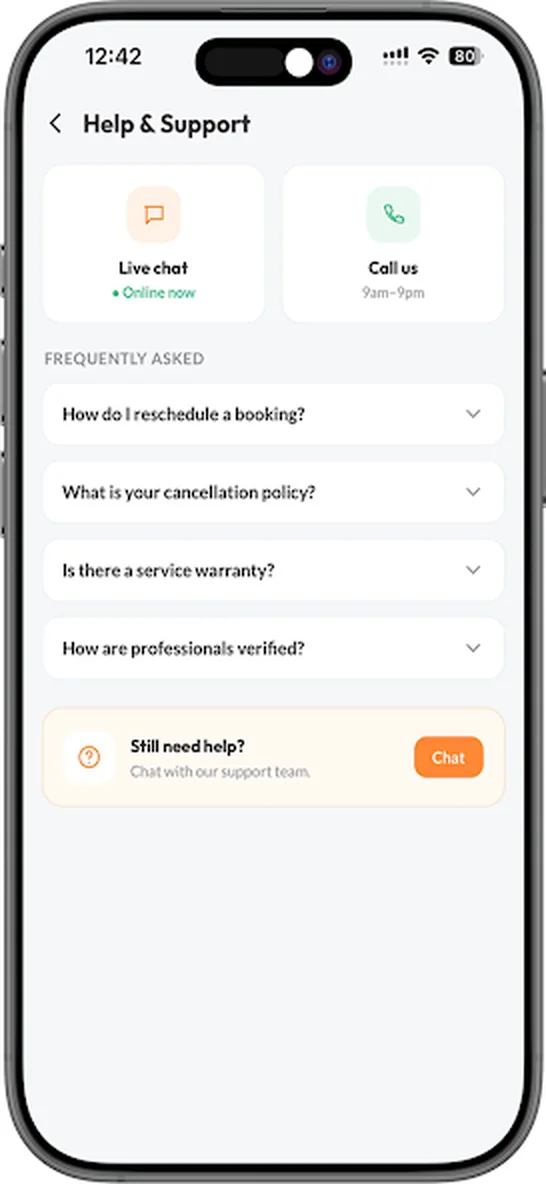
The detail that matters most is the least glamorous: a priced service catalogue. Once every job has a name, a duration and a number attached to it, a customer can book without a phone call, a professional can be assigned without a negotiation, and the business can be measured. That is the actual difference between a services company and a services platform.
UrbanXperts runs on its own platform. Customers book through the web or either app store, professionals receive their jobs in an app built for the field, and the company manages the whole operation from one panel instead of one phone.
No booking volumes, revenue, professional counts or app-download figures are claimed on this page. This engagement was product development — the outcome is the platform the business now runs on, stated as of August 2026.
UrbanXperts never needed to be saved. It needed to be unblocked — which is a different job, and in some ways a harder one, because the software has to earn its place against a process that already works.
The business, the customers and the professionals all stayed exactly as they were. What changed was where the coordination lives. Treating an offline operation as a thing to be encoded rather than reinvented is what keeps it running while you do it.
A customer app alone would have moved the bottleneck rather than removed it — someone would still be phoning the professional. The operation only becomes a platform when the field and the back office are on it too.
Naming and pricing every service is unglamorous work, and it is the thing that makes self-serve booking possible at all. Most of what looks like a technology problem in a services business is really an undefined-offering problem.
A business that runs on memory is not badly run. It is just running at the size one memory can hold.Every founder starts at zero — the first 500 days decide what you are standing on at the end of them.
Share a few details and our team will get back to you within 24–48 hours.