As an early-stage startup, finding partners who genuinely understand both the business and execution challenges of building a company is rare. The First500Days team supported us across consulting, marketing, and technology development, bringing structured thinking, practical insights, and a collaborative approach throughout the engagement.
What stood out most was their willingness to deeply understand our vision, challenge assumptions, and contribute beyond the scope of a typical service provider. Their team remained responsive, committed, and focused on helping us move forward at every stage.
Goupal Uujjainwal approached First500days with an idea and nothing else: a platform that inverts the usual bargain of social media, paying viewers a share of advertising revenue for the attention they already give. There was no company, no product, no team, no technology and no route to market.
First500days worked across the full arc of the venture — refining the idea into a workable model, forming the company, building the platform in-house, assembling the founding team and taking the product to market.
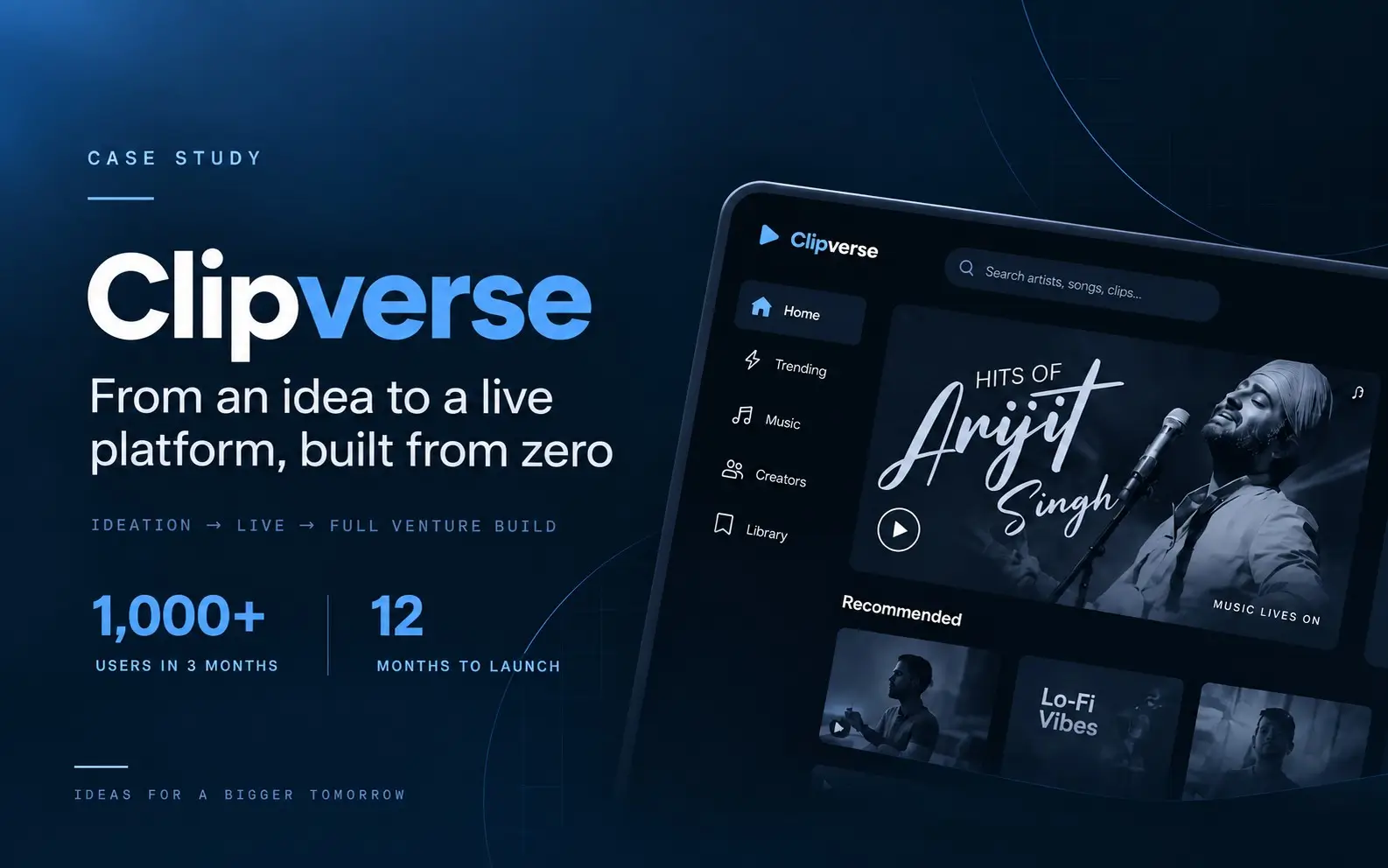
Clipverse is now an operating business: four connected applications serving users, creators, advertisers and internal administration, 50+ creators onboarded, 1,000+ users within three months, and a team of five. The venture has moved into its growth and fundraising phase.
Attention is the commodity every social platform runs on, yet almost none of its value returns to the people supplying it. Clipverse routes part of it back — advertisers pay for deliberate attention, viewers take a share, and creators supply the content that holds the audience in place.
That makes Clipverse a three-sided platform: each side needs the other two present for the model to work, which shaped what had to be built and in what order.
The founder was bootstrapped and had committed his own capital to take the concept from inception to investor-ready. That commitment mattered — but capital alone does not build a platform business.
An unusually clean starting line: no partial build to inherit, no team to work around, no prior strategy to unpick.
The founder's problems were typical of a first venture — what makes the stage hard to survive alone is that they arrive together. First500days took each as an execution mandate, not an advisory note: the venture needed a company that existed and a product that ran.
An idea is not yet a business — it needed a defined model, a product scope and a sequence that could actually be executed.
We refined the idea into a working business model, defined the product strategy, and set the approach to incorporation and first-user acquisition. The vision was the founder's; the structure and sequencing were ours.
The platform was the business. With no technical team there was no path to a product — and hiring one with nothing to show is slow and high-risk.
The largest piece of the engagement: the entire product — all four applications — designed and built by our in-house team rather than an external vendor or a first technical hire.
Every function the venture would need — product, technology, growth, operations — was unstaffed.
As requirements emerged, we sourced the people to meet them: a co-founder, interns and full-time hires who joined Clipverse.
The founder had no growth background. A platform whose premise is audience cannot launch without a way to acquire one.
Once the product was live, we led brand development and performance marketing to bring the first users onto the platform.
There was no company. Nothing could be built, sold or hired for without a legal foundation.
We took the founder through company formation in India, establishing the entity the venture now operates through.
Before anything was built, the idea was worked into a defined product and business model. The venture also incorporated at this stage rather than later, giving it an entity to hire into, contract from and eventually raise against.
Rather than launching a viewer app and adding the rest later, the platform was built as four connected applications covering all three market sides plus administration. A revenue-share model cannot be demonstrated with viewers alone — creators need somewhere to publish, advertisers somewhere to bid, payouts somewhere to be controlled. Building the full loop meant launching with a functioning economic model, not a demo of one.
In parallel, the founding team was assembled: a co-founder alongside the founder, plus interns and full-time staff to carry execution.
Marketing began only once the product was live, and its purpose was validation rather than monetisation — real users on the platform so the product could be tested under genuine conditions. That kept early growth honest: real behaviour on a working platform, not a vanity user number.
The venture is now operating and has moved into its growth and fundraising phase.
Where viewers watch content and earn from it.
Where creators publish, manage content and earn from performance.
Where advertisers post ads, bid against inventory and manage campaigns.
Where the company manages users, creators, advertisers, payouts and analytics.
Advertiser spend enters through one panel, is distributed through two others, and is controlled and measured through the fourth. Alongside the product, the idea was refined into a defined model, a founding team was sourced to carry execution, brand and acquisition launched once the product was live, and company formation gave all of it a legal foundation.
Clipverse launched into a market with no shortage of content platforms — so the proposition did the work: a platform that pays you for time you already spend.
Establishing how Clipverse presented itself to an audience being asked to try something structurally unfamiliar.
Driving acquisition of the first cohort of users onto the live platform.
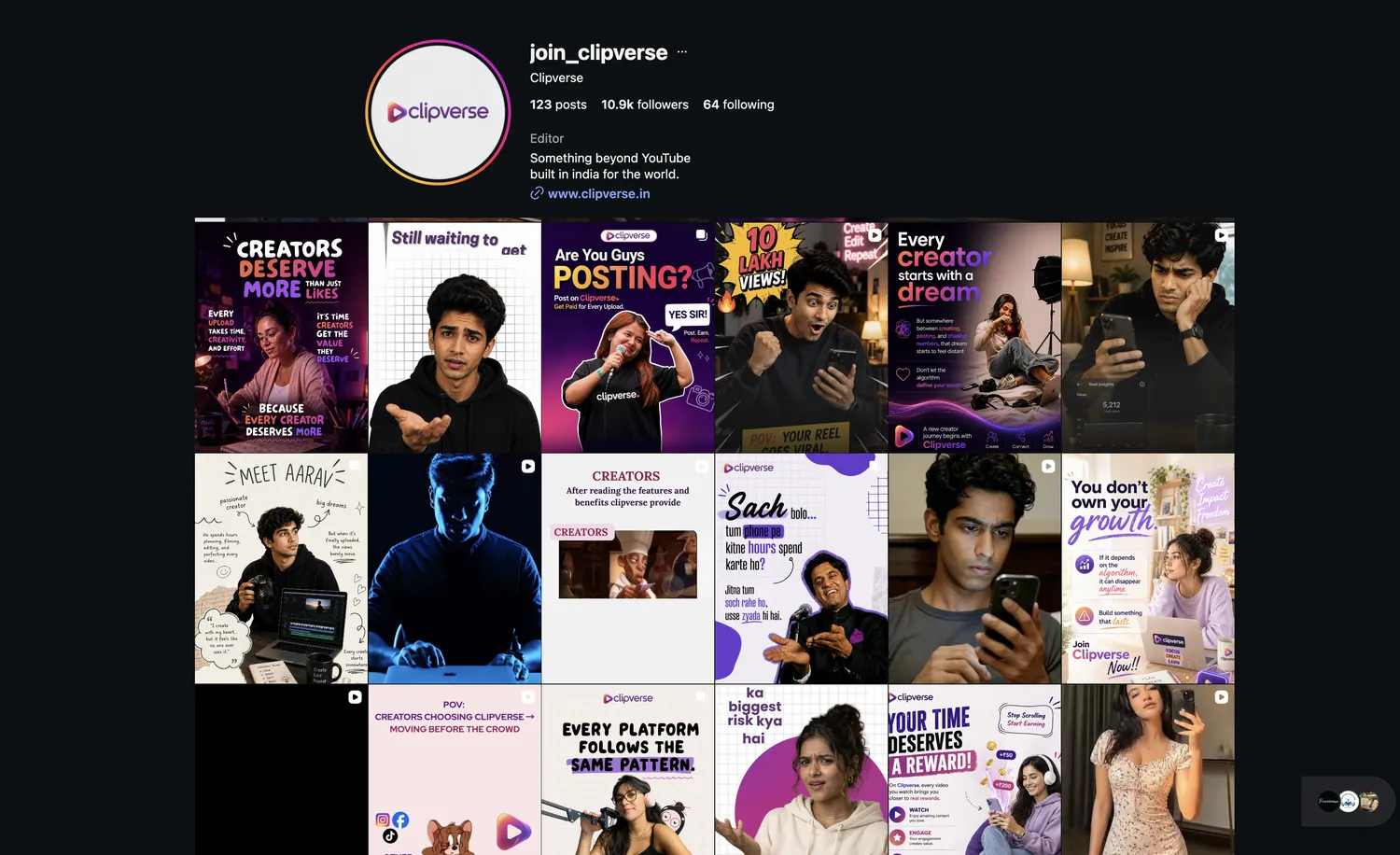
A creator-first content engine built from scratch — positioning, art direction and a publishing cadence that carried the "get paid to watch" proposition into feed.
The goal was validation rather than scale — whether people watched, returned, and whether the earn mechanic held attention. In that period the venture crossed 1,000+ users within three months, onboarded 50+ creators to supply the content library, and built an Instagram community of 10.9K+.
Beyond the numbers: an incorporated company, a working product across all three market sides, a functioning team, and a market presence that did not exist twelve months earlier.
The advertiser side is not yet monetised and no revenue is claimed here — but the platform, audience and creator supply it would depend on are in place.
Clipverse was at ideation when this engagement began. Every asset the venture holds today — the company, the platform, the team, the audience — was created during it.
The founder started with an idea, his own capital and no team — the position most people wait to grow out of. Twelve months later there was an operating company. What closed the gap was execution, not certainty.
Half a product proves nothing. Launching every side of the market at once meant real behaviour to learn from on day one, rather than a demo that still had to be imagined into a business.
Incorporate, then build, then hire, then market. Each step existed to make the next one possible — and doing them in that order is what turned a concept into a company that runs.
Ideas are common. What is rare is the order, the discipline and the partner to carry one all the way out.Every founder starts at zero — the first 500 days decide what you are standing on at the end of them.
Share a few details and our team will get back to you within 24–48 hours.